📅 Book an Appointment

Accessing Psychology Services via Telehealth at Your Mind Matters


A woman sitting comfortably in a beanbag at home with a laptop and a mug, part way through a telehealth session

Why Telehealth Matters in Mental Health Care

In today’s busy world, flexibility in accessing mental health support is more important than ever. Telehealth psychology sessions allow you to connect with a qualified psychologist from the comfort of your home, school, or workplace. At Your Mind Matters (YMM), our clinicians offer secure, evidence-based telehealth services to ensure support is available wherever you are in Victoria and across Australia.

What is Telehealth in Psychology?

Telehealth refers to psychological consultations delivered via a secure online platform. You’ll speak with your psychologist in real time, just as you would in a clinic, but without the need to travel. Research shows that telehealth can be just as effective as face-to-face sessions for many mental health concerns, including:

  • Anxiety and depression
  • ADHD and executive functioning challenges
  • Autism assessments and therapy supports
  • Trauma-informed care
  • NDIS-related psychological assessments and reports
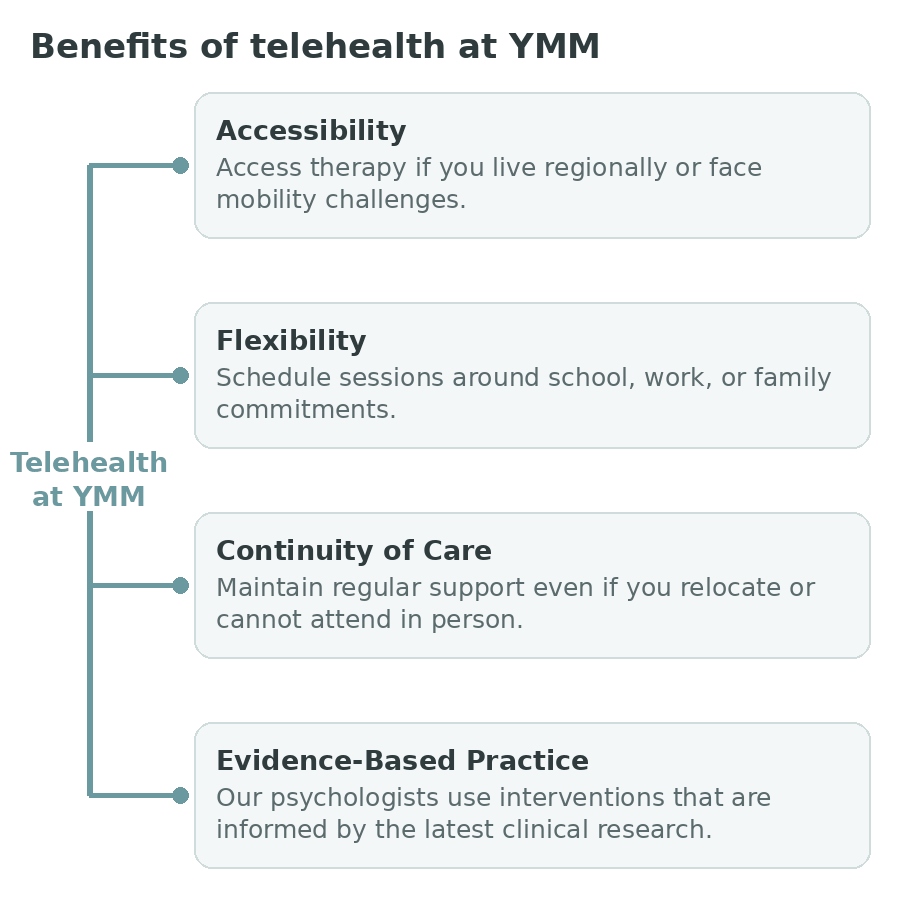
Four benefits of telehealth at Your Mind Matters branching from a single stem: accessibility, flexibility, continuity of care and evidence-based practice

Benefits of Choosing Telehealth at YMM

  • Accessibility: Access therapy if you live regionally or face mobility challenges.
  • Flexibility: Schedule sessions around school, work, or family commitments.
  • Continuity of Care: Maintain regular support even if you relocate or cannot attend in person.
  • Evidence-Based Practice: Our psychologists use interventions that are informed by the latest clinical research.

Is Telehealth Right for You?

Telehealth may be suitable if you prefer the comfort of your own space, live outside Melbourne, or find it difficult to attend in person. For children and young people, telehealth can work best when a parent, carer, or support worker is nearby to assist with technology and engagement.

If you’re unsure, our team can help you decide whether telehealth or in-clinic appointments are the best fit for your needs.

How YMM Delivers Safe and Effective Telehealth

At Your Mind Matters, our psychologists follow strict professional and ethical standards to ensure that online sessions are safe, private, and effective. This includes:

  • Using secure, encrypted video platforms
  • Maintaining confidentiality and privacy at all times
  • Providing clear information so you can make informed decisions about your care
  • Following AHPRA and Psychology Board of Australia guidelines for safe practice

Booking a Telehealth Appointment

Accessing telehealth psychology at YMM is simple:

  1. Get in touch with our team to discuss your needs, or view our clinician profiles.
  2. Book an appointment at a time that suits you through our online portal.
  3. Connect online with your psychologist using a secure link sent before your session.

Whether you are seeking an ADHD or autism assessment, or ongoing therapy, our telehealth psychologists are here to support you.

Book a telehealth appointment with a psychologist today. Take a look at our clinicians and, once you know who you’d like to work with, call us or book online.

Your Mind Matters Psychology Services

Written by the team at Your Mind Matters
Our blog is written by the registered psychologists at Your Mind Matters Psychology Services in Notting Hill, Melbourne. If something here speaks to your situation, our team is here to help. Meet our team.

📅 Book an appointment

Maintaining Emotional Wellbeing When Life Feels Uncertain

Father and son laughing as they roast marshmallows over a small fire pit beside a tent in their backyard at dusk

Life doesn’t always turn out like we envisioned. What starts as a regular year can soon turn into something very different. When we are faced with uncertainty, it is natural to feel a level of fear and anxiety. Coupled with that, frequent changes and new demands can easily lead to feeling overwhelmed. What we deemed as “normal” may no longer feel relevant, and we can find ourselves in uncharted territory, with a lot of change and adjustment.

Tips to help with maintaining emotional wellbeing during uncertain times

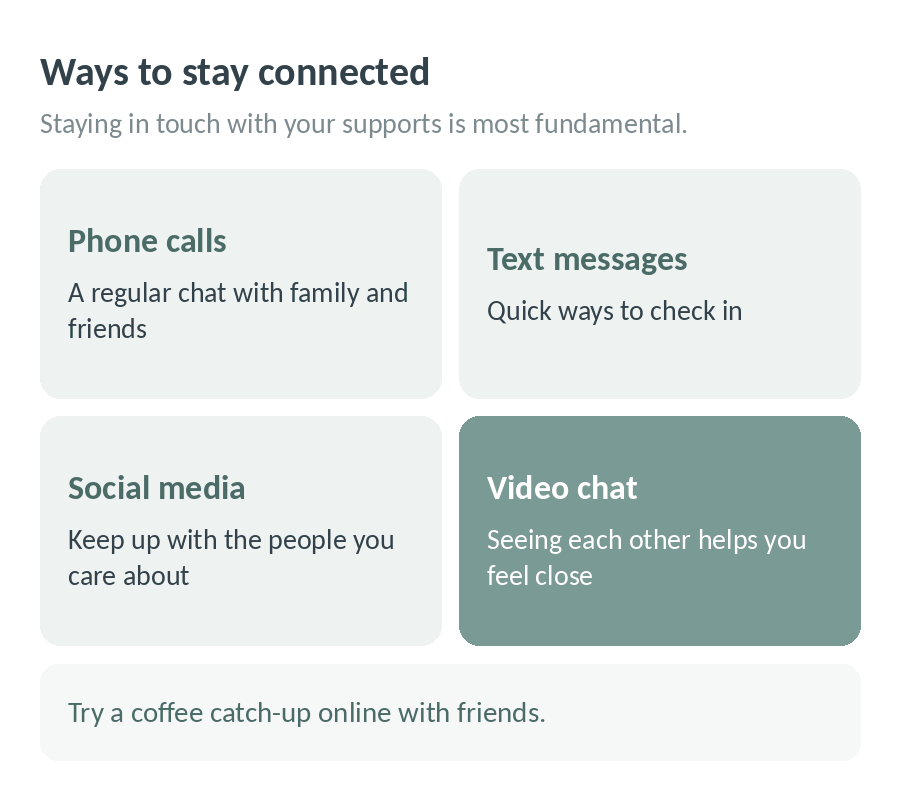
  • Stay socially connected. This is most fundamental! Even when life gets busy, or circumstances keep us from seeing friends and family in person, that doesn’t mean we need to disconnect from our supports. Stay connected to family and friends through regular telephone conversations, text messaging, social media or video chat. My personal preference is video chat, as you can see the person and it helps to form that personal connection. There are lots of group video chat platforms and apps that are free to download, e.g. Zoom, FaceTime, WhatsApp. Why not schedule in a coffee catchup with mates online or play online games together? It can be great fun!
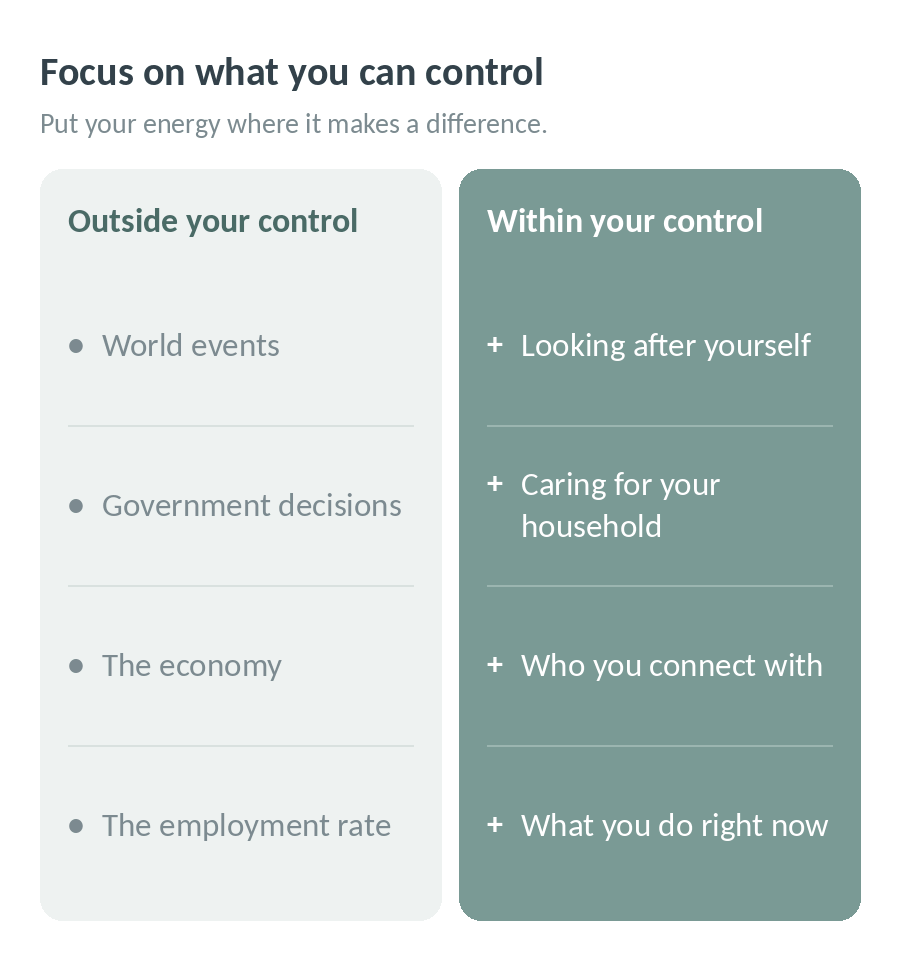
Focus on what you can control: world events, government decisions, the economy and the employment rate are outside your control; looking after yourself, caring for your household, who you connect with and what you do right now are within your control
Ways to stay connected with your supports: phone calls, text messages, social media and video chat, such as a coffee catch-up online with friends
  • Establish a daily routine. Routines are beneficial as they provide structure, aid us to be more productive and efficient, encourage good habits and reduce stress. Although your regular routine may not be applicable when things change, establishing a new routine or maintaining a form of your usual routine is still important. Allowing yourself to fall out of routine can lead to increased distress and feelings of disempowerment. Sticking to a routine such as a regular bedtime and awakening time, scheduling in time for work and study as well as planning enjoyable activities to look forward to each day, regular exercise, and opportunities to relax, can help to increase your sense of control.
  • Exercise. Exercise is a natural way to reduce stress and is great for physical and emotional wellbeing! Try and get outdoors for a walk, jog, run or bike ride. Ask other members in your household to join you or take the kids for a bike ride or scooter ride. If you have some exercise equipment at home, try to schedule in time each day for a workout. There are lots of apps available, online resources, and YouTube exercise clips you can access.
  • Relaxation. Set aside time each day to engage in a relaxing activity like a nice bath, reading or a jigsaw. You may wish to try mindfulness meditation (the Smiling Mind app is free and has lots of guided meditations to choose from), some gentle stretching, or calm breathing. For more ideas on various relaxation strategies, see my post on incorporating relaxation into everyday life.
  • Focus on what is within your control. Let’s face it, there is so much that is outside of our control at times. No, we cannot control world events, the decisions governments make, the economy, the employment rate — the list goes on. I can’t stress how vital it is to focus on what is within your control, what you can do and the choices you can make. Concentrate on how you can look after yourself and others in your household, who you can connect with and offer support to (this could include family, friends or the community), and things you can do right now, in the moment, that help to enhance your life or that of others.
  • Make it fun. When you find yourself spending more time at home than you’d like, take the opportunity to make that time fun. Some ideas include:
    • Setting up a tent in the backyard and making a bonfire — you can even roast some marshmallows!
    • Scavenger hunt
    • Games night (board games, cards, video games and so on)
    • Indoor picnic
    • Movie marathon
    • Art and craft activities
  • Manage your exposure to news and media coverage. There is heaps of information out there and news coverage on every channel. Every time you turn on the TV, radio station, or scroll through social media, you’re likely to come across distressing news, and this can be overwhelming. Stick to reputable sources which can provide you with accurate information, and give yourself breaks from the news.

I hope these tips are helpful in guiding you through challenging times. Stay safe and healthy. I know it doesn’t always seem like it, but as the Buddhist proverb says, “this too shall pass”.

If you would like some support, our team of psychologists are here to help. Your Mind Matters Psychology Services offers counselling support through telehealth as well as in person. Call us on (03) 9802 4654, book an appointment online, or read more about telehealth appointments at Your Mind Matters.

Maria Kampantais seated and smiling

Our Blog Author
This post was written by Maria Kampantais, Senior Clinical Psychologist at Your Mind Matters. Maria has a particular interest in working with clients experiencing anxiety disorders and past trauma. Meet our team.

Book an appointment

Telehealth Sessions at Your Mind Matters: How They Work

A quiet corner of a home ready for an online appointment, with a laptop, a cup of tea, a notebook and a small plant on a wooden table by the window

At Your Mind Matters, you can have your sessions in person at our clinic or via telehealth, by phone or video. Telehealth means you can keep working on your health and well-being from home, from work, or wherever you feel most comfortable.

When telehealth can help

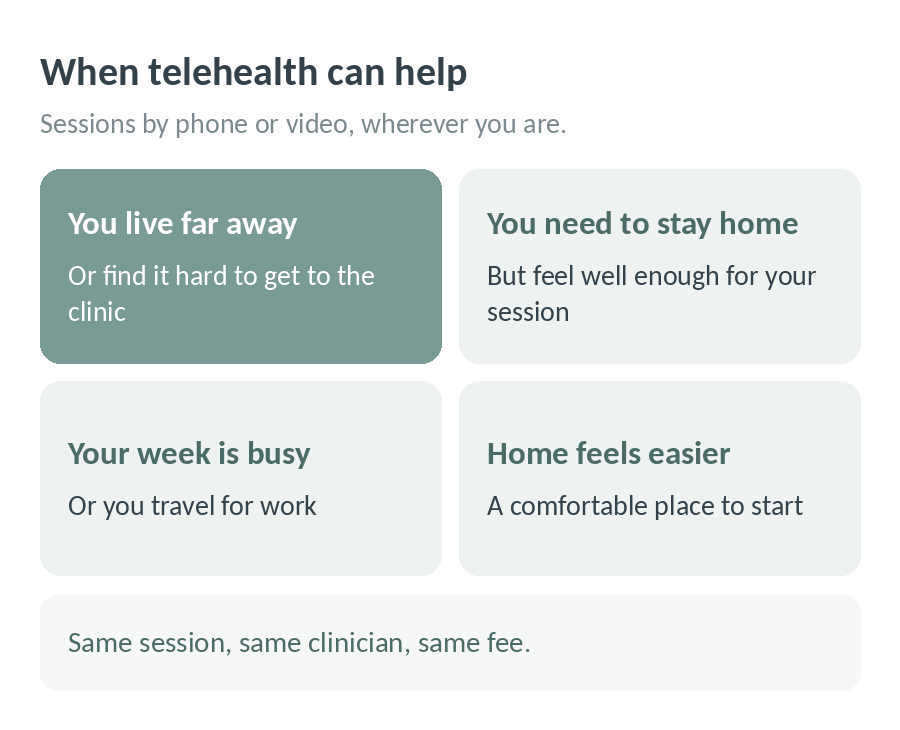
  • You live far from the clinic or find it hard to get here
  • You need to stay home, but feel well enough to have your session
  • You have a busy schedule or travel for work
  • You feel more comfortable starting from home

If your clinician needs to stay home but is well enough to run sessions, you will be offered a telehealth consultation instead of cancelling. Likewise, if you can’t come in but feel well enough for your session, just let us know and we can switch your appointment to telehealth.

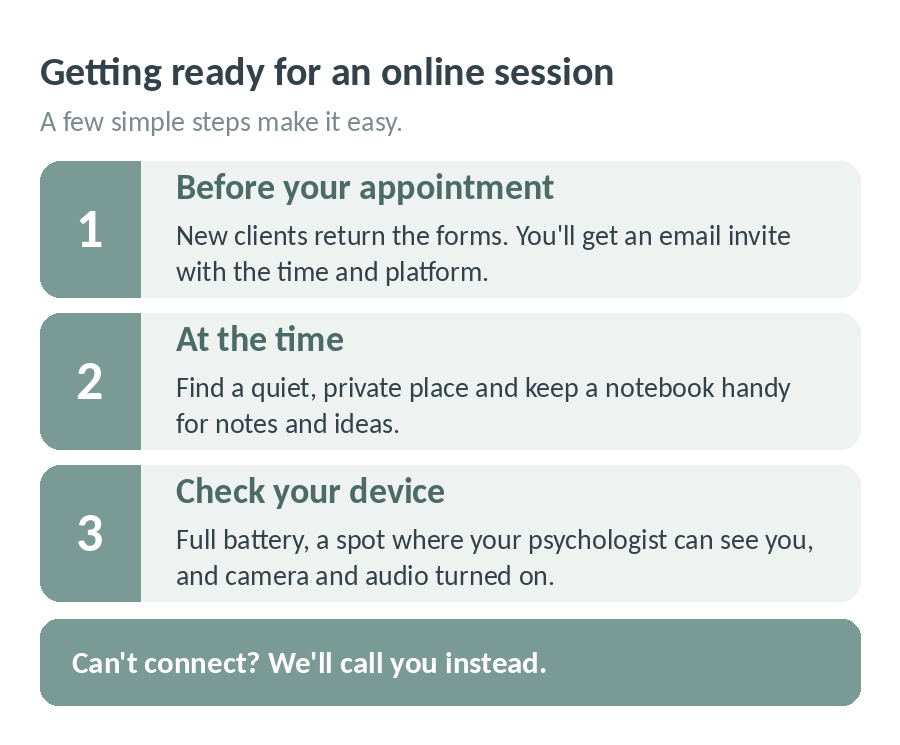
Getting ready for an online session: before your appointment new clients return the forms and you get an email invite; at the time find a quiet, private place with a notebook; check your device battery, position, camera and audio; if you cannot connect we will call you
When telehealth can help: you live far away or find it hard to get to the clinic, you need to stay home but feel well enough for your session, your week is busy or you travel for work, or home feels like an easier place to start; same session, same clinician, same fee

How are telehealth sessions charged?

Session fees cover the time spent with your clinician, so telehealth sessions are charged at our normal fee. NDIS self-managed or Plan Managed clients are able to use their funds for phone and online sessions. If you have a Mental Health Treatment Plan from your GP or private health insurance, please check with our admin team or your insurer about the rebates available to you for telehealth sessions.

How do I pay for a telehealth session?

You can pay for sessions via credit card, which is stored in our secure encrypted system (using Stripe with Power Diary), or we can send you an invoice and ask that you transfer funds as soon as possible (within 48 hours).

If you have any questions, please call us on 03 9802 4654.

How do I prepare for an online session?

Before your appointment

If you are a new client, our admin team will send you some forms to complete, including our consent form. Please sign and email them back to us prior to your first online session. Your psychologist will email you an invite confirming the time of your appointment and which telehealth platform they will use.

If they use Zoom, you will receive instructions on how to use it. Here is a little video that outlines how to join a Zoom session https://youtu.be/vFhAEoCF7jg. If they use Power Diary, all you need to do is click the link at the time of your appointment. So easy!

Make sure at the time of your appointment you have a quiet, private place, and ideally have a notebook with you, so you can take down any notes, ideas, or insights.

Troubleshooting

  • Make sure that you have a full battery in preparation
  • Practice placing the phone, iPad, laptop or computer in a suitable location so that your psychologist can see you
  • Make sure the camera and audio are turned on (it is a good idea to practice before your scheduled session time)

If at the time of the session you aren’t able to connect, we will call you instead!

Frequently asked questions

What if I don’t have the same connection online or on the phone as I do in person?

This is a concern that many of us have, which is understandable when we are used to face to face interactions. However, most clients report that after a few minutes, once they adjust to the new way of connecting, video sessions are just as effective! Of course, this may not be everyone’s experience, but it certainly can work under the right circumstances.

The first session may be a bit strange and you may be more focused on how the camera is angled or how your voice sounds, but once you have settled in, you will likely notice that it feels the same. If it doesn’t, tell your practitioner and work through why and what is happening for you around the connection.

I am not tech savvy, is it complicated?

We use Power Diary (our practice management software) or Zoom (similar to Skype or FaceTime, but more secure, check out their privacy policy https://zoom.us/privacy/) and set up the meeting on our end. We then email you a link with any information you need to sign in.

If we log in to the meeting and cannot see you online, we will give you a call. That way, if you are struggling to set up, we can help walk you through the steps. And if your device doesn’t wish to cooperate, we’ll chat over the phone instead.

The benefits of telehealth

The beauty of telehealth is that you can access support without leaving the house, and you can even stay in your PJ’s if you like (we don’t mind!). It saves travel time, makes it easier to keep your sessions going when life gets busy, and means distance doesn’t have to stand in the way of getting help.

If you have any other questions about telehealth, please call us on 03 9802 4654. We’re here to help.

From all of us at Your Mind Matters.

Laura Forlani smiling, in a portrait photograph

Our Blog Author
This post was written by Laura Forlani, Director and Senior Clinical Psychologist at Your Mind Matters. Laura works with adults on mood and anxiety disorders and difficulties arising from changes in personal circumstances, using cognitive behaviour therapy, skills training and relaxation strategies. Meet our team.

Book an appointment
📅 Book an Appointment