📅 Book an Appointment

Goal Setting

Goal setting is the process of creating an action plan with the aim of motivating a person towards a goal. It is an important part of personal development. Every individual will endeavour to set goals for themselves at some point. The most popular goals are those which we call ‘New Year’s Resolutions’. This tradition focuses on setting goals towards changing an undesirable trait or behaviour, and therefore improve one’s life. This tradition of goal setting is likely so popular as people want to start the year anew. However, it doesn’t need to be the start of a new year for you to set some goals around important areas of your life.

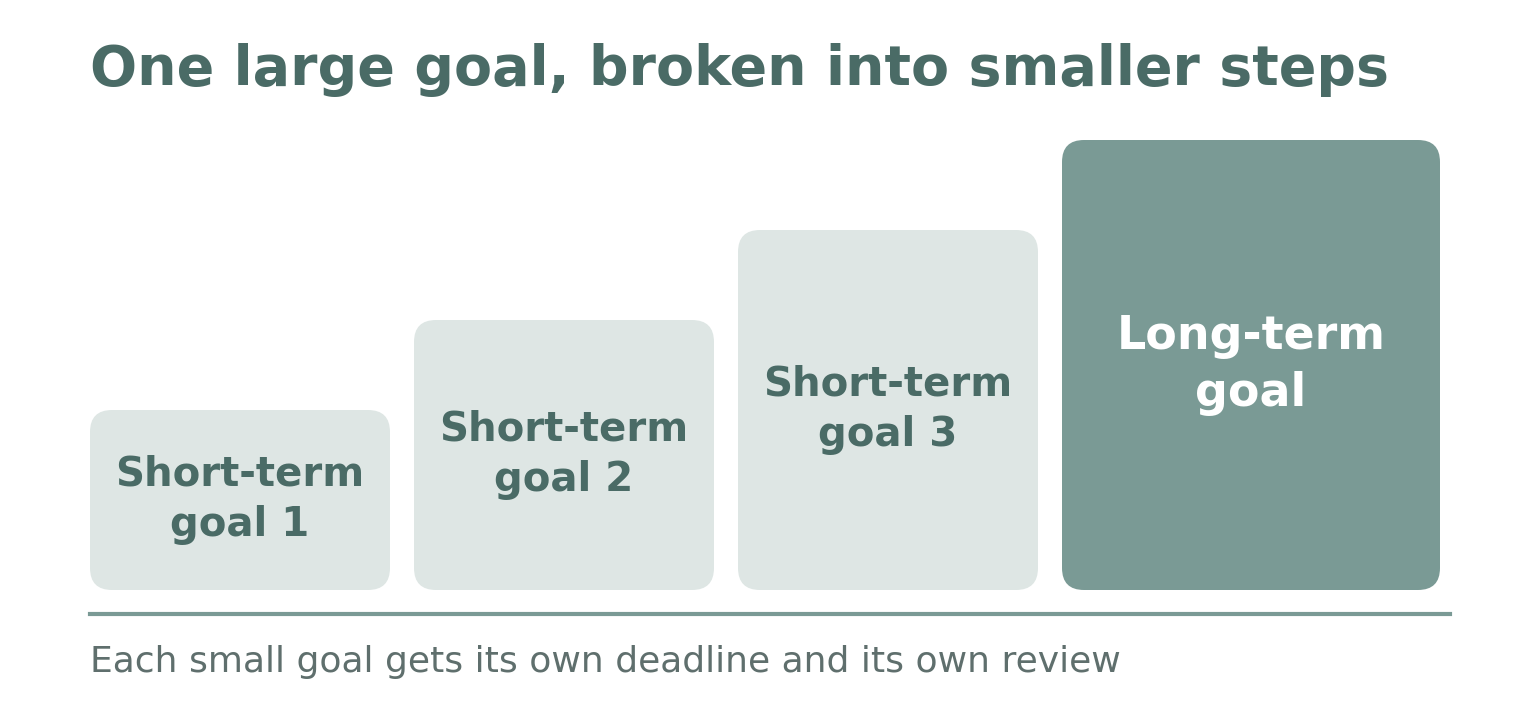
Ever tried to set a goal for yourself and found you couldn’t follow through? Most will answer YES! A lack of success in goal setting doesn’t mean that we aren’t as capable as those who seem to achieve all the goals they set. It might just mean that the integral aspect of goal setting known as the action plan, has been missed, meaning that you haven’t thoroughly planned out your goal or thought about how you will go about achieving the goals you set. Often people will not achieve their goals because they are too broad and/or are not realistic given the circumstances. For example, one might set the goal ‘To lose weight’. This goal is very broad and doesn’t tell us any information about what needs to be done to achieve this goal and how we will know when the goal is achieved. So, let’s say the goal was to lose 20 kilograms. In and of itself, this is quite a lot of weight to lose, and the goal has been set quite high. Larger goals should be broken down into smaller, more achievable goals. While the goal to lose 20 kilograms is still there, the focus is on the short-term goal. These small goals lead to achieving the long-term goal. Here’s how it is done


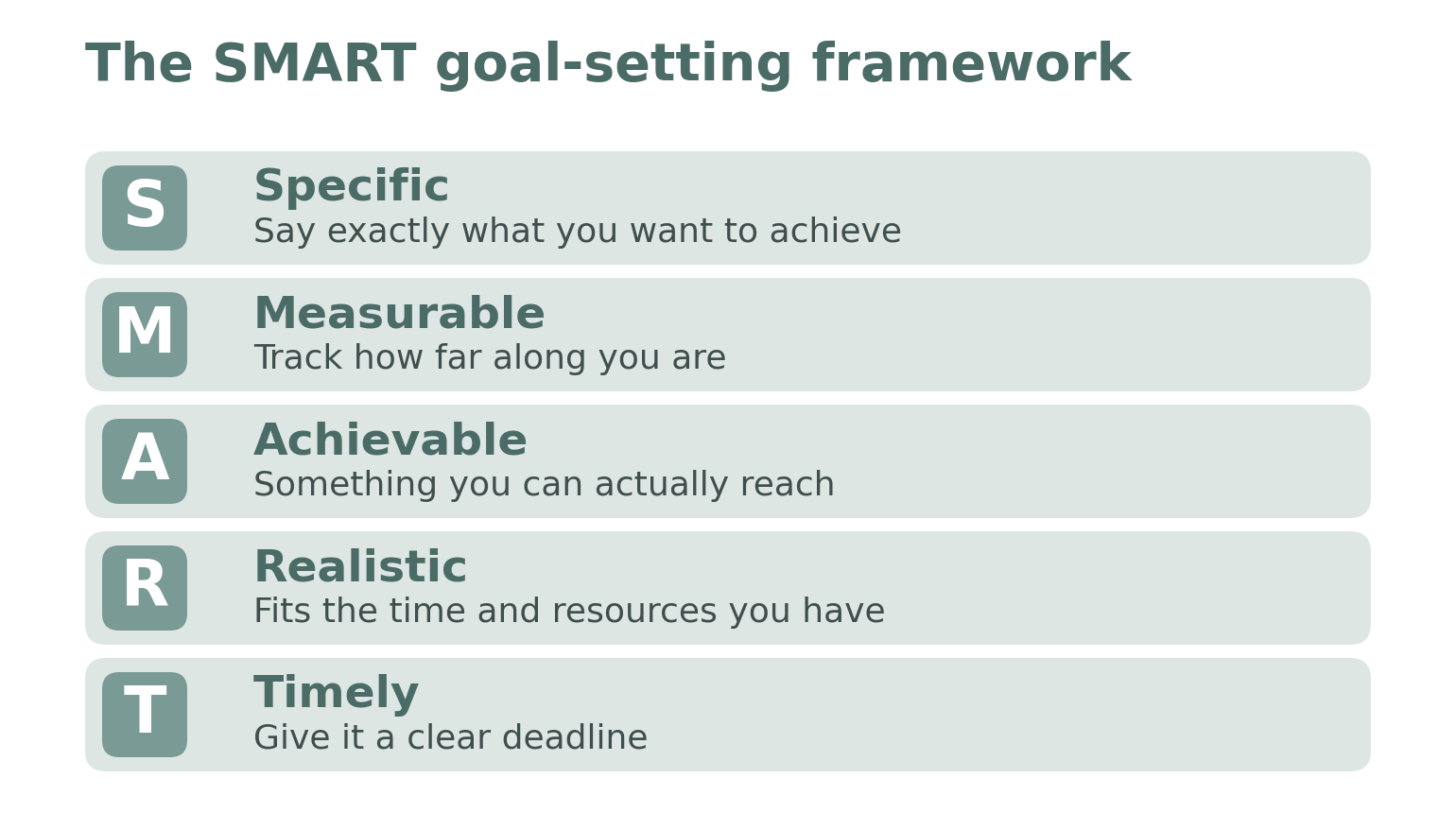
We can follow the SMART goal setting framework to help create an action plan for goal setting:

S = Specific: Goals should be well defined. Be specific about what you want to achieve.

M = Measurable: Ensure that you can measure the goal over time so you know how far away from completion it is.

A = Achievable: The goal needs to be attainable and one that can be reached successfully.

R = Realistic: The goal should be realistic given the current circumstance and availability of time, knowledge or resources.

T = Timely: Set enough time to complete the goal. Not setting enough time can impact on the overall success of the goal.


Using the SMART goals framework and the weight loss example mentioned above, here is our new SMART goal:

To lose 3 kilograms per month, for the next 7 months, by engaging in regular exercise (1-hour gym workout, 4 times per week) and sticking to an eating regime lower in carbohydrates.


Let’s look at how this goal fits within the SMART goal framework:

  • Specific & Achievable: We have specifically outlined what we want to achieve i.e. to lose 3 kilograms each month and have outlined how this will be achieved, i.e. by engaging in exercise and sticking to an eating regime
  • Measurable: We can measure progress towards this goal each month
  • Realistic: It is realistic given that the action plan involves healthy eating and exercise which we know aid in weight loss
  • Timely: We have set a time-limit of monthly review and want to have achieved the goal in 7 months.


When you follow the SMART goal setting framework, your chances of achieving your goals are a lot higher. Wishing you all the best of luck on your goal setting journey.

If you are finding it challenging to set personal goals and would like some support, why not give us a call? Our team of highly skilled and well-experienced Psychologists are here to help. Call us now and take that first step towards obtaining the life you deserve.

mariaThis blog was written by Maria Kampantais, psychologist at Your Mind Matters Psychology Services. She works with us 4 days per week (day and evening sessions) and is passionate about working with clients suffering from various anxiety disorders. 

Navigating the NDIS

Are you new to the NDIS? Below we have answered some of the common questions asked by families.

Once I have my funding, what happens next?

First things first, you will need to have a good look at the details of your plan and then think about what therapies you would like to engage in (psychology, speech therapy, occupational therapy etc
). Next you will need to think about how much of each may be required over the span of your 12-month plan. This involves having a look at your plan and deciding roughly how much funding you may like to allocate to each therapy (this is not something you need to be exact about, but its good to have an idea – this way you don’t risk allocating too much to any one source and tying up your funds). If you are finding this tricky, have a chat with your therapist in the first session – we are here to help guide you.  TIP: Don’t forget you can always allocate more funds to your therapy later down the track if more sessions are required.


How do I engage a therapist under my NDIS funding?

To engage with a therapist, you will require what is called a service agreement. This is a document outlining how many sessions you plan to fund under your NDIS plan, the cost of sessions and the kind of supports you would like to engage in (e.g. behavioural support, counselling). It will also outline the responsibilities of both the therapist and yourself, for example, the session cancellation policies. The details of the service agreement will be worked out with your therapist in the first session. As such, it is important to make sure you bring your NDIS plan along to this session.

Once the agreement is in place, a service booking will be created for your sessions. This requires a hold to be placed on the funds allocated to your therapy sessions, and ensures funds are not accidentally ‘double booked’ by being also allocated to another therapy or service.


What happens if we don’t end up using all the sessions allocated in the service agreement?

If you allocate funding for a number of sessions and then decide you do not require all of the sessions, the service booking can be cancelled with your request and the funds will be released back to into your plan.

Alternatively, if you find at the end of a service agreement that you require more sessions beyond those originally allocated, a new service agreement can be drawn up at any time (provided you have funding available). There is no limit to the amount of service agreements that can be undertaken over a 12-month period – as long as you have the funding to continue sessions.


What happens at the end of the 12- month plan?

One of the great benefits of the new NDIS funding system is that there are no limitations on the number of therapy sessions that can be accessed per year (unlike Medicare), provided you have funding available. This gives you plenty of choice and freedom in how you allocate funds and access supports, allowing you to tailor the use of funds to your specific needs.

At the end of a 12-month period, the NDIS will hold a plan review designed to assess your funding requirements for the following year. This generally requires all of your therapists to provide a report to support your request for funding, so you may want to consider adding 1-2 hours of additional funding to your service agreement if you wish to have this provided for you (this can be discussed with your therapist). It can be beneficial to take along as much supporting information as possible to your plan review, to ensure that you are in the best position to accurately represent your needs for the following year.

The NDIS process may seem challenging at first, but don’t forget that your therapist is always here to support and guide you through. So, bring your questions along with you to sessions and we can help you navigate the NDIS journey!

Still have questions? Visit the NDIS website  for further details or to start the process of registering for funding.

jasmine website pic

This blog was written by Jasmine Silberbauer, Provisional Psychologist at Your Mind Matters. 

Jasmine has worked with children and their families for several years and is our in-house NDIS-guru. Jasmine provides support to clients funded under NDIS services, including early intervention and Applied Behaviour Analysis, and also conducts assessments. 

Please note that Your Mind Matters is a registered provider with NDIS 🙂 

Jasmine works with us 2 days per week. 


Incorporating relaxation into everyday life

Many of us struggle to unwind and relax. We can often get caught up in the busy nature of life, that we forget to take time for ourselves and allow our body and mind to recover. Relaxation is a vital part of maintaining a good level of emotional wellbeing, reduction in blood pressure, increased energy levels and can reduce absenteeism from work, study, and susceptibility to the common cold.


When you think about ‘relaxation’ you may envision sitting or meditating for long periods of time. This can be a deterrent for some and lead to dread and avoidance. Spending as little as 10 minutes a day can be beneficial and is likely to be achievable for most individuals.


There are many forms of relaxation. Below are a few you may wish to try:

Breathing techniques

  • Diaphragmatic/deep breathing: sitting up straight, place one hand on your chest and the other hand on your abdomen. Take a slow deep breath, inhaling through the nose for approximately 4 seconds, hold that breath momentarily, then exhale slowly through your mouth for 6 seconds. Repeat for a count of 3. As you feel more comfortable with this technique, try to stay engaged in this breathing relaxation for longer periods of time.
  • Square/Box breathing: sitting up straight, inhale slowly and deeply through your nose for 4 seconds feeling the air completely fill your lungs and moving into the abdomen, hold that breath for four seconds, exhale slowly through your mouth for 4 seconds, pause for 4 seconds, and repeat.


Progressive muscle relaxation

This technique involves tensing and relaxing various muscles in the body. Starting with your feet, tense your toes for 5 seconds and then allow the muscles to relax for 10 seconds. Next tense your calves (being careful not to tense too much as this part of the body is susceptible to cramping!) for 5 seconds and then relax the muscles for 10 seconds. Continue to follow this process whilst you work through your body, from your thighs, hips, chest and stomach, shoulders, upper back, neck, arms and face. Follow the below link for a guided outline. https://www.cci.health.wa.gov.au/~/media/CCI/Mental%20Health%20Professionals/Panic/Panic%20-%20Information%20Sheets/Panic%20Information%20Sheet%20-%2005%20-%20Progressive%20Muscle%20Relaxation.pdf 


Mindfulness

Mindfulness is noticing and being aware of the present moment. It’s about paying attention to our thoughts, feelings, and sensations in our body. 

      Sensory exercise

  • Take 30 seconds to focus on your breathing. You may wish to utilise one of the breathing techniques listed above.
  • Sight: look around and name 5 objects
  • Touch: look at and touch 4 different objects. Notice their texture, weight and temperature
  • Sound: notice 3 sounds
  • Smell: identify 2 smells, paying attention to the aroma
  • Taste: notice 1 thing you can taste.

      Body scan

  • Close your eyes and gently bring your awareness to your breathing. Spend 30 seconds focusing on your breathing, not changing it in anyway, just noticing your natural breath and how your chest rises and falls with each breath you take.
  • If you notice your mind begins to wander and you start thinking of other things, remember that this is completely natural and okay. Just gently notice your thoughts, without getting caught up in them, and bring your awareness back to your breathing.
  • Begin the body scan by noticing your feet. Notice how your feet feel in your shoes and against the floor. Pay attention to all sensations such as temperature, pressure, tingling or weight.
  • Continue the body scan by noticing each part of your body; legs, hips, chest and stomach, shoulders, upper back, neck, arms and face.
  • Return your awareness to your breathing. Noticing your chest rising and falling, as you breathe in and out. Open your eyes.

*You may wish to do a variation of this exercise. Follow steps 1 and 2 as above, and when you reach step 3, as you begin to notice sensations in your body, imagine a warm glow of light. Starting at your toes, work your way up your body, imagining that this warm light radiates warmth and comfort.


  • Guided mindfulness meditation

Mindfulness apps are a great tool to utilise as they provide guided meditations you can engage in throughout the day. I recommend Smiling Mind. Why? Well it’s a free app, no ads, no junk emails/spam sent to your inbox, and offers ample meditation clips, starting from 1 minute! So, for those of you who are time poor, there is sure to be a guided meditation here for you.  There are plenty of great apps out there, which require you to purchase the app or to subscribe, and it is totally up to you if you choose to look into these.


  • Mindful colouring

Mindful colouring is a great way to relax and unwind. Mindful colouring is not just about colouring in a picture or pattern, rather it is about paying attention and noticing the process of the colouring. Notice the feel of the marker or pencil in your hand. Pay attention to each stroke, the pressure you apply, the movement of your hand as you colour in the image, and the sound made as your marker/pencil touches the paper. Adult colouring books are available from local bookstores, department stores and your local supermarket may stock some. When searching for a mindful colouring book, go with the one whose patterns or images are most appealing to you.  


Relaxation doesn’t always have to entail a process. It can also be seen as engaging in enjoyable activities such as having a bath, reading a book, or going for a walk. Try to do these activities mindfully, with openness and curiosity, paying attention to the present moment.

Remember, practice and consistency is key to establishing relaxation in your daily schedule!

About the Author:

mariaThis blog was written by Maria Kampantais, psychologist at Your Mind Matters Psychology Services. She works with us 4 days per week (day and evening sessions) and is passionate about working with clients suffering from various anxiety disorders.

Handy tips towards improved mental health in adolescents

Adolescence is the peak age of onset for many mental health conditions, with half of all mental disorders usually starting by mid-teens. Despite the increased awareness of mental health issues through a number of initiatives, almost a quarter of Australian teenagers exhibit symptoms of mental illness.

How Adolescents Can Deal with Stress and Improve Mental Well-being.

If you’re an adolescent, or the parent of an adolescent who is struggling with mental health issues, here are some tips to work towards improved mental well-being:

Sleep

Getting sufficient amounts of good quality sleep is integral for mental health. Inadequate sleep has been linked to depression and substance abuse problems. Teens aged 14-17 require 8 to 10 hours of sleep a night, but it is common for this to not be attained due to school pressures, social life commitments and use of electronic devices.

To achieve better sleep habits, try developing an evening and bedtime routine, turning off all electronic devices at least half an hour before going to sleep, limiting caffeine after midday and trying to get some exercise and sunlight during the day.

Interpersonal relationships

Spending time with friends and family is a vital part of mental well-being. Regardless of how busy your study/work/social schedule is, make sure you make the time to be with people who elevate your mood.

Relationship breakdowns can trigger negative feelings and depressive symptoms, but these feelings should improve over time. It’s important to seek out the support of others during this time and avoid using drugs or alcohol to cope with the pain.

Diet

The food you eat has an impact on your mental as well as physical health. High sugar and fat diets have been linked with emotional and behavioural problems in young people and a may negatively affect mood, concentration and general mental health. Adolescence is also a peak time for developing eating disorders with most young people knowing someone who might have an eating disorder.

A healthy relationship with food is vital to reducing the risk of developing eating disorders, but also to prevent conditions such as obesity, which may result in low self-esteem and also physical implications.

Slowing down and relaxing

Slowing down your pace and mentally removing yourself from everyday worries can help you to deal with stress more easily and prevent you from becoming overwhelmed.

Deep breathing, mindfulness meditation, progressive muscle relaxation, creative visualisation and yoga, are all effective relaxation strategies which are simple to learn and readily accessible on the internet and through phone apps. A simple warm bath, time outdoors in nature, calming music or pursuing hobbies are all excellent distractors.

Substance avoidance

Alcohol and other drugs can briefly make you feel an improvement in your mood, but they can have detrimental impacts in the long run, particularly if there are pre-existing mental health issues.

Using drugs and alcohol as an attempt to self-medicate for depression, anxiety and other issues can increase risk of self-harm and also lead to more chronic substance use problems in the future.

Family and friends are a great source of support, but sometimes things can seem so overwhelming even for them. In those cases, seeking professional advice and support from a trained psychologist can assist young people and their families to work through their challenging situations.

If you or someone you know are going through difficulties and need support, why not give us a call today?  Our team of highly skilled and well-experienced Psychologists are here to help.

Lana professional photo

This blog was written by Lana Lubomirska, Psychologist at Your Mind Matters. 

Lana is a warm, friendly and empathic practitioner with experience in working with children, adolescents and adults from different cultural and socioeconomic backgrounds. 

Lana uses a variety of evidence-based therapies to support clients in addressing difficulties with anxiety, depression, relationship issues, friendship problems and educational stresses. These include Acceptance and Commitment Therapy, Cognitive Behaviour Therapy, Motivational Interviewing, Solution Focused Therapy and Mindfulness Techniques as well as elements of psychodynamic and play therapies.

Lana works with us 2 evenings per week. 

References

Kessler, R. C., Amminger, G. P., Aguilar‐Gaxiola,  S., Alonso, J., Lee, S. and Ustan, T. B (2007). Age of onset of mental disorders: A review of recent literature. Current Opinion in Psychiatry 20(4): 359–364.

Mission Australia’s 2016 Youth Survey Report

Mojtabai, R., Olfson, M., Han, B. (2016). National Trends in the Prevalence and Treatment of Depression in Adolescents and Young Adults. Paediatrics. Nov. http://pediatrics.aappublications.org/content/early/2016/11/10/peds.2016-1878


Dealing with a diagnosis of bipolar disorder

Bipolar Disorder is a mood disorder characterized by episodes of depression and mania. You may know this condition by its former title, “manic-depression”.

Like any physical health condition, sharing a diagnosis of a mental health condition with family and friends is of paramount importance. Given the nature of bipolar disorder, where depressive episodes may contribute to isolation and manic episodes may lead to impulsive decision making, open communication can not only help better manage your symptoms but also reduce stigma. Here are some suggestions to better communicate your diagnosis:

  • Educate family and friends: Important people in your life may have limited knowledge about bipolar disorder and are likely to have some misconceptions around the condition. Educating them will not only address any myths around the condition but will create a better support network. Remember to remain calm and avoid being defensive. As frustrating as it can be that you loved ones may not understand your illness, keep in mind that at first, it probably took you a while to understand it. Direct your friends and family to important websites where they can learn more and talk to them about your treatment plan. If you feel you need their support to cope with the condition, openly share these feelings with them. Your ability to educate them will normalise your diagnosis and open gates of further communication. Give them the official definition, and credit the source, rather than relying on misconceptions and myths, your family and friends will turn to you to clarify and ask questions.


  • Create a support team: Decide a list of people who you think will benefit from knowing and understanding the diagnosis. Openly share your symptoms with your support team and let them know what type of support you may need. Preparing them will only ease the process of receiving support.


  • Building acceptance & setting boundaries: Acceptance from others that you may not be able to make sound judgements during episodes of depression or mania can ease the process of asking for support. You could benefit from using your support network and have people looking out for you. But it’s equally important to set some boundaries so that you don’t feel that you are always being watched. Hence why openly talking about creating a plan around acceptance of your condition and setting boundaries with loved ones will help better manage your condition.


It’s important to remember that bipolar disorder can be a lifelong condition and therefore is likely to involve ongoing conversations. However remember that with better treatment, and learning new coping skills, the effects of bipolar disorder will diminish in your life. It’s best not to feel frustrated by constant questions about what it’s like to live with bipolar disorder, the ones that ask probably ask because they care. The more you embrace it, the easier it becomes to communicate about it.

If you are going through difficulties and need support, why not give us a call today?  Our team of highly skilled and well-experienced Psychologists are here to help.  

photo__1_ aanchal

This blog was written by Aanchal Sood, Psychologist at Your Mind Matters.

Aanchal completed studies in psychopharmacology and psychology in England, and is fluent in both Hindi and Punjabi.

Aanchal has experience assisting adolescents, adults and couples to address a variety of difficulties including anxiety and mood disorders, grief and loss, trauma and stress related disorders, adjustment issues (e.g. cultural adjustment), sleep difficulties, relationship difficulties, schizophrenia spectrum and other psychotic disorders, obsessive compulsive and related disorders. 

Aanchal works with us 1-2 evenings per week. 


Overcoming Procrastination

Procrastination is the term used to define the act of avoiding or putting something off. We can all relate to holding off on doing something. Putting a task off occasionally is not so much a problem, as when we begin to do this on a regular basis. For example, putting off your washing for a day or two isn’t likely to interfere significantly with your life, however when this is delayed for over a few weeks, this can be problematic. What can be challenging is breaking free of the procrastination cycle. There are many reasons why we procrastinate; the task may seem too overwhelming, boring or unpleasant. When we delay completing tasks, in the short-term we may feel relief, however in the long-term it may lead to feelings of shame, guilt or increased anxiety.


Tips for managing procrastination:

  • Notice your excuses or reasons for procrastinating. Does the task seem too big, time consuming or maybe you don’t have all the tools you need to complete it? Write down a list of reasons for putting off the task, and next to each write down a pro and con. If there are certain things you need to put in place first, also write these down along with a strategy you could implement to achieve this. This can help you to sift through the barriers to completing the task and assist you to come up with some solutions. Try working on aspects of the task that you already have the tools for first.
  • Set SMART goals. SMART goals are those that are Specific, Measurable, Achievable, Realistic and Timely. When setting goals, it helps to know exactly what it is that you want to achieve and be able to measure that you are achieving this goal. For example, say you wanted to sort through your clothes and potentially update your wardrobe. Instead of titling the goal as ‘To sort my clothes’, try setting a SMART goal such as ‘To sort one drawer per day, for the next week’. This is a SMART goal because it is specific (sort one drawer per day), measurable (each day you can measure that you have sorted one drawer), achievable and realistic (as this is something you are likely to be able to achieve and is realistic given the task) and timely (you have set the time limit of one week).
  • Use lists. Write a list of the things that need to be accomplished, then prioritise the items on the list from most to least important, for example use a 1 – 10 numbering system. Then compose a list for each day, trying to keep the number of items to a minimum. Looking at a lengthy list of things to do can be overwhelming. As you complete each task, tick it off, this helps you see what you accomplished each day.
  • Build momentum. Prior to starting the task you have been delaying, try to build momentum by engaging in an enjoyable activity first and then moving straight onto the task you have been putting off. For example, read a chapter of your favourite book or scroll through social media. Make sure to set a time limit for the enjoyable activity such as 10-15 minutes, and try set an alarm so that you don’t get caught in the cycle of procrastination.
  • Pick the right time and space. Is there a time of day in which you feel most productive? Arrange to complete the task at the time of day when you are feeling most rested and energised. Consider if there is a place where you are the most productive. This may be at home, in a specific room or even outside. For assignments, consider visiting the local library for a change of environment.
  • Minimise distractions. Think about ways in which you procrastinate. Do you watch television or scroll through your Facebook news feed? Try and reduce the likelihood of distractions. This may include turning off your mobile phone, iPad/tablet, computer and/or television.
  • Just five-minutes approach. Plan to spend five minutes completing the task you have been postponing. Once you have spent five minutes, evaluate how you are feeling and if you can spend another five minutes, keep working on the task. Otherwise you can always move on to something else. Usually getting started is the hardest, so when you spend a little time working on something you can build the momentum to keep going.
  • Stick to time limits. Decide on a specific time to spend on a task, for example 20 minutes, and just do that. If you know that you will expect yourself to do more once the time is up, that may stop you from getting started in the first place.
  • Worst-first approach. Often, we have a few things we need to get done. Try to complete the task you find most daunting first and get it out of the way.
  • Use a schedule, diary or planner. Schedule in times to complete tasks throughout the week. Make sure to give yourself breaks and not plan too much in the same day.
  • Break tasks into smaller more manageable components. This can be particularly helpful with bigger jobs that are time consuming. For example, if you have an assignment you need to complete break this down into small steps. Firstly, you could plan to research articles or resources for the assignment, next you could organise a time to read through your research, write dot points about the research and then plan to start the body of the assignment, followed by the conclusion and introduction.
  • Use reminders to trigger your memory that something needs to be done. This can be either on your phone (alerts), notes/post-its on the fridge or other places you will be likely to see the reminders.
  • Remember and do. When you remember you forgot to do a task, get started on it immediately or write a note for yourself as soon as you remember so you don’t forget to complete the task. This technique can work well for scheduling appointments.
  • Rather than using enjoyable activities to procrastinate about completing a task, use these as rewards. Reward yourself when you have done what you planned to do. For example, you could surf the internet, play your favourite video game, call a friend, or watch some television.
  • Seek help or support from others. Ask assistance from others (e.g. family or friends) if you get stuck. Even telling another person that you are planning to work on something you have been postponing can help you to become more accountable.
  • Monitor your self-talk. Notice what you are saying to yourself about the task at hand. Our self-talk can at times act as a road block to getting things done, especially when the thoughts are unhelpful. Look out for “I can’t
” and “I should
” self-talk and try to turn this into something more helpful such as “I choose to
”.

Be patient with yourself. It takes time to overcome the habit of procrastination. Once you have identified which strategies work best for you, attempt to implement them as often as possible. Congratulate yourself on the small gains, as those achievements, however small, add up to big gains in the long run.

If you’d like to read more on ways to manage procrastination, we recommend this book: Eat That Frog 21 Great Ways to Stop Procrastinating and Get More Done in Less Time.  

If you would like some support with overcoming procrastination, why not give us a call today? Our team of highly skilled and well-experienced Psychologists are here to help. 

mariaThis blog was written by Maria Kampantais, psychologist at Your Mind Matters Psychology Services. She works with us 4 days per week (day and evening sessions) and is passionate about working with clients suffering from various anxiety disorders.


Screen Time – How Much Is Too Much? When Is It a Problem?

I have so many parents asking me about screen time these days and what is and isn’t okay, so I figured I’d share my thoughts with you based on a)research and b)feedback and comments from clients I’ve worked with.

Screen time relates to the time spent on a screen – this could be the television, smartphone, tablets, gaming consoles, computers…you get my drift. Back when I was in high school, the Nokia 5110 was all the rage and phones were used for talking and SMS. Even then, it was pretty hard to resist the urge to text your fellow mobile user. Then came along the smartphone in 2007. According to the Pew Research Center, smartphone ownership among U.S. teens rose from 37 percent in 2011 to 73 percent in 2015. By 2016, the average child in the U.S. got their first smartphone at the age of 10.  Yes, that’s right, TEN YEARS OLD!!! The problem isn’t the phone itself, or the age at which someone acquires a smartphone, rather, it’s everything that comes with it and the user’s ability to regulate how they use it.

When you give someone a smartphone, you are giving them the world at their fingertips. In addition to calls and sms, they have all of the internet available. They can connect with anyone, they have access to games (which, by the way, are designed to be addictive), access to social media, videos, basically EVERYTHING!  A child with a smartphone can look up current affairs and see things that emotionally and socially they are not equipped to deal with, they just haven’t got the maturity or life experience – that comes with time. Smartphones make it pretty much impossible for parents to really monitor what their kids have access too. Kids are smart with technology, they can get around firewalls and parental controls. Often, they are more tech-savvy than their parents.

Here are some other facts for you
. in 2009, about 50% of teens were on social media. This rose to 82% by 2015. Also, teens who spend more time on electronic devices have more suicide risk factors, and studies using longitudinal and experimental designs show that the causation primarily goes from social media to unhappiness rather than from unhappiness to social media use. Considering that the stats show that some of our teens are on their smartphones/devices for 4+ hours per day, that’s pretty alarming! (According to https://www.rchpoll.org.au/, 21% of teens are spending 12+ hours on screens on a typical weekday and half of all teens spend 6+ hours using a screen-based device on a typical weekday!) Increased screen time doesn’t just mean people are exposed to online bullying and inappropriate content, but it leaves less time for other things that are beneficial for mental health, such as sleep and seeing friends in person (and homework!)

BUT, here’s the thing, kids and teens need to know how to use these smart devices – technology will keep advancing and it’s important to know at least the basics. With so many jobs relying on technology, being tech-savvy is extremely helpful. So, where do we draw the line?

Some general recommendations:

  • Kids 2 to 5 years can be limited to less than 1 hour of screen time each day – this means they have time to play, explore, run around, be creative, learn, and sleep.
  • According to https://austparents.edu.au/parentech_resources/screentime, 5-17 year olds should have less than two hours per day (this is purely social time and doesn’t include homework, which will increase their exposure to screens).
  • Parents need to not only monitor the time spent on smart devices, but also get clued in on the content. We need to teach kids and teens what is safe and unsafe communication and to understand that once they put something on the internet, it’s there forever, even if they delete it. It’s about being smarter with the technology.


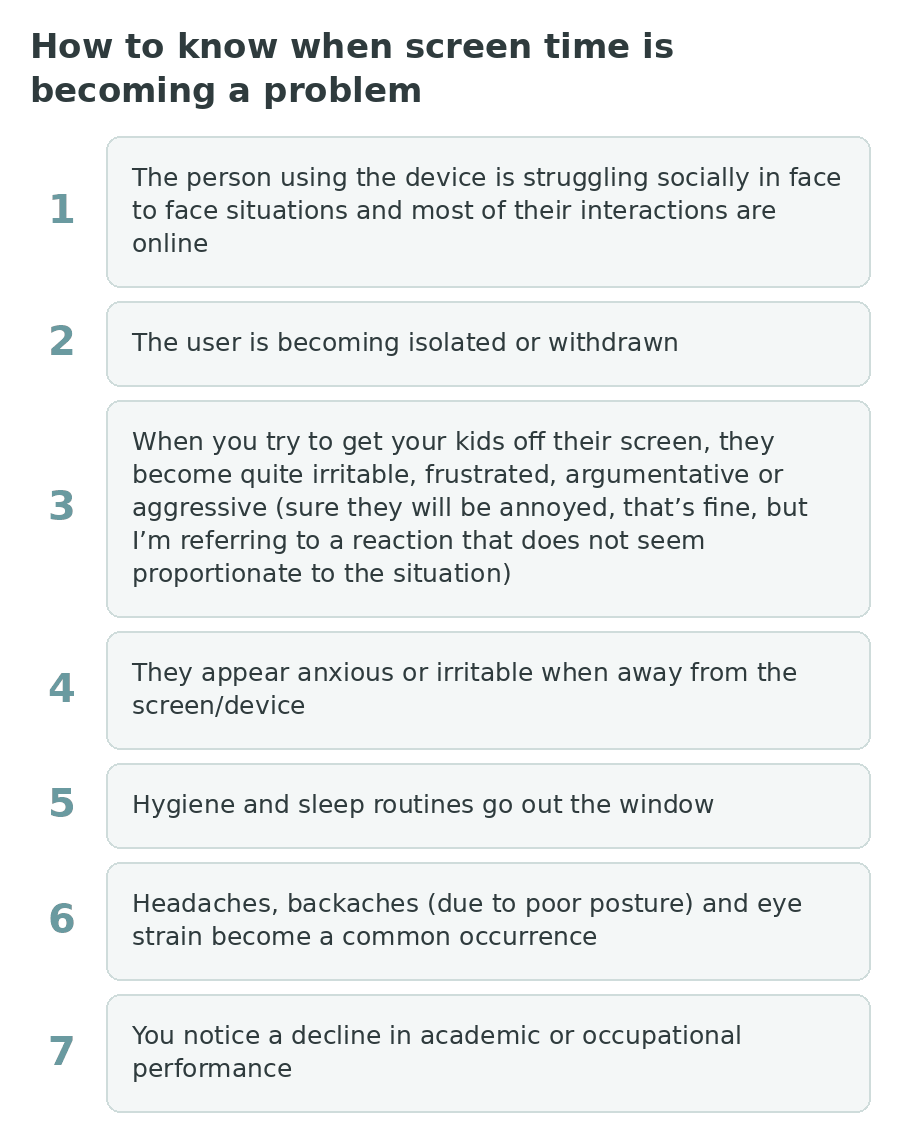
How to know when screen time is becoming a problem

  • The person using the device is struggling socially in face to face situations and most of their interactions are online
  • The user is becoming isolated or withdrawn
  • When you try to get your kids off their screen, they become quite irritable, frustrated, argumentative or aggressive (sure they will be annoyed, that’s fine, but I’m referring to a reaction that does not seem proportionate to the situation)
  • They appearing anxious or irritable when away from the screen/device
  • Hygiene and sleep routines go out the window
  • Headaches, backaches (due to poor posture) and eye strain become a common occurrence
  • You notice a decline in academic or occupational performance

Like most things, MODERATION IS KEY. Technology and smart devices are not bad, if we use them wisely and teach the younger generation to do the same.

If you are concerned about your kids or teens and their screen-time usage, have an open conversation with them about how they are using the technology. If you need to limit their usage, do it (even if they hate you for it). As a parent, you need to protect your kids and make sure they are balancing their time. Kids need to socialise, study, have family time, engage in hobbies, and SLEEP (this is a HUGE issue, probably best to discuss in another blog) and they can’t if they spend all their time on screens.  

A note to parents of younger kids – If you need the occasional night to unwind and you pop your kid in front of the TV or tablet a little longer than usual so you can have a rest, that is fine! If you give your toddler the phone so they can watch Pepper Pig while you have a coffee with a friend, that is also totally fine. Your sanity is very important! Just don’t make a habit out of it and ensure your kids have time to do all the other non-screen related stuff J

The take home message – BALANCE, MODERATION, KNOWLEDGE – Get these things down-pat and you’ll set yourself and your kids up for success in our tech-loving society!


Links

https://www.rchpoll.org.au/wp-content/uploads/2017/06/ACHP-Poll7_Detailed-Report-June21.pdf

https://austparents.edu.au/parentech_resources/screentime

laura    

 About the author:

This blog was written by Laura Forlani, Director and Clinical Psychologist at Your Mind Matters.      

Laura has completed undergraduate and post graduate studies in psychology, most recently completing a Masters in Clinical Psychology at Swinburne University.She has experience helping children and adults overcome a wide variety of difficulties such as mood and anxiety disorders, and problems arising due to changes in personal circumstances (e.g. family breakdown or a change in career). Her approach to therapy involves education, collaboration, and evidence-based interventions such as cognitive-behaviour therapy, skills training, and relaxation strategies. 


Knowing when to seek help

Most of us experience stress at some point in our life and some experience other mental health issues during their lifetime. So when do you know you might need to find some help for a mental health issue? Stigma has long been a barrier, but now more and more people readily access therapy and discuss mental health. Everybody feels down or sad at times, but it’s important to be able to recognize when a mood or behavioral change has become more than a temporary thing. Some of the signs that may indicate that it’s time to seek support may include but not limited to:

  • Unusual changes in mood, sometimes those changes include more than just your mood, such as, crying frequently without knowing why, having anger outbursts at others for no apparent reason, and feeling anxious in situations that are usually considered non-threatening.
  • Changes in the way we cope with life’s pressures can be an indicator.
  • Grief: Loss of a loved one, a divorce, relationship breakdown, or loss of employment can be a long and difficult process to endure. While not everyone needs counselling during these times, consulting an expert is not a sign of weakness especially if you’ve experienced multiple losses in a short period of time.
  • Sometimes a significant or traumatic event in your life can cause physical and emotional problems. It can be an event that has happened recently or something that happened a long time ago. If you have a history of abuse, neglect or other trauma that you haven’t fully dealt with, or if you find that it impacts your functioning, it’s probably time to seek support.

If you are going through difficulties and need support, why not give us a call today?  Our team of highly skilled and well-experienced Psychologists are here to help.  

photo__1_ aanchal

This blog was written by Aanchal Sood, Psychologist at Your Mind Matters.

Aanchal completed studies in psychopharmacology and psychology in England, and is fluent in both Hindi and Punjabi.

Aanchal has experience assisting adolescents, adults and couples to address a variety of difficulties including anxiety and mood disorders, grief and loss, trauma and stress related disorders, adjustment issues (e.g. cultural adjustment), sleep difficulties, relationship difficulties, schizophrenia spectrum and other psychotic disorders, obsessive compulsive and related disorders. 

Aanchal works with us 1-2 evenings per week. 

Autism Spectrum and Sensory Issues

Individuals on the Autism Spectrum often experience differences in the way they process sensory experiences. They typically experience sensory input more intensely than others. There can be a need for extra sensory input, or a need to reduce the sensory input that is being experienced intensely. This is for all types of senses. The pattern of sensory needs varies from person to person and the same stimulus that can be calming for some on the spectrum can cause distress for others.   


Hearing

This is a very common and difficult sense for those on the spectrum. Types of noises that are experienced as distressing can be loud noises, sudden noises, or chaotic noise. It could be a very specific noise, such as the noise a texta makes when writing on paper, or the noise of an egg being cracked. Wearing headphones in noisy environments can go a long way to reducing the distress caused by noises experienced as overwhelming. Those on the spectrum will often make noises of their own that are comforting to them such as rhythmic groaning or talking a lot about their area interest.


Seeing

Those on the spectrum can be very sensitive to light, finding it unbearable to be exposed to too much. Other sights that may be upsetting include a lot of varied visual stimulus in the one place, such as the set-out of fruit and vegetables at the fruit shop, or all the sights at a fun fair or market. On the flip side, watching something in particular can be very comforting, such as a favourite movie or cartoon, or watching wheels on a toy car spin around.  


Touch

There may be textures that are very uncomfortable for the individual to touch with their hands or any other skin. There may be aspects of clothing they find unbearable to wear, for example the scratchiness of wool, the feeling of a clothing label on the back of the neck, or the feeling of the seam in a sock against the skin of the toes. On the flip side, an individual on the spectrum may find stroking a particular texture very comforting, such as their mother’s arm, a pillow case, or a favourite soft toy.  


Another aspect of touch is pressure. Often those on the spectrum will be calmed by the feeling of pressure, such as that experienced under a weighted blanket or a tight squeeze from a trusted person. Again, on the flip side, sometimes the individual requires the absolute absence of pressure, such as always wanting to wear shorts so as not to have any fabric on the legs, or wanting to wear loose clothing.  


Taste

Individuals on the spectrum can be very fussy eaters. This can be due to needing routine and familiarity, but it is also commonly associated with the foods themselves. There may be some tastes the individual finds distressing or nauseating, and others they find comforting. There may also be textural issues, such as not enjoying some textures in the mouth (e.g. soft foods such as mash potato) or finding it distressing to mix textures of different foods in the mouth.  


Smell

Those on the spectrum are often very sensitive to smell and can detect subtle smells that others can’t, such as rubbish in the bin or dampness in the walls of a house.  Some people on the spectrum also enjoy smelling objects and foods as part of their perception of those objects.


Another feature of autism is difficulty with communication; it can be difficult for the person to explain what is wrong when they are experiencing sensory overload, or to explain their need for sensory input that may look unusual.  If someone you know on the spectrum seems distressed and there is no obvious trigger, try to tune into sounds, sights and smells of which you are not immediately aware.  


These sensory sensitivities are real and experienced intensely. The distress that can be caused by these experiences needs to be taken seriously, and accommodations made to allow the individual to escape the sensory input when it becomes overwhelming. 

photo ymm

This blog was written by Dr Naomi Castelan, Clinical Psychologist at Your Mind Matters. Naomi is passionate about working with children and their families and provides early intervention support.

To learn more about Naomi, click here.

Quick Self-Care Tools for Parents


Having worked with children with a range of varying needs, one thing I have noticed is that parents often forget to take care of themselves as they prioritise their children’s needs over theirs.

It’s important that parents care for themselves – first, for their own well-being, but also because any effort they put into self-care also has huge payoffs for their children. When parents “fill their own cups”, they have more patience, energy, and passion to spread to their family.


The following are a list of some Self-Care Tools that parents may wish to consider

  1. Write in a journal. Notice your thoughts and feelings and spend some time, anywhere from 5 minutes to an hour, writing. This can help with managing your emotions, particularly on those difficult days.
  2. Listen to some uplifting music whether you are sitting on the couch relaxing or busy working on household duties.
  3. Make yourself a soothing drink like a cup of tea, hot chocolate, or brew some coffee – and sip it slowly and savour the whole cup.
  4. Schedule at least 1 uninterrupted hour per week for you to spend with a friend or loved one, this could include going out for brunch or dinner, talking on the phone, out for a walk or spending some time getting pampered like getting a massage or your nails done. Socializing and being around friends can be extremely beneficial.
  5. Write down 3 things that are causing you stress or are bothersome. Problem-solve one solution for each of these that may help to relieve your stress.
  6. Reach out to a friend or loved when you are having a difficult day. Whether it be to ask for advice, support, or just a listening ear.
  7. Go for a walk, preferably somewhere serene, like a park or nature reserve.
  8. Do a short meditation by closing your eyes, breathing deeply, and focusing on your breath. Sometimes a mantra can help, like “All sounds return to the breath, all thoughts return to the breath, all distractions return to the breath”. Try the Smiling Mind app.
  9. Do a single tiny household chore that’s been bothering you – empty one drawer, give away one bag of clothes, or clean one shelf of your fridge. Pat yourself on the back for completing it.
  10. Let yourself be blue for a bit. Cuddle under a blanket, play sad bluesy music, eat chocolate ice cream, or cry.
  11. Follow the “rule of three”: always be consciously aware of 3 things that you’re looking forward to.
  12. Write down one goal or intention you have for the week and post it on your fridge. Take everything else (like magnets, pictures, art projects, to-do lists, etc.) off your fridge.
  13. Go somewhere local that you’ve never been before – a new nature reserve, a new park, a new beach, a different library, a conservatory, etc.
  14. Think of one way you compare yourself to others and feel bad about it – remind yourself that you rarely see the hard parts of people’s lives because they purposely hide them or keep them private.


For more ideas and to check out the inspiration for this blog, head to https://www.psychologytoday.com/au/blog/joyful-parenting/201708/25-simple-self-care-tools-parents.

Shannon

This blog was written by Dr Aiyuen (Shannon) Choong, Psychologist at Your Mind Matters. Aiyuen is fluent in English and Mandarin, and is passionate about working with children from preschool years through to adolescence. 

To learn more about Aiyuen, click here. 

📅 Book an Appointment