5 Signs You Might Benefit from a Telehealth Psychologist

In today’s busy world, accessing support has become easier with online services. A Telehealth psychologist offers the same professional, evidence-based care you would receive in person, but with the convenience of connecting from home, work, or anywhere with internet access.

Not sure if Telehealth psychology is right for you? Here are five signs you might benefit from working with a psychologist online.

1. You Live in a Regional or Remote Area

For many Australians, local psychology services may be limited. A Telehealth psychologist in Australia makes it possible to access professional support without travelling long distances. This ensures you can receive consistent care, no matter where you live.

2. You Have a Busy Schedule

Balancing work, study, or family life can make it difficult to attend in-person sessions. Telehealth appointments save time by cutting out travel, making it easier to fit therapy into your week.

3. You Feel More Comfortable at Home

Some people find it easier to open up in a familiar environment. Meeting with a psychologist via Telehealth can provide a greater sense of comfort and reduce the anxiety that may come with attending a clinic.

4. You Need Flexible Options

Telehealth can be combined with face-to-face sessions, giving you choice and flexibility. This means you can still see a psychologist in person if you prefer, but switch to online sessions when needed — such as during busy times, illness, or travel.

5. You Want Access to Evidence-Based Care & Services

Whether you are seeking an ADHD assessment online or counselling for trauma, anxiety, or relationships, Telehealth gives you access to psychologists who may not be based in your local area. This expands your options and helps you find the right professional fit.


A Telehealth psychologist provides the same standard of professional care as in-person sessions, with the added convenience of flexibility and accessibility. If you are considering support for your mental health, Telehealth might be a helpful option.

At Your Mind Matters Psychology Services, our Melbourne-based team also offers Telehealth psychology across Australia, including assessments and therapy.

📞 Get in touch today to book a Telehealth psychologist appointment.

Accessing Psychology Services via Telehealth at Your Mind Matters

Why Telehealth Matters in Mental Health Care

In today’s busy world, flexibility in accessing mental health support is more important than ever. Telehealth psychology sessions allow you to connect with a qualified psychologist from the comfort of your home, school, or workplace. At Your Mind Matters (YMM), our clinicians offers secure, evidence-based telehealth services to ensure support is available wherever you are in Victoria and across Australia.


What is Telehealth in Psychology?

Telehealth refers to psychological consultations delivered via a secure online platform. You’ll speak with your psychologist in real time, just as you would in a clinic, but without the need to travel. Research shows that telehealth can be just as effective as face-to-face sessions for many mental health concerns, including:

  • Anxiety and depression
  • ADHD and executive functioning challenges
  • Autism assessments and therapy supports
  • Trauma-informed care
  • NDIS-related psychological assessments and reports

Benefits of Choosing Telehealth at YMM

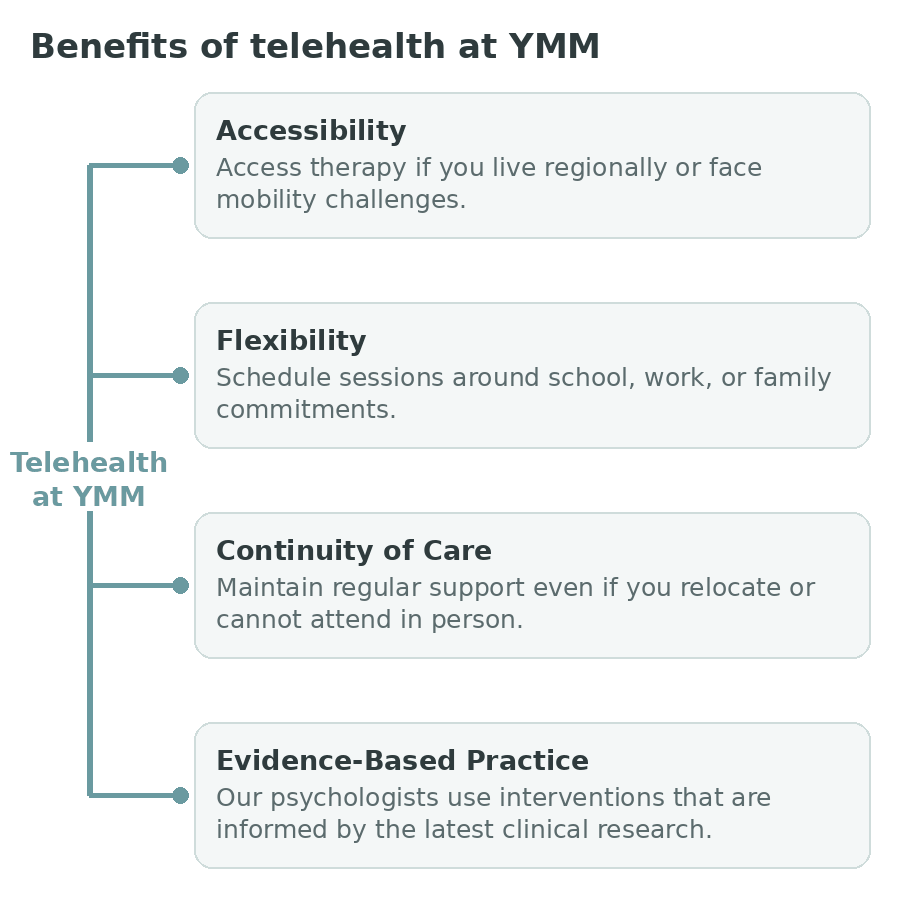
  • Accessibility: Access therapy if you live regionally or face mobility challenges.
  • Flexibility: Schedule sessions around school, work, or family commitments.
  • Continuity of Care: Maintain regular support even if you relocate or cannot attend in person.
  • Evidence-Based Practice: Our psychologists use interventions that are informed by the latest clinical research.

Is Telehealth Right for You?

Telehealth may be suitable if you prefer the comfort of your own space, live outside Melbourne, or find it difficult to attend in person. For children and young people, telehealth can work best when a parent, carer, or support worker is nearby to assist with technology and engagement.

If you’re unsure, our team can help you decide whether telehealth or in-clinic appointments are the best fit for your needs.


How YMM Delivers Safe and Effective Telehealth

At Your Mind Matters, our psychologists follow strict professional and ethical standards to ensure that online sessions are safe, private, and effective. This includes:

  • Using secure, encrypted video platforms
  • Maintaining confidentiality and privacy at all times
  • Providing clear information so you can make informed decisions about your care
  • Following AHPRA and Psychology Board of Australia guidelines for safe practice

Booking a Telehealth Appointment

Accessing telehealth psychology at YMM is simple:

  1. Get in touch with our team to discuss your needs or view our clinician profiles here: https://yourmindmatters.net.au/our-team
  2. Book an appointment at a time that suits you through our online portal: https://clientportal.zandahealth.com/clientportal/yourmindmatters
  3. Connect online with your psychologist using a secure link sent before your session.

Whether you are seeking an ADHD or autism assessment, or ongoing therapy, our telehealth psychologists are here to support you.

👉 Book a telehealth appointment with a psychologist today! Head to our website and learn about our clinicians. Once you know who you’d like to work with, call us or book online: https://yourmindmatters.net.au/contact-us/

DISTRESS TOLERANCE – AN INTRODUCTION TO A DIALECTICAL BEHAVIOUR THERAPY (DBT) PRINCIPLE

Photo by Andrea Cassani on Unsplash


There’s no question that feelings can be highly, highly unpleasant. For many people, emotions can become so overpowering that they can compel us to do things we mightn’t be proud of – we can yell, throw things, or binge drink.


Many clients we see at Your Mind Matters struggle with big emotions – some clients report feeling emotionally dysregulated when they’re upset, and struggle to bring themselves back to a baseline, neutral state. It’s a common problem, and can lead to all kinds of difficulties.


This blog is about Distress Tolerance, which is a host of psychological tools that can help us when we’re struggling with truly overwhelming feelings. The goal of Distress Tolerance is not to eliminate an emotion, or even significantly reduce its intensity – instead, it’s about teaching us to tolerate the emotion, and withstand the urges that can come with it. It belongs to a kind of therapy called Dialectical Behaviour Therapy (DBT).


DBT is an evidence-based therapy for multiple forms of mental health challenges, and contains plenty of ideas that can be great for anyone’s emotional wellbeing. DBT breaks itself up into lots of different bits and pieces – one of these is a Skills component, that has Distress Tolerance as a sub-school inside it. You can think of DBT as a big book – Skills is a chapter, and Distress Tolerance takes up a few pages in that chapter.


Distress Tolerance is about asking yourself what behaviours your emotions urge you toward, with a particular focus on the kind of behaviours that lead to greater distress later on – i.e., make the situation worse. For instance, if you were a tennis player whose emotions led to an urge to smash your racquet against the court, your Distress Tolerance goal could be to reduce your racquet-smashing – because this will make you feel embarrassed or guilty later on, and avoid the competitive consequences that come with it. Note the player’s goal wouldn’t be to feel less angry, although this would be nice… instead, Distress Tolerance asks you to ride that emotion more effectively, and not make the feeling worse.

Other behavioural goals can be:

  • Not binge-drinking alcohol.
  • Not texting people with threats, sarcasm, or aggressive themes.
  • Not using drugs.
  • Not self-harming.


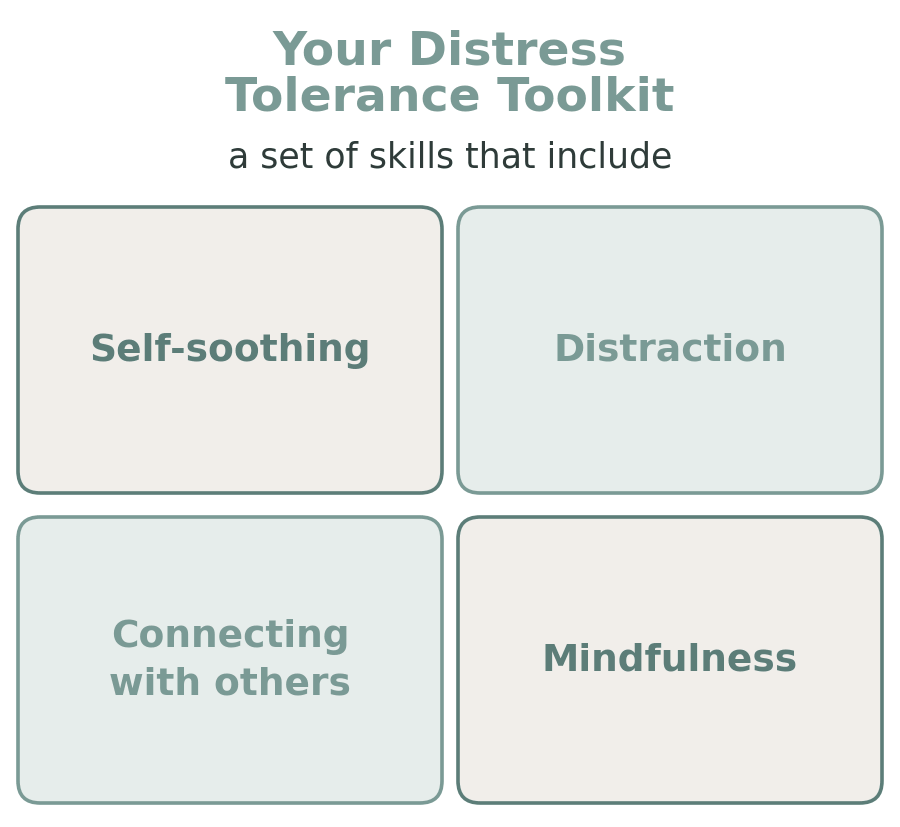
Distress Tolerance asks clients to build a Distress Tolerance Toolkit – i.e., a set of skills that include self-soothing, distraction, connecting with others, and mindfulness. Again, we’d hope these tools reduce the intensity of your feelings; but more importantly, we’d hope they lead to you tolerating your distress without engaging in life-worsening behaviour. 


There are lots of methods and strategies DBT uses in their Distress Tolerance framework – many of them are available for free from their official website: (https://dialecticalbehaviortherapy.com/distress-tolerance/).


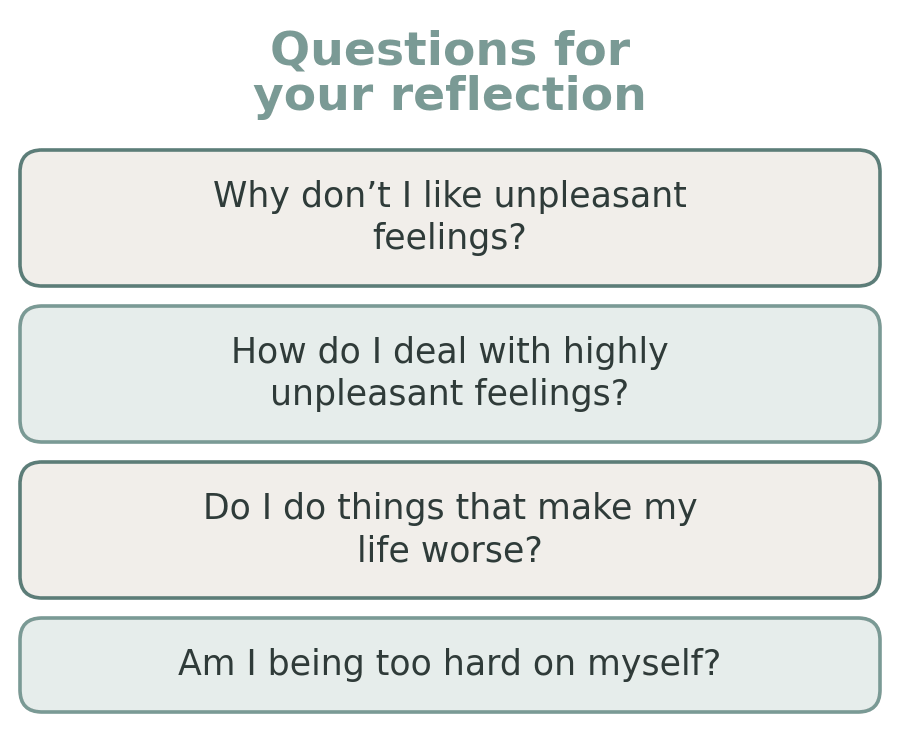
Some questions for your reflection:

  • Why don’t I like unpleasant feelings? Aside from being viscerally uncomfortable, is there something I’m worried the feelings will do to me? I.e., that I’ll lose control, or not be able to recover?
  • How do I deal with highly unpleasant feelings? If I watched myself living with difficult feelings on CCTV, what would I see myself doing?
  • Do I do things that make my life worse, or increase a sense of shame or guilt? What sort of things are they? Do I want to change these typical responses, and why?
  • Lastly – am I being too hard on myself? Often, clients say they ‘respond badly’ to certain feelings… but there’s nothing necessarily wrong with eating more chocolate than usual, or scrolling on your phone for a few minutes. If you want to change those things, that’s great – but it’s certainly not compulsory for good mental health. 


[siteorigin_widget class=”SiteOrigin_Widget_Headline_Widget”][/siteorigin_widget]
[siteorigin_widget class=”WP_Widget_Media_Image”][/siteorigin_widget]

This blog was written by Patrick (Paddy) Carey – Clinical Psychologist at YMM.

Paddy works with adults presenting with anxiety disorders, mood disorders, trauma and stressor-related disorders, obsessive-compulsive disorders, substance and gambling issues, psychosis spectrum disorders, and grief and loss. He is trained in Cognitive Behaviour Therapy (CBT), Acceptance and Commitment Therapy (ACT), Cognitive Processing Therapy (CPT), Metacognitive Training (MCT), and mindfulness approaches.

Paddy is focused on developing warm, trusting, and strengths-based relationships with clients. He recognises that his clients are the foremost experts in the room, and unearthing their own expertise is crucial to applying his skills.

To learn more about Paddy, check out the “Our Team” page on our website! https://yourmindmatters.net.au/our-team/

Do you have a fear that’s holding you back? Overcoming Fears

People can be scared of many different things, such as dogs, airplanes, needles or insects. And the degree to which we’re fearful of these things can also vary. For example, I personally am scared of birds (this is also known and ornithophobia). Yes, I know…terrifying. However, it’s a mild fear, as this does not stop me from walking through a park where I know birds will be present, or walking down the sidewalk when I see them on the footpath in front of me. I may not like it, but it doesn’t interfere with my life. Unfortunately, this may not be the case for everyone, because, as mentioned above, the degrees of fear can vary. Many individuals will go out of their way to avoid that which causes fear. Some may never go on a desired holiday, or see family interstate due to being frightened of flying. Others may avoid going outside in spring and summer due to their fear of bugs. In these circumstances, seeing a psychologist can be helpful, in order to help tackle this issue.

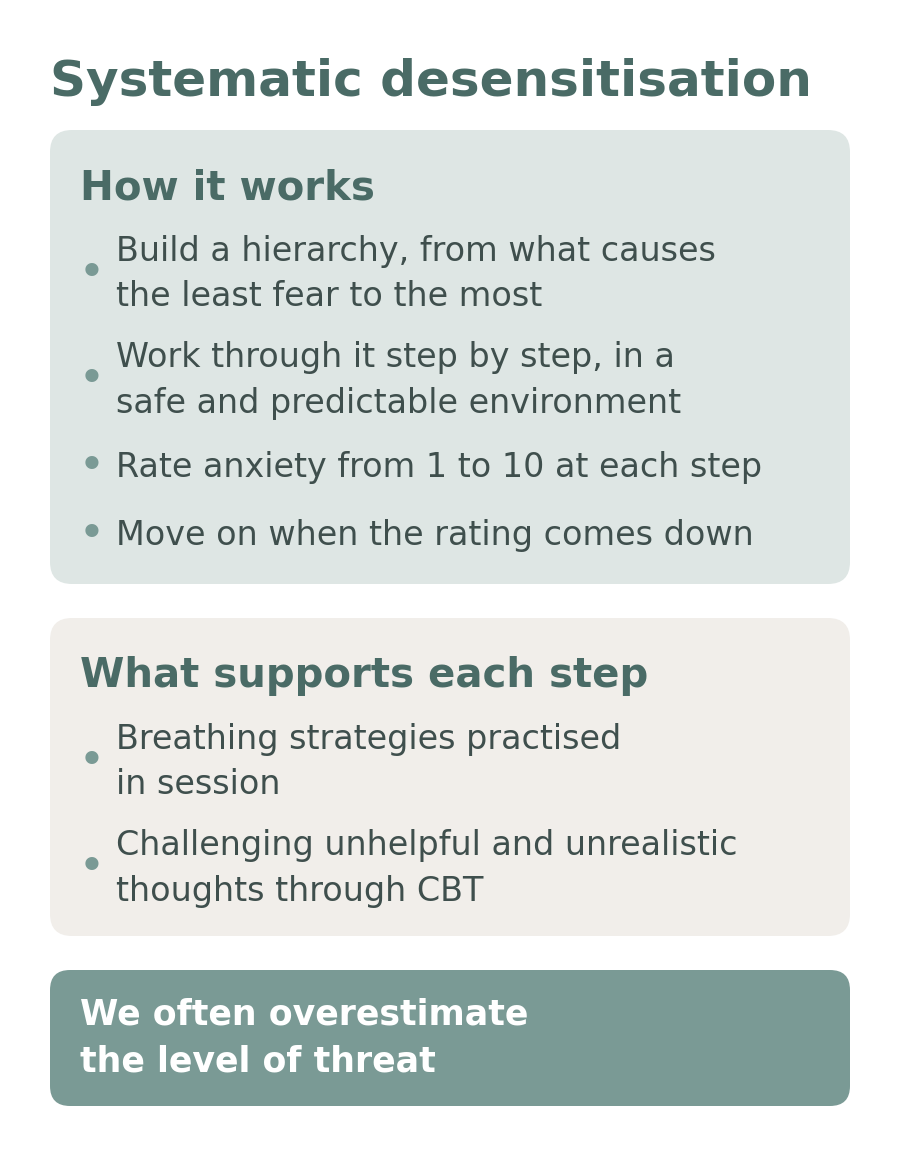
One way to do this, and my preferred way, is through systematic desensitisation. This involves gradual exposure to that which causes fear and discomfort. To start off, I work with my clients to develop a hierarchy, starting with what causes the least amount of fear, or anxiety, and building up to that which causes the most fear. It’s important that clients follow these steps in an environment that is safe and predictable. Let’s use fear of dogs as an example. Depending on the severity, step one may be just talking about dogs. Believe it or not, this alone can be enough to cause uneasy feelings for some. I ask my client to rate their anxiety level for step one (1-10). The idea is that the more the client is exposed to this step, they will become desensitised, leading to their self-rating to drop over time. Once the client is comfortable and essentially bored with this step, we then move onto step two. Step two may involve looking at pictures of dogs. For example, I would advise against going to a dog park to observe dogs there, as this is an unpredictable environment, as we cannot control or stop a dog from running up to the client, which could lead to more distress. Moving, on, step three may involve looking at videos of dogs. Once again, the client would continue to rate their level of discomfort, and eventually, once this drops to an extremely comfortable level, we move on to the next step. Eventually, the aim and goal would be to have the client comfortably sitting in a room with the dog, and even interact with a dog.

In addition to a hierarchy, it is beneficial to work on breathing strategies in sessions as well. These help ease some of the discomfort within each step. Learning to challenge unhelpful and unrealistic thoughts via CBT (Cognitive Behavioural Therapy) is also very helpful, as often, we overestimate the level of threat, and are more fearful of certain things than necessary.

If an individual has an animal-related fear, such as the above, it can be beneficial if the psychologist they are working with utilises animal-assisted therapy. Therapy dogs are generally quite well-trained and love people. Exposure to therapy animals is done in a safe and predictable environment, and it’s reassuring to know that the specific dog is friendly, and that the handler (in this case, the therapist), has an understanding of the client’s fear, and can work with the client in a manner in which they are comfortable. As opposed to attempting to interact with a dog at a dog park, or on the street, which is less predictable. However, it is important to ensure that the psychologist and therapy animal you choose to work with are suitable for your own level of fear, as some dogs can be more excitable than others and may not be suitable for someone who has trouble even being in the same room as a dog.

*blog featured image:  <a href=”https://www.vecteezy.com/free-vector/phobia”>Phobia Vectors by Vecteezy</a>

If you think working with a psychologist would help you tackle your fear, give us a call to find a psychologist that is suitable for you. Please note that Johana is able to assist with clients who have a moderate fear of dogs, as Luna is an excitable dog.

[siteorigin_widget class=”SiteOrigin_Widget_Headline_Widget”][/siteorigin_widget]
[siteorigin_widget class=”WP_Widget_Media_Image”][/siteorigin_widget]

This blog was written by Johana Xanthopoulos, Clinical Psychologist at Your Mind Matters.

Johana works with a range of clients, including children and adolescents. Working previously in an early childhood intervention setting, Johana has skills and experience working with a range of childhood disorders, particularly Autism Spectrum Disorder. Johana’s other special interests include anxiety and depression. She has also completed Animal Assisted Therapy training with her dog Luna, who you may see in our office.

Johana is fluent in English and Greek.