📅 Book an Appointment

Assertiveness: What does it look like and why it’s important


A scatter of blank wooden letter tiles on a table, with a person sitting further back out of focus

Most people have experienced situations where they have not received what they wanted or needed. These might have been at work, with friends, family, or in intimate relationships. Some may have thought “I am just not an assertive person” and let it go or potentially have it fester into ongoing resentment or sense of helplessness. Some, may have reacted in an opposite manner, with anger and frustration, but this too did not result in needs being met but rather fractured relationships.

Assertiveness is important in all spheres of life from domestic to social to vocational. If you have ever found it difficult to get your point across, to even speak up or keep your cool and had a difficult time communicating your needs, you will undoubtedly recognise the importance of assertive communication in balancing relationships and having needs met.

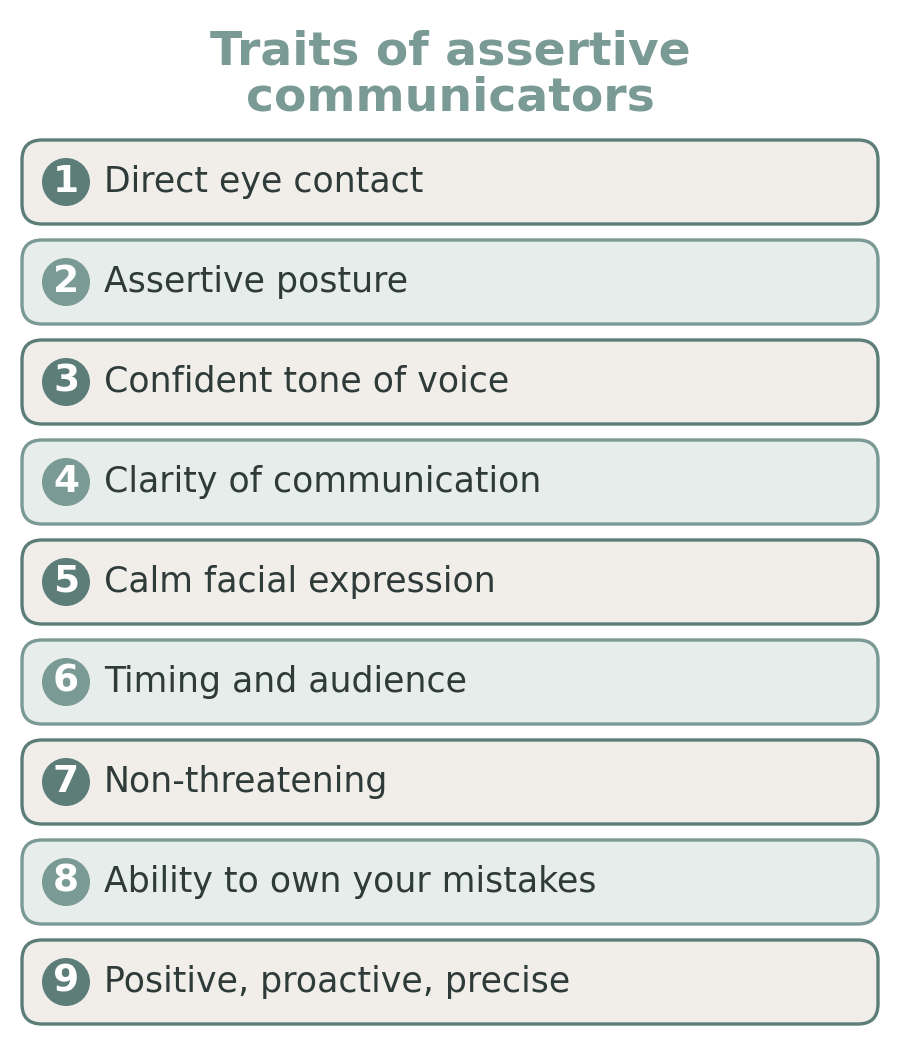
Diagram listing nine traits of assertive communicators, numbered from direct eye contact to positive, proactive and precise communication

Whilst one might accept these circumstances as the norm of not being assertive, assertiveness is actually a set of skills that can be learned and developed. Personality, culture, life experiences and previous relationships may all make this skill harder to learn for some people, however it is possible to learn to be assertive and doing so is likely to make a positive difference to one’s life.

So what is Assertiveness and what is it not?

Although the meaning of “assertive” may be familiar, it is important to consider what Assertive Communication actually looks like and what it entails.

Assertive communication has been defined as “the ability to speak and interact in a manner that considers and respects the rights and opinions of others while also standing up for your rights, needs, and personal boundaries” (Pipas & Jaradat, 2010, pp. 649). In other words, it’s a communication style which is comprised of direct yet calm, respectful and reasonable expression of your needs whilst also taking the other party’s needs into account. It is standing up for your values without impeding another’s right to do so. Assertiveness is a key skill that can help you to better manage yourself, people and situations. It can help you to influence others in order to gain acceptance, agreement or behaviour change whilst allowing one to feel less guilty for saying ‘no’ to tasks or plans that may not be serving them. It is not coming out as the champion of a heated argument. Assertiveness is knowing when and how to demonstrate your view.

Conceptually, if we look at communication styles on a continuum, assertiveness is the middle balance between being passive (where one is overly focussed on the needs of others’, but struggles to vocalise their own) and being aggressive (where a person may be overly forthright and demanding about their needs, but fail to acknowledge the needs and wants of others). Assertiveness is therefore a positive personality characteristic that enables individuals to be present, actively engaged and aware of their rights, whilst also extending the same to others. They are a benefit to both themselves and society (Parmaksiz, 2019).

Benefits of Assertiveness vs Consequences of when it’s lacking

The importance of feeling considered, heard and valued is well established. Not having our reasonable needs or wants met and feeling that these are not seen as important or valued, leads to feelings of stress and upset. These negative emotions can compound over time and can become a “time bomb” with detrimental impacts on our self-esteem, anxiety and stress (Bulantika and Sari, 2019). A lack of assertiveness may contribute to depression and anxiety, whereas maladaptive approaches to assertiveness may manifest as aggression (American Psychological Association, n.d.a, para. 1).

What are some of the traits of Assertive Communicators?

There are certain traits that are present in effective assertive communication, spanning both verbal and non-verbal characteristics.

  1. Direct eye contact which communicates confidence and that the person is not intimidated
  2. Assertive posture/stance which balances an open confident stance without looking aggressive. Hand gestures and fidgeting also need to be minimised.
  3. Tone of voice should be confident, strong, but not loud and aggressive.
  4. Clarity of communication is vital, so using specific words that clearly communicate ones needs with little room for ambivalence can assist in getting the message across.
  5. Facial expression needs to remain calm and important to not express anger or anxiety.
  6. Timing of any conversations needs to be considered and appropriate as should the audience
  7. Non-threatening: the person should not blame or threaten the others in order to get their way.
  8. Ability to own your mistakes whilst not taking the ownership for the mistakes of others is part of standing up for own beliefs.
  9. Communication needs to be framed in a positive, proactive but precise manner and self-criticism should be avoided when trying to be assertive. It’s imperative that when trying to have effective communication, you’re clear on your position and needs.

While assertive communication skills come naturally for some individuals, these skills can be developed through practice. Effective communication can assist career progression and improve relationships. Relationships are complex and individual and sometimes we may need additional support navigating them. Psychological therapy can be helpful to develop skills in assertiveness in a safe supportive space. If you would like some support with better managing communication and improving the quality of interactions, why not give us a call today? Our team of highly skilled and well-experienced practitioners are here to help.

References

  • American Psychological Association (n.d.a). Assertiveness. In APA Dictionary of Psychology. APA Dictionary of Psychology
  • Bishop, S. (2013). Develop your assertiveness. London, UK: Kogan Page Limited.
  • Bulantika, S. Z., & Sari, P. (2019). The effectiveness of assertive training techniques and thought-stopping techniques to increase student assertiveness ability. Biblio Couns: Jurnal Kajian Konseling dan Pendidikan, 2(3), 109–116.
  • Millacci, T. (2017). Assertiveness in the Workplace: A Quick Guide. Assertiveness in the Workplace
  • Pipaş, M., & Jaradat, M. (2010). Assertive communication skills. Annales Universitatis Apulensis Series Oeconomica, 12, 649–656.
  • Williams, M. (2023). What is Assertiveness and why it is important. What is Assertiveness and why is it important
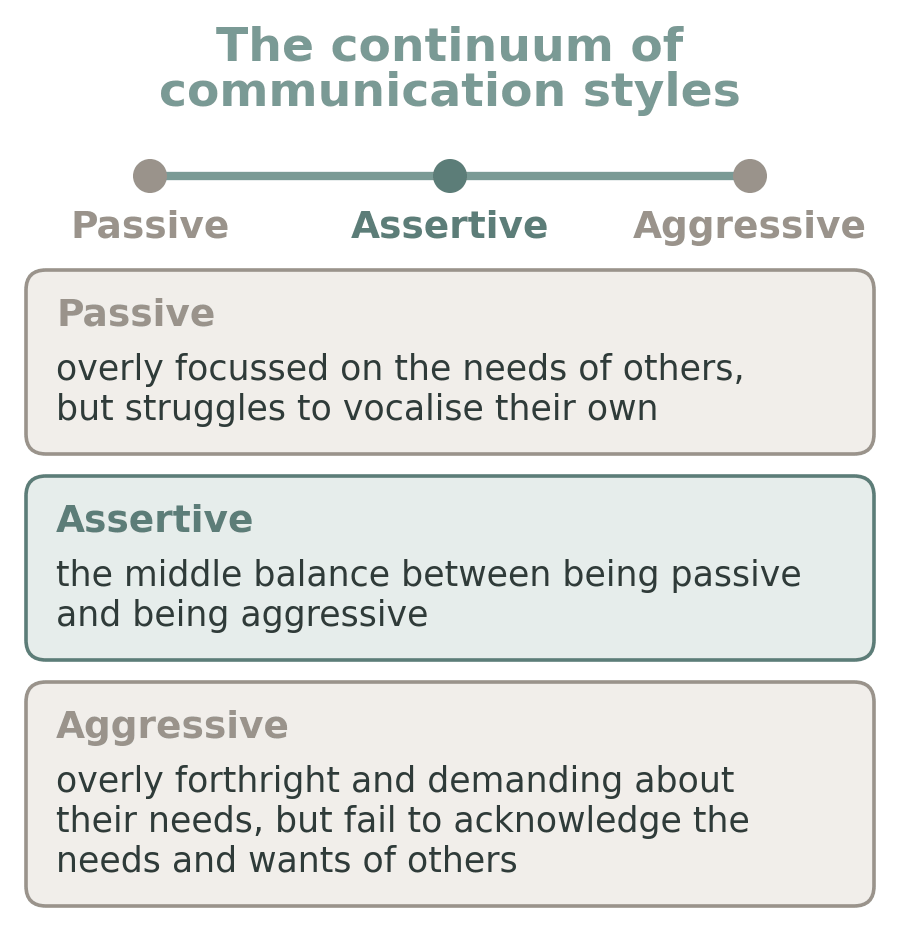
Diagram of the continuum of communication styles, with passive at one end, aggressive at the other and assertive as the middle balance
Lana Lubomirska wearing glasses, in a portrait photograph

Our Blog Author
This post was written by Lana Lubomirska, Senior Psychologist at Your Mind Matters. Lana works with children, adolescents and adults from a range of cultural and socioeconomic backgrounds, and is committed to providing a client-centred, safe environment for every individual. Meet our team.

Book an appointment

Coping with the Stress of Year 12’s Final Semester with Strategies for Success

A person stepping back from a small calm dog whose shadow looms over the scene, far larger than the animal itself

People can be scared of many different things, such as dogs, aeroplanes, needles or insects. And the degree to which we’re fearful of these things can also vary. For example, I personally am scared of birds (this is also known as ornithophobia). Yes, I know…terrifying. However, it’s a mild fear, as this does not stop me from walking through a park where I know birds will be present, or walking down the sidewalk when I see them on the footpath in front of me. I may not like it, but it doesn’t interfere with my life. Unfortunately, this may not be the case for everyone, because, as mentioned above, the degrees of fear can vary. Many individuals will go out of their way to avoid that which causes fear. Some may never go on a desired holiday, or see family interstate due to being frightened of flying. Others may avoid going outside in spring and summer due to their fear of bugs. In these circumstances, seeing a psychologist can be helpful, in order to help tackle this issue.

Systematic desensitisation: building a hierarchy, working through it step by step, and what supports each step

One way to do this, and my preferred way, is through systematic desensitisation. This involves gradual exposure to that which causes fear and discomfort. To start off, I work with my clients to develop a hierarchy, starting with what causes the least amount of fear, or anxiety, and building up to that which causes the most fear. It’s important that clients follow these steps in an environment that is safe and predictable. Let’s use fear of dogs as an example. Depending on the severity, step one may be just talking about dogs. Believe it or not, this alone can be enough to cause uneasy feelings for some. I ask my client to rate their anxiety level for step one (1-10). The idea is that the more the client is exposed to this step, they will become desensitised, leading to their self-rating to drop over time. Once the client is comfortable and essentially bored with this step, we then move onto step two. Step two may involve looking at pictures of dogs. For example, I would advise against going to a dog park to observe dogs there, as this is an unpredictable environment, as we cannot control or stop a dog from running up to the client, which could lead to more distress. Moving on, step three may involve looking at videos of dogs. Once again, the client would continue to rate their level of discomfort, and eventually, once this drops to an extremely comfortable level, we move on to the next step. Eventually, the aim and goal would be to have the client comfortably sitting in a room with the dog, and even interact with a dog.

In addition to a hierarchy, it is beneficial to work on breathing strategies in sessions as well. These help ease some of the discomfort within each step. Learning to challenge unhelpful and unrealistic thoughts via CBT (Cognitive Behavioural Therapy) is also very helpful, as often, we overestimate the level of threat, and are more fearful of certain things than necessary.

Luna, a yellow Labrador Retriever, sitting on the grass wearing a blue therapy dog vest

Animal-assisted therapy for animal-related fears

If an individual has an animal-related fear, such as the above, it can be beneficial if the psychologist they are working with utilises animal-assisted therapy. Therapy dogs are generally quite well-trained and love people. Exposure to therapy animals is done in a safe and predictable environment, and it’s reassuring to know that the specific dog is friendly, and that the handler (in this case, the therapist), has an understanding of the client’s fear, and can work with the client in a manner in which they are comfortable. As opposed to attempting to interact with a dog at a dog park, or on the street, which is less predictable. However, it is important to ensure that the psychologist and therapy animal you choose to work with are suitable for your own level of fear, as some dogs can be more excitable than others and may not be suitable for someone who has trouble even being in the same room as a dog.

Luna in her therapy dog vest.

If you think working with a psychologist would help you tackle your fear, give us a call to find a psychologist that is suitable for you. Please note that Johana is able to assist with clients who have a moderate fear of dogs, as Luna is an excitable dog.

Johana Xanthopoulos with her therapy dog Luna

Our Blog Author
This post was written by Johana Xanthopoulos, Clinical Psychologist at Your Mind Matters. Johana works with children and adolescents, with particular experience in autism, anxiety and depression, and has completed Animal Assisted Therapy training with her dog Luna. She is fluent in English and Greek. Meet our team.

Book an appointment

Understanding Your Thoughts

A quiet suburban living room in soft morning light, with a person standing by the window

Simply put, thoughts are our opinions and beliefs about ourselves, others and the world around us. Thoughts can be experienced in different ways. Some of us think in the form of ‘words’, images/pictures, or even both. We all have that ‘voice’ in our head that helps us process events that are unfolding around us. Sometimes our inner self-talk can be very positive, supportive and encouraging, almost like a cheerleader. However, at times it can be very critical. You may have heard of the term ‘the inner critic’; this is the part of you that scrutinises/judges you. It may, for example, tell you that you ‘should’ do better or that you’re failing in life.

A big part of therapy is to shift our thinking. Now we have all heard the term ‘positive thinking’. We might be going through a tough situation and in an attempt to help, a friend or loved one may tell us “STOP thinking so negatively and think more positively!!”. Easier said than done, right?! We first need to understand our thoughts, before we can start to shift them. Most importantly, we need to understand what has led us to form that interpretation of the situation/event at hand, ourselves, others or the world.

Let’s start at the beginning… First and foremost, you CAN NOT stop yourself from thinking! The more you tell yourself to ‘stop thinking’ the more you think that thought! Have you ever had a song stuck in your head? I bet the answer is YES! And your mind sings it over, and over, and over! It becomes annoying, right? And the more you try to ‘get rid of’ that song, the more your mind keeps replaying it. Eventually, you may decide to stop fighting it and allow your mind to ‘sing’, you allow the song to be there, and go on with your day, focusing on what is important to you. And alas… IT GOES AWAY!!

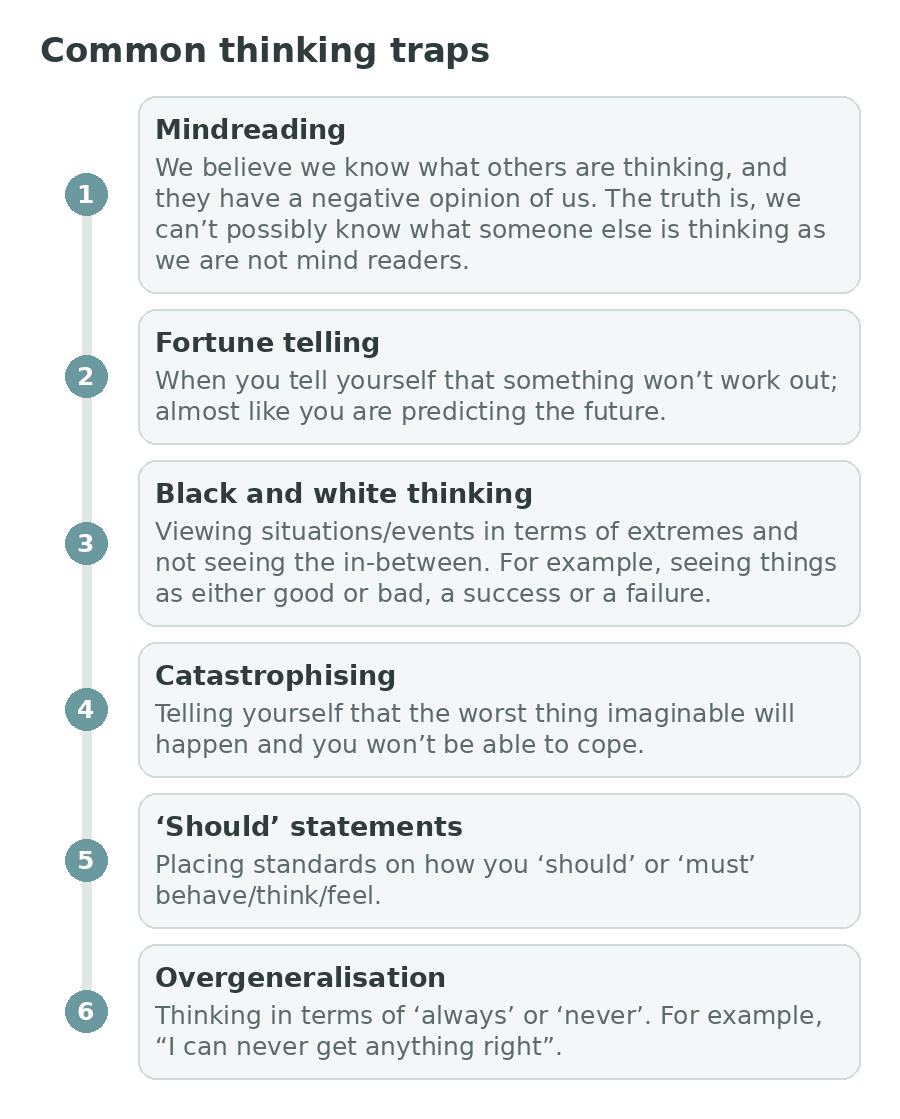
Six common thinking traps listed along a vertical ribbon: mindreading, fortune telling, black and white thinking, catastrophising, should statements and overgeneralisation

Above, I mentioned that thoughts are words/pictures/images. I want you to keep this in mind. Thoughts in and of themselves do not have any meaning; they are words/pictures/images formed in our mind about our interpretation of a situation. We are the ones who give our thoughts meaning…we think them and automatically believe them to be true. Just because you think something, it DOES NOT make it true. For example, if you had the thought “I’m not a good friend”, that does not make it a fact.

We can often get caught in ‘thinking traps’. These are also referred to as cognitive distortions. Thinking traps are inaccuracies in thinking which are often very unhelpful and get in the way of us viewing a situation more objectively. Here are some common thinking traps:

  • Mindreading – We believe we know what others are thinking, and they have a negative opinion of us. The truth is, we can’t possibly know what someone else is thinking as we are not mind readers.
  • Fortune telling – When you tell yourself that something won’t work out; almost like you are predicting the future.
  • Black and white thinking – Viewing situations/events in terms of extremes and not seeing the in-between. For example, seeing things as either good or bad, a success or a failure.
  • Catastrophising – Telling yourself that the worst thing imaginable will happen and you won’t be able to cope.
  • ‘Should’ statements – Placing standards on how you ‘should’ or ‘must’ behave/think/feel.
  • Overgeneralisation – Thinking in terms of ‘always’ or ‘never’. For example, “I can never get anything right”.

Rather than refer to our thoughts as ‘positive’ or ‘negative’, I personally prefer to use the terms ‘helpful’ or ‘unhelpful’. Ask yourself, is it useful for me to think this way? Does this help me to live by my values and pursue my goals? In the same way that we stop trying to ‘get rid of’ the songs stuck in our mind, we want to start making choices towards not engaging in our thoughts or getting stuck in the trap of ‘believing them’. Instead, we want to start noticing them more mindfully.

Our thoughts can be quite powerful and influence us in many ways. If you would like some support to shift your thinking to be more helpful and aligned with your values, our team of psychologists are here to help.

Maria Kampantais seated and smiling

Our Blog Author
This post was written by Maria Kampantais, Senior Clinical Psychologist at Your Mind Matters. Maria works with clients using evidence-based therapies including Cognitive Behavioural Therapy, Acceptance and Commitment Therapy, mindfulness techniques, Motivational Interviewing, and Solution Focused Therapy. Meet our team.

Book an appointment

Mind Full or Mindful?

A couple on a park bench under gum trees: one hunched over a phone with papers spilling from a bag, the other sitting back with their head tilted up to the canopy

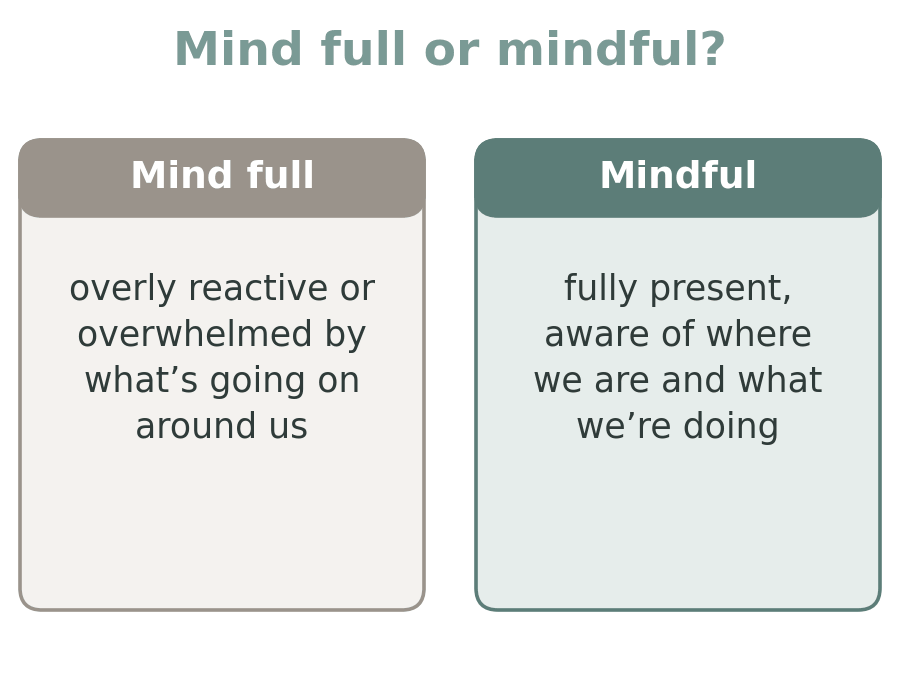
No doubt you, as a therapist or client will at some point in the process be introduced to the principles of Mindfulness. Mindfulness is the basic human ability to be fully present, aware of where we are and what we’re doing, and not overly reactive or overwhelmed by what’s going on around us. It is an integral part of some forms of therapy such as Mindfulness based Cognitive Behavioural therapy and Dialectical Behaviour therapy. Mindfulness can provide strategies to manage challenging thoughts and emotions through a focus on the here and now.

Mindfulness can act as a grounding approach to settle ourselves when we’re feeling overwhelmed. If you find yourself stuck with a strong emotion, this approach can help you to feel anchored in the present and restore balance in your body and mind. Grounding skills are helpful to build sensory and cognitive awareness which can also help in therapy as you begin to recognise patterns and trends that either help or hinder you in your goals.

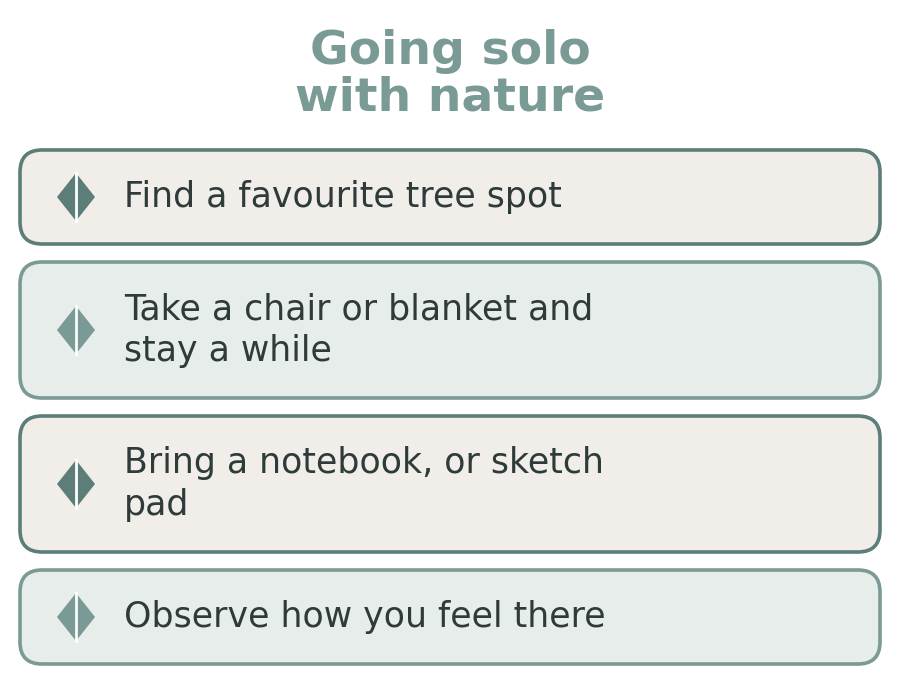
Four suggestions for going solo with nature: find a favourite tree spot, take a chair or blanket, bring a notebook, and observe how you feel there
Two panels comparing a mind full, overly reactive or overwhelmed by what is going on around us, with mindful, fully present and aware of where we are and what we are doing

Connecting to nature can be a key part of developing mindful and grounding activities. Nature has the power to reconnect us to ourselves, our present, and our memories, through our senses. Indeed, as Lao Tzu, the Chinese Philosopher from 500 BCE said, ‘Nature does not hurry, yet everything is accomplished’. There is stillness and motion, acceptance and change, all happening under our feet and above our heads.

There are many ways of connecting to nature, but here are a few ideas to get you started.

Forest Bathing

We know from our own experiences that when we are surrounded by trees and their canopies, we can feel calmed, and the scents of the earth and leaves and bark can stimulate our senses in a way that encourages relaxation and reconnection with ourselves and nature.

The Japanese practice of Shinrin-Yoku, translated as ‘forest bathing’, recognises the healing power of forests which provide sensory stimulus to decompresses our nervous system, allowing us to reset and recharge. Originating in the 1980s in Japan it has become a key preventative element of Japanese medicine, with 44 accredited Shinrin-Yoku forests across the country. Internationally this practice is also called ‘Forest Therapy’.

You don’t need to live close to a forest to benefit from forest bathing. A local park with trees will also provide opportunities for wellbeing. As forest bathing is gaining in popularity in Australia there are many choices of accessing in-person or online forest bathing sessions. The Royal Botanic Gardens in Melbourne offers two- or three-hour sessions involving time spent in key gardens and with certain trees, concluding with a shared tea ceremony. for more details: the Royal Botanic Gardens forest therapy page

Other ways to connect with Forest Therapy is through individual trained practitioners such as Forest Walks and Three Little Birds Nature Therapy where in person and online events occur. You can learn more about this developing health sector here: the International Nature and Forest Therapy Alliance

If you prefer to go solo with nature, here are some suggestions:

  • Find a favourite tree spot from your favourite nature place
  • Take a chair or blanket and stay a while.
  • Bring a notebook, or sketch pad.
  • Observe how you feel there. Be with yourself and the natural world.

Water

Similarly, the atmosphere of forests, bodies of water can evoke a sense of calm and tranquillity in us. Watching water or being close to this ‘blue space’ can be meditative. It allows us to connect to the vastness of the ocean landscape, or the intimacy of a flowing river with all of its living lifeforms, bringing us greater calm and connection. Marine Biologist, Wallace J. Nichols, writes about in his book, Blue Mind. Connection to water comes in many different forms from the beach and ocean, or the local creek or river, to a swimming pool or floatation tank. If we are water observers, we can benefit for the connection to it with a walk alongside our chosen blue space. If we prefer to be emersed and receive benefit that way, regular swims at our local pool or beach, spas at a bathhouse (Sense of Self) or natural springs (Peninsula Hot Springs) can support our wellbeing. A more immersive water experience can be found in a floatation tank. Floatation tanks are pods filled with warm salt water and hour-long sessions emersed in them alone can include music and different lightening effects, or quiet darkness. There are many centres around the city, and across the country offering this service and you can learn more here: Float Therapy Australia

Whichever nature path you choose to take, connecting to the earth can support our mental health in many ways.

Our Blog Authors

This post was written by Ian Clark, Senior Clinical Psychologist at Your Mind Matters, together with Rachel Clark. Ian works with adolescents and adults presenting with mood disorders, anxiety, and stress related to school or work, and has years of experience supporting victims of domestic violence. Meet our team.

Rachel Clark is an educator and community organiser with 25 years of experience in teaching, cultural diversity, disability, and social justice.

Book an appointment

Importance of Self-Compassion

At some point in our lives, we all have heard the phrase that ‘charity begins at home’! Most of us accept it and even preach it to others when the opportunity for sharing wisdom arises (yeah, we are good at that!). The essence of the above phrase is seated in the value of compassion or kindness towards others. Compassion is empathy, kindness and understanding for others during suffering or challenging times.

So, I have a question for you – have you ever heard that ‘compassion starts with self’? Probably not, aside from the fact that I made the phrase up. Chances are that self-compassion is an alien concept and only comes into our lives through social media memes. So let me give you a brief snapshot and advocate the case for ‘self-compassion’ as an essential in our lives.

A simple Google search will define ‘self-compassion’ along the lines of empathy, understanding and kindness towards one’s own self, when big or small life challenges happen. Kristin Neff, the world’s leading researcher on self-compassion, has identified three main components to it:

  1. Self-kindness vs self-judgement: treating ourselves with kindness and understanding when we fail, suffer or feel inadequate, as opposed to ignoring our needs or belittling ourselves.
  2. Common humanity vs isolation: remembering that everyone fails and suffers at times and that we are not the only ones.
  3. Mindfulness vs over-identification: taking a balanced approach to our challenges and emotions, without over-identifying with heavy emotions or situations.

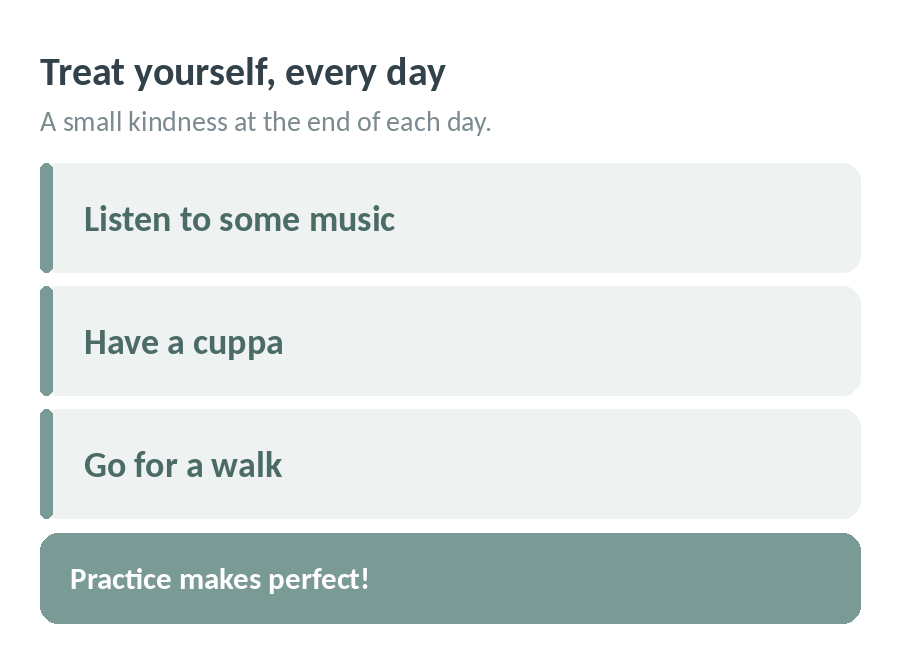
Kristin’s research has contributed significantly to understanding the importance of practising self-compassion in daily life and more so when experiencing mental health challenges. Self-compassion also forms a crucial part of my own therapy model and aims at supporting and empowering clients, by helping them connect and understand their own emotions and situations. A simple activity that I encourage clients to do is to treat themselves at the end of the day, each day. This can be as simple as listening to some music, having a cuppa or going for a walk. Practice makes one perfect!

So, I invite you to explore self-compassion for yourself and incorporate it in small ways within your daily life. Self-compassion will be the strongest script that you can have for yourself. If you would like to work on further developing your skills, our psychologists at Your Mind Matters will be happy to assist you.

Source: self-compassion.org

Our Blog Author
This post was written by Prabha Mishra, formerly a Psychologist at Your Mind Matters. Prabha worked with clients using psychoeducation and research-based interventions including Cognitive Behavioural Therapy, Acceptance and Commitment Therapy and play-based therapy. Support with self-compassion continues to be part of our services. Meet our team.

Maintaining Motivation

Not motivated to exercise as the COVID-19 pandemic drags on? You’re not alone!

Most of us are having trouble sticking with healthy habits right now. There’s less structure in our lives and social events are cancelled or move online, as a result many of us are facing additional stress and anxiety due to social isolation, financial worries, or family/personal health concerns. All of this makes it hard to maintain motivation. Just like every other challenging time in history, this time shall also pass.

Below is a list of tips to help you achieve your personal best and stay motivated, and how to cope and thrive during these challenging times:

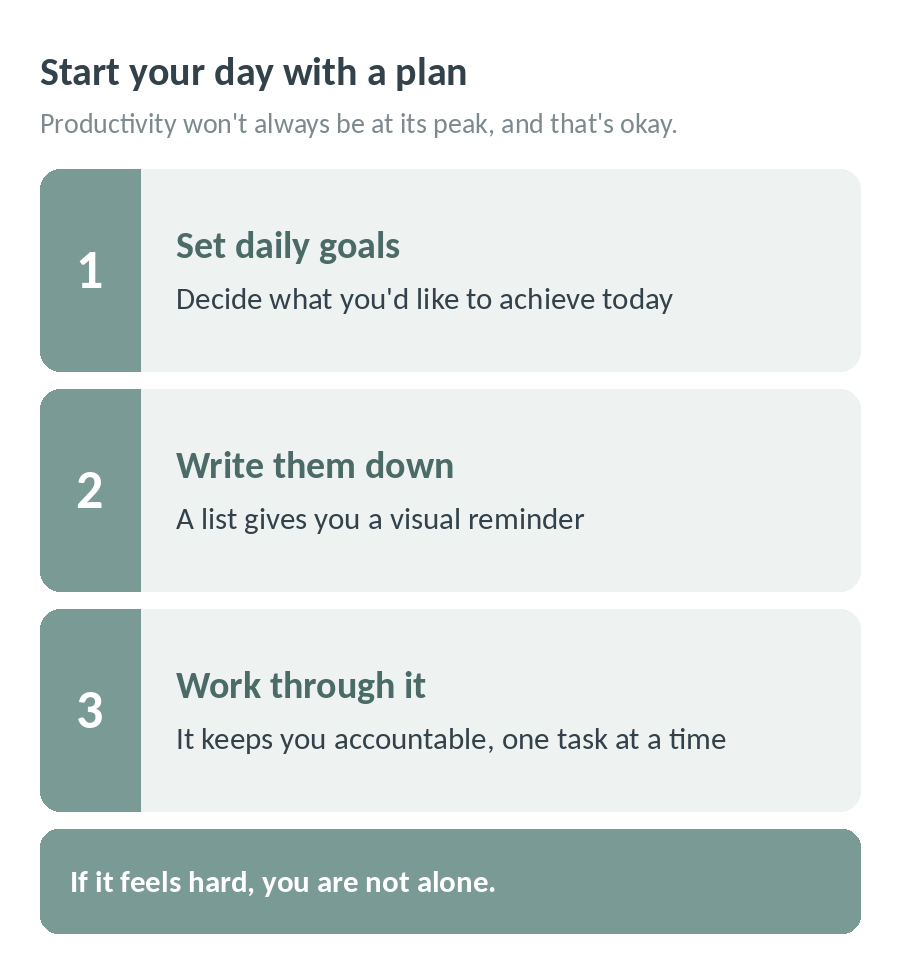
  1. Start your day with a plan and a schedule: It is important to recognise that these are not normal times and individual productivity is likely to be not at its peak right now. So, setting daily goals with a list of things you would like to achieve in a day is likely to increase accountability and give you a visual reminder to work on achieving the tasks you have set on your plan.
  2. Squeeze in shorter bouts of activity. By planning when you will work and when you will relax can help you to manage a healthy work-life balance at home. Exercise doesn’t have to be long or for hours. Short bouts of exercise are equally beneficial, and often serve as motivation to exercise more. If you have a busy day, schedule in two ten or fifteen-minute workouts. Or make it a habit to do a round of push-ups in between online meetings. Notice how good exercise makes you feel. You’re much more likely to exercise regularly when you take a moment afterwards to focus on how good you feel.
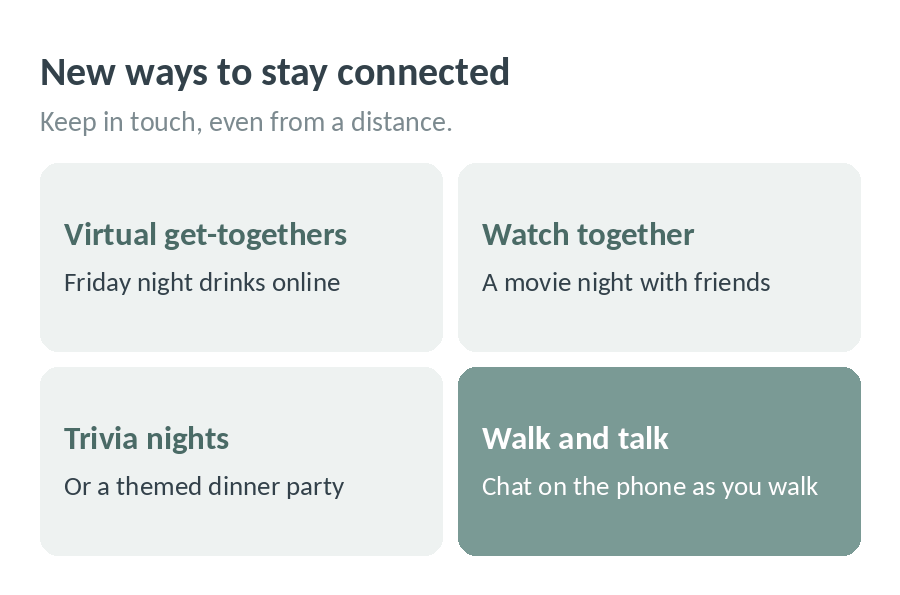
  3. Think of innovative ways to stay connected socially: Why not schedule virtual get-togethers with your friends? Ideas like Friday night drinks, Netflix parties, virtual trivia nights or even group dinner parties, where you all decide on a theme, share recipes and eat together. You could also make a regular date to chat on the phone while each of you walks around your neighbourhood.
  4. Be kind to yourself: Give yourself small rewards when you accomplish a task or goal. Having something to look forward to makes it easier to stick to your plans and maintain motivation. You may find that some days you are highly motivated and get through more tasks than you had planned, but other days you have no focus at all. It’s okay, nothing is normal right now, and we all need to listen to ourselves.
  5. Looking after your mental health: If you are feeling down, anxious, or depressed more than occasionally, this can interfere with your motivation and general health and wellbeing. Ensure that you are getting enough sleep and prioritising your mental health. If the feelings continue to persist, it’s okay to reach out for support.

Through these tough times, it can be hard to stay motivated, just remind yourself that this time will eventually pass, set realistic goals for yourself and take the time to look after yourself.

Remember it’s good to reach out for support. If you are going through difficulties and need to find your inner strength, why not give us a call today? Our team of highly skilled and well-experienced Psychologists are here to help.

Aanchal Sood smiling, in a portrait photograph

Our Blog Author
This post was written by Aanchal Sood, Senior Psychologist and Supervisor at Your Mind Matters. Aanchal works with adolescents, adults and couples on anxiety and mood disorders, grief and loss, trauma, adjustment and relationship difficulties, and is fluent in Hindi and Punjabi. Meet our team.

Coping and Managing with Workplace Stress

An office where one person pauses at their keyboard while colleagues move past out of focus

The workplace environment is rapidly and constantly changing. Online platforms, digital tools and smart devices make work more portable and professional lives more accessible than ever. Whilst these devices are intended to simplify things, they also make professional and personal lives more stressful. It has become all too easy for work to be a 24/7 pursuit. The number of Australian workers stressed because of technology has increased by 27 per cent since 2016, according to a 2017 workplace survey from Reventure.

With organisations increasingly putting a strong emphasis on employee productivity, many workers are faced with long hours, unrealistic workloads and looming deadlines. The pressure to be ever-available and ultra-responsive could be having an adverse effect on the health and productivity of employees.

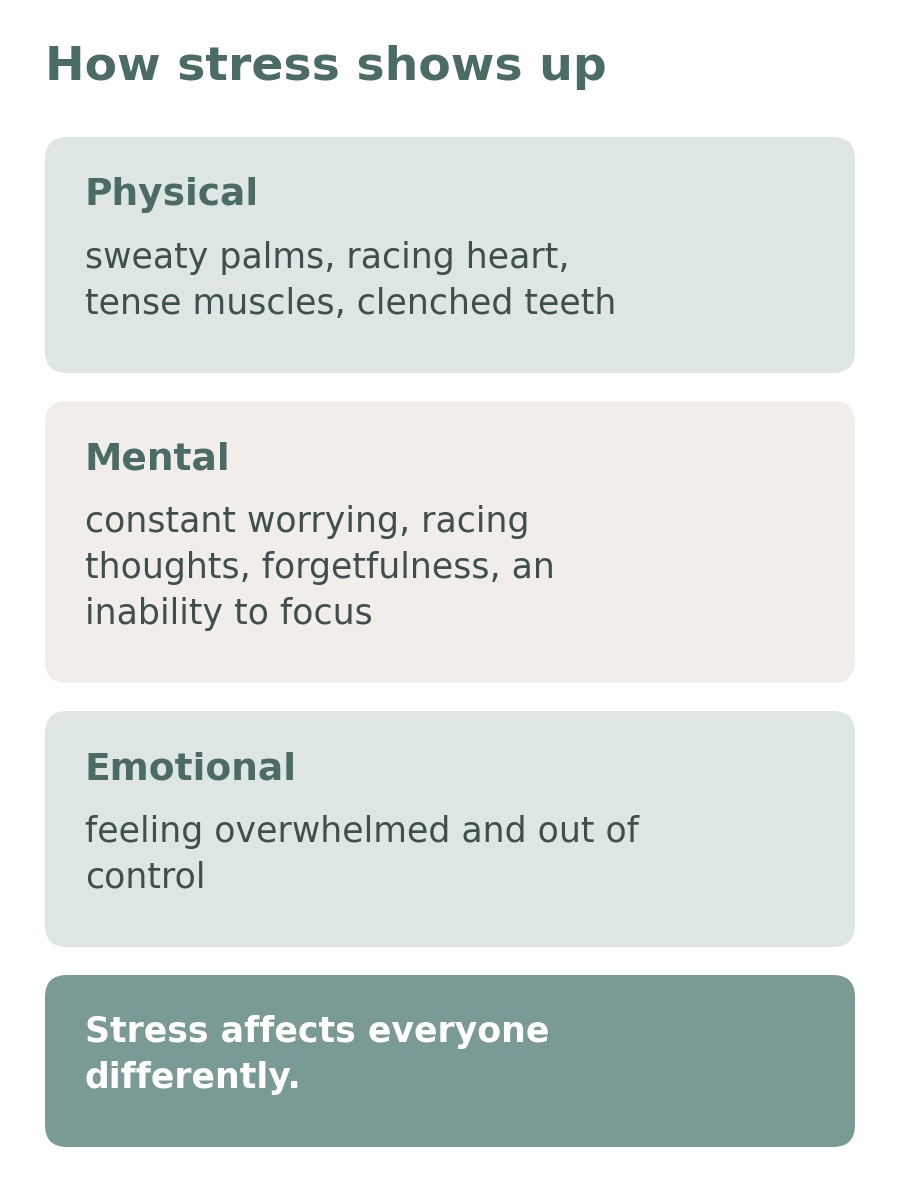
Stress affects everyone differently, but there are common symptoms:

  • Firstly, there are the immediate physical symptoms, like sweaty palms, racing heart, tense muscles, clenched teeth, high blood pressure, and low energy.
  • Then there are the mental symptoms like constant worrying, racing thoughts, forgetfulness, an inability to focus, and being overly pessimistic.
  • Lastly, and probably most disruptive to the ability to work, is the emotional impact of workplace stress. Stress causes people to feel overwhelmed and out of control. It is easier to become agitated and frustrated, thus making workplace relationships more difficult. Decision making, focussing and quieting down racing thoughts become a struggle. All of these can lead to a loss of self-esteem and confidence, which in turn leads to procrastination and a loss of motivation.
Diagram of how workplace stress shows up: physical, mental and emotional symptoms

According to statistics provided by health insurance provider Medibank, 3.2 days are lost every year per worker due to stress-related absenteeism. The total cost on the economy weighs in at a staggering $14.81 billion per year, with more than $10 billion being a direct cost to employers. These statistics highlight the importance of maintaining mental wellbeing in the workplace.

So here are some tips that can assist in the reduction of work stress:

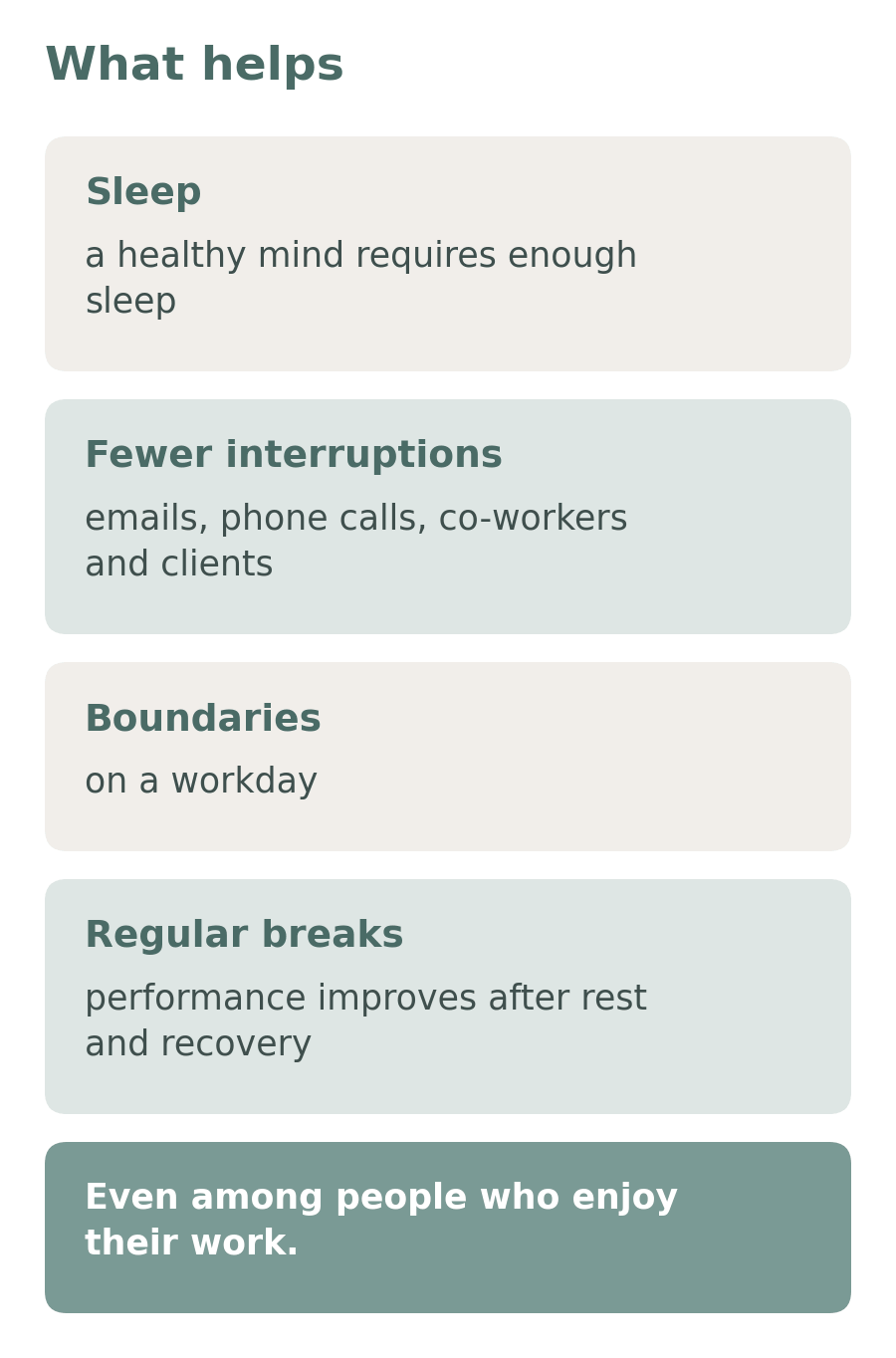
  • Getting enough sleep — a healthy mind requires enough sleep. Most would agree that adequate sleep is the most important element in reducing stress and living a balanced lifestyle.

Keeping to a healthy sleep routine, reducing use of electronics before bed and simply an earlier bedtime are all recommended as a means of ensuring adequate sleep.

  • Reduce the number of interruptions at work — emails, phone calls, co-workers and clients, many of us can relate to being bombarded from a multitude of sources vying for our attention throughout the day. The high number of distractions encountered in the modern workplace is a factor in workplace stress.
Diagram with four things that help with workplace stress: sleep, fewer interruptions, boundaries and regular breaks

Allocating structured time periods to deal with tasks requiring communication and collaboration, would enable one to better manage and control interruptions, while setting aside the rest of the day to concentrate on the task at hand.

  • Setting boundaries on a workday — continually increasing workload, changes to work environment and unrealistic work expectations increase the chances of burnout, which is characterised by constant fatigue, cynicism, feelings of disenchantment and loss of motivation.

Without clear boundaries, the temptation to continue working is more difficult to contain. Reducing the temptation to overwork requires the identification of factors contributing to the need to put in long hours. These can include:

  • Unrealistic deadlines;
  • Scheduling interruptions and work across timelines;
  • Readily available access to communication (email, phone, chat).

Once identified, these factors can be changed. This may include scheduling work and rest times, having a discussion with management about reasonable workloads and expectations and controlling technology access.

  • Ensuring that regular breaks are taken — research shows workplace performance improves after a period of rest and recovery, even among people who enjoy their work.

Whilst taking breaks is important, taking the right types of breaks is also significant. Some suggestions include: Going outside where practical since fresh air has been found to increase energy levels; resting eyes from all of the screens; doing some brief stretching exercises; eating the right food and drinking plenty of water.

There’s no escaping the fact that work is a stressful place. Yet it’s when that stress becomes a constant presence in our lives that we need to start worrying about it. Too much exposure to stress makes us worse at our jobs. It puts us at risk and can have serious consequences for our physical health.

If you would like some support with better managing work stresses, why not give us a call today? Our team of highly skilled and well-experienced psychologists are here to help. 

References

Author Unknown (2019). Burnout: A Growing Mental Health Crisis Employers Are Regrettably Dismissing. Corporate Wellness Magazine. July 17, 2019

McMillen, Lindsay (2017). Industry Insights. Reventure. https://www.convergeinternational.com.au/docs/default-source/research/a-future-that-works—industry-insights.pdf?sfvrsn=fc34b56e_2

Medibank (2019). Are our jobs making us more stressed than ever? 21/1/2019

Smallwood, J. and Schooler, J. (2015). The Science of Mind Wandering: Empirically Navigating the Stream of Consciousness. Annual Review of Psychology, Vol. 66:487-518.

Lana Lubomirska wearing glasses, in a portrait photograph

Our Blog Author
This post was written by Lana Lubomirska, Senior Psychologist at Your Mind Matters. Lana works with children, adolescents and adults, using evidence-based therapies to address anxiety, depression, relationship issues and educational stress. Meet our team.

Book an appointment
📅 Book an Appointment