📅 Book an Appointment

How to Succeed in Achieving Your Goals: A Quick Guide to Changeology


Photo by Annick Saminaden

What you get by achieving your goals is not as important as what you become by achieving your goals.

Henry David Thoreau

Change is a Process not a Single Event or Action

Humans are capable of impressive personal accomplishments even in the midst of deep suffering. The backbone of all goals is embracing self-change. Whether making a new habit stick (e.g., going to the gym) or making a permanent transformative life change (e.g., ending long-term addiction), navigating the process of change can be daunting.

The science of behaviour change (Changeology) outlines a more efficient and effective path to successful change and goal achievement, based on 40 years of extensive psychological research (Norcross, 2013).

“If you want to live a happy life, tie it to a goal, not to people or things.”

Albert Einstein

SMART Intrinsic Goals Provide Effective Direction to the New You

Define SMART goals to maximise your chances of success (Moore, 2019; Sutton 2020). Make your goals relevant to you and your life priorities. Intrinsic goals have deeply rooted personal meaning and align with our core values and need for growth and fulfilment. Meaning provides a sense of direction, purpose and satisfaction in life.

Specify realistic goals (and subgoals), differentiating between short-term and long-term goals. Ensure goals are within your control and are expressed in a healthy/positive direction. Measure your goals (e.g. number of cigarettes smoked) to track progress. Successful self-changers teach us that it takes 90 days to create lasting behaviour change (Norcross, 2013).

“ A goal without a plan is just a wish.”

Antoine de Saint-Exupéry

Stage of Change Predicts the Probability of Long-term Success

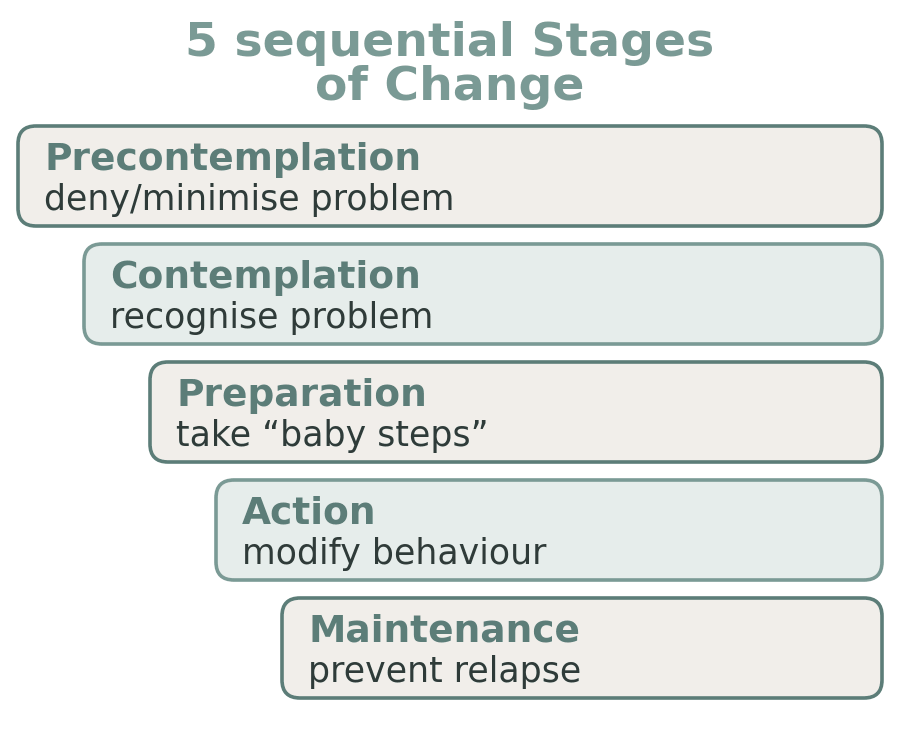
People’s journey of change typically unfolds over time across 5 sequential Stages:

Precontemplation (deny/minimise problem; no intention to change),

Contemplation (recognise problem; ambivalent about change; no commitment to act),

Preparation (intend to take action/ take “baby steps”),

Action (modify behaviour, experiences and/or environment to overcome problem),

Maintenance (prevent relapse and stabilise behaviour change over time).
People spend varying time in each stage, but complete specific activities at each stage to progress to the next stage (Transtheoretical Model). The further along you are in the stages, the more likely you are to succeed. Assess My State of Change (Dr John Norcross, ChangeologyBook.com) helps identify your readiness for change.
Key to Efficient Change and Goal Achievement: Doing the Right Thing at the Right Time

Dr Norcross’ scientific approach to realising goals involves traversing 5 sequential Steps over a period of 90 days. At every step, goal progression is tracked (e.g., graphing cigarettes smoked). This maintains focus, provides feedback and helps reward your achievement.

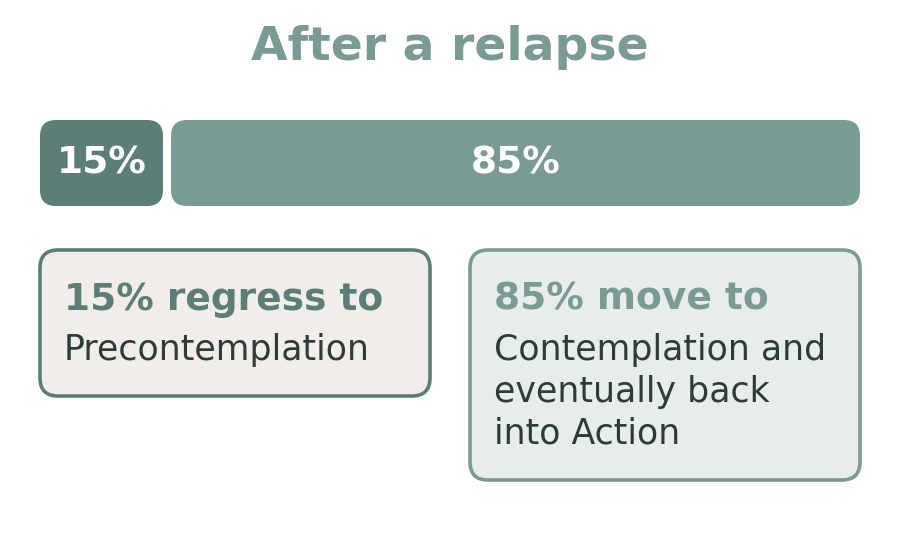
People derail at any step. Some remain in Contemplation confronted by unrealistic expectations/self-defeating thoughts. Others rely excessively on motivation/ willpower when needing skills to take Action. Research shows that 15% of individuals who relapse regress to Precontemplation while 85% move back to Contemplation and eventually back into Action. Moving from Contemplation to Action doubles a person’s chances of succeeding (e.g., sobriety).

Successful self-changers typically recycle through the Steps in a spiral path, before reaching their end goals and creating lasting change (e.g., maintaining sobriety). Focus on meaningful goals that place you further along in the 5 Steps process.

The key to success involves identifying your Step (stage) and implementing proven strategies/change catalysts specific to that Step, in order to move to the next Step (Step matching).

Norcross’ 5 Steps and Strategies to Achieving Your Goals:

1. Psych: Get Ready (Stage: Contemplation; Week 1&2)

Outline intrinsic goals and define the New You (without consequences of the problem behaviour). Increase motivation to change.

Catalysts: Raising awareness of problem behaviour/ (un)desirable consequences and (New) You. Harnessing emotions pulling you away from change/towards a better ideal future. Redirecting these emotions (e.g., fear/ guilt/ shame/regret) to propel you forward. Committing- reviewing Pros/Cons of change; declaring your goal to another person.

2. Prep: Prepare Before Leaping (Stage: Preparation; Week 2&3)

Define SMART Goals. Understand the behavioural chain of the problem behaviour (triggers /behaviour/consequences). Build commitment before making your goal public. Choose your start day, identify support people, take “baby steps” and prepare for the launch.

Catalysts: Committing (e.g., practicing healthy alternative behaviour to increase self-efficacy); Finalising Action Plan with your Change Team (1-4 committed/supportive people).

3. Perspire: Take Action (Stage: Action; Week 2-8)

Develop healthy alternatives to the problem and build new behaviours. Create a flourishing environment/Change Team.

Catalysts: Rewarding yourself for keeping on track. Countering (doing healthy opposites of the behavioural problem, e.g., confronting dreaded situations); Controlling your environment (e.g., avoiding high-risk situations/people that can rekindle problem behaviour); Maintaining contact with Change Team (e.g., to keep a positive outlook, cope ahead, practice skills-Saying NO to requests that regress to old behaviour).

4. Persevere: Manage Slips (Stage: Maintenance; Week 8-12)

Minimise exposure to triggers that precipitate a slip; Recognise a slip (lapse; single unwanted event) need not become a fall (relapse; end goal is abandoned /reverting back to old patterns); Forge towards your goal despite unavoidable self-defeating thoughts/feelings/setbacks. Reach out to your Change Team for support.

Catalysts: Responding constructively after a slip; Preparing for the next time you slip (Create My Slip Card; Dr John Norcross, ChangeologyBook.com).

5. Persist: Maintain Change (Stage: Maintenance; Week 12 and beyond)

Master relapse prevention skills to maintain the New You. Have backup plans for unavoidable slips. If a rare slip occurs, understand the behaviour/situation, and shift any self-blame to lessons learnt and respond constructively to steer yourself back on track towards your goal.

Catalysts: Sustaining new behaviour (value/intrinsic meaning act as reinforcer); Enhancing self-efficacy across high-risk situations; Understanding process of change; Distinguishing between when to exit or persevere for a lifetime. Exit if temptation to regress/relapse across triggers is very low, self-efficacy to maintain the new behaviour is high across situations and a healthy lifestyle precludes the old problem behaviour.

“ The journey of a thousand miles begins with one step.

Lao Tzu

Persevere Towards Your Goals with One Small Step at a Time

Through the science of behaviour change, you understand why your efforts derail(ed) and how to steer yourself back on track towards successful goal achievement. You learn to celebrate progress, build self-efficacy and develop self-compassion. You also learn to harness emotions to turn your fears into fuel and feel empowered in your ability to make meaningful, lasting change.

Whatever unique goals or personal change you are seeking, our team of highly skilled mental health professionals at Your Mind Matters is here to support you.

Resources

Changeology Resources – Book, ChangeologyBook.com Free Resources, Podcast, Youtube

Norcross, J. C. (2013). Changeology: 5 Steps to realize your goals and resolutions. New York: Simon & Schuster.

Dr John Norcross- ChangeologyBook.com (e.g., Self-Assessments- Assess My State of Change, Self-Change Exercises-Create My Slip Card).

ChangeologyBook.com

Dr John Norcross – Proven Methods to Define Your Goals.

Proven Methods to Define Your Goals

Dr John Norcross – 5 Basic Steps of Change.

5 Basic Steps of Change

5 Stages of Change from the Transtheoretical Model.

5 Stages of Change from the Transtheoretical Model

Podcast- Dr John Norcross

How to Make Lasting Changes in Your Life with John Norcross.

How to Make Lasting Changes in Your Life

Goal Setting and Achieving Goals -Defining SMART Goals, Free Worksheets

Moore, C. (2019, May 27). How to Set and Achieve Life Goals The Right Way.

How to Set and Achieve Life Goals The Right Way

Sutton, Jeremy (2020, July 01). Goal-Setting: 20 Templates & Worksheets for Achieving Goals.

Goal-Setting: 20 Templates and Worksheets

Science behind Goals, Values, Meaning, Behaviour Change and Flourishing

Locke, E. A., & Latham, G. P. (2002). Building a practically useful theory of goal setting and task motivation: A 35-year odyssey. American Psychologist, 57(9), 705.

Maslow, A.H. (1943). A theory of human motivation. Psychological Review, 50(4), 370.

Prochaska, J. O., & DiClemente, C. C. (1982). Transtheoretical therapy: Toward a more integrative model of change. Psychotherapy: Theory, research & practice, 19 (3), 276-288.

Norcross, J. C., Mrykalo, M. S., & Blagys, M. D. (2002). Auld Lang Syne: Success predictors, change processes, and self-reported outcomes of New Year’s resolvers and nonresolvers. Journal of Clinical Psychology, 58(4), 397-405.

Norcross, J. C., Krebs, P. M., & Prochaska, J. O. (2011). Stages of change. Journal of Clinical Psychology, 67, 143-154.

Seligman, M. E. (2004). Authentic happiness: Using the new positive psychology to realize your potential for lasting fulfilment. Simon and Schuster.

Seligman, M. E. (2012). Flourish: A visionary New Understanding of Happiness and Well-being. Simon and Schuster.

Annick Saminaden smiling, in a portrait photograph

Our Blog Author
This post was written by Annick Saminaden, Senior Psychologist at Your Mind Matters. Annick works with young people and adults on stress, grief and loss, trauma, self-esteem, assertiveness and perfectionism, drawing on Cognitive Behaviour Therapy, Acceptance and Commitment Therapy, Dialectical Behaviour Therapy, Schema Therapy and Motivational Interviewing. Meet our team.

Importance of Self-Compassion

At some point in our lives, we all have heard the phrase that ‘charity begins at home’! Most of us accept it and even preach it to others when the opportunity for sharing wisdom arises (yeah, we are good at that!). The essence of the above phrase is seated in the value of compassion or kindness towards others. Compassion is empathy, kindness and understanding for others during suffering or challenging times.

So, I have a question for you – have you ever heard that ‘compassion starts with self’? Probably not, aside from the fact that I made the phrase up. Chances are that self-compassion is an alien concept and only comes into our lives through social media memes. So let me give you a brief snapshot and advocate the case for ‘self-compassion’ as an essential in our lives.

A simple Google search will define ‘self-compassion’ along the lines of empathy, understanding and kindness towards one’s own self, when big or small life challenges happen. Kristin Neff, the world’s leading researcher on self-compassion, has identified three main components to it:

  1. Self-kindness vs self-judgement: treating ourselves with kindness and understanding when we fail, suffer or feel inadequate, as opposed to ignoring our needs or belittling ourselves.
  2. Common humanity vs isolation: remembering that everyone fails and suffers at times and that we are not the only ones.
  3. Mindfulness vs over-identification: taking a balanced approach to our challenges and emotions, without over-identifying with heavy emotions or situations.

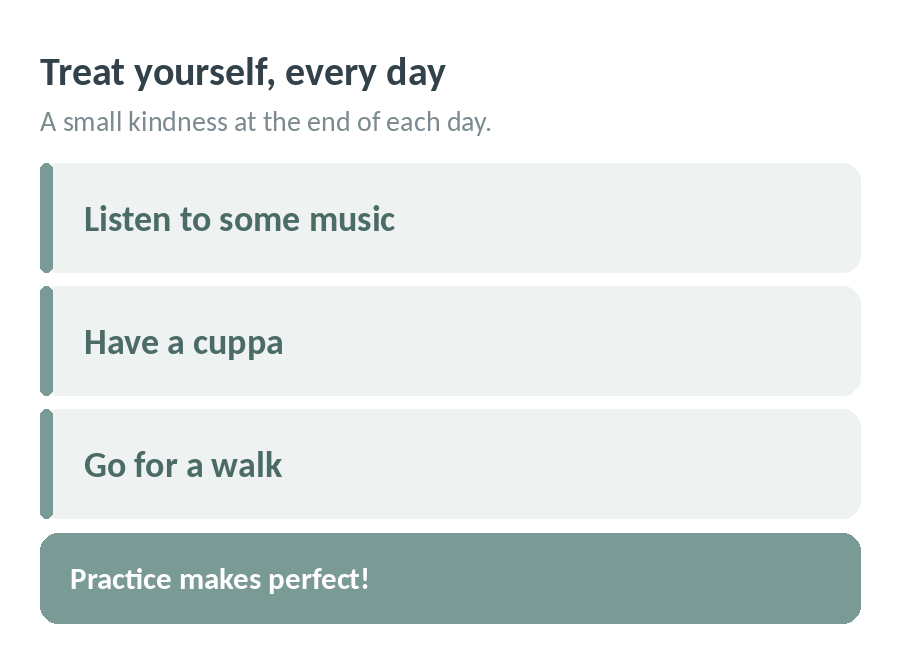
Kristin’s research has contributed significantly to understanding the importance of practising self-compassion in daily life and more so when experiencing mental health challenges. Self-compassion also forms a crucial part of my own therapy model and aims at supporting and empowering clients, by helping them connect and understand their own emotions and situations. A simple activity that I encourage clients to do is to treat themselves at the end of the day, each day. This can be as simple as listening to some music, having a cuppa or going for a walk. Practice makes one perfect!

So, I invite you to explore self-compassion for yourself and incorporate it in small ways within your daily life. Self-compassion will be the strongest script that you can have for yourself. If you would like to work on further developing your skills, our psychologists at Your Mind Matters will be happy to assist you.

Source: self-compassion.org

Our Blog Author
This post was written by Prabha Mishra, formerly a Psychologist at Your Mind Matters. Prabha worked with clients using psychoeducation and research-based interventions including Cognitive Behavioural Therapy, Acceptance and Commitment Therapy and play-based therapy. Support with self-compassion continues to be part of our services. Meet our team.
Maintaining emotional wellbeing during the COVID-19 pandemic

This post was published on 14 April 2020, during the first COVID-19 lockdown in Victoria. It is kept here as it was written. The restrictions described are no longer in place, and some of the apps mentioned are no longer available. Telehealth appointments continue to be part of our services.

2020 sure hasn’t turned out like we envisioned. What started as a regular year, soon turned into something very different. During the COVID-19 pandemic we have all been faced with uncertainty and a level of fear and anxiety. Coupled with that are the frequently changing guidelines and rules we have been asked to adhere to and this can easily lead to feeling overwhelmed. Life as we know it has changed, and what we deemed as “normal” is no longer relevant, well for the short term that is! We are all in uncharted territory. As a community, we know that we must remain home, to reduce the curve but with that comes a lot of change and adjustment.

Tips to help with maintaining emotional wellbeing whilst in isolation

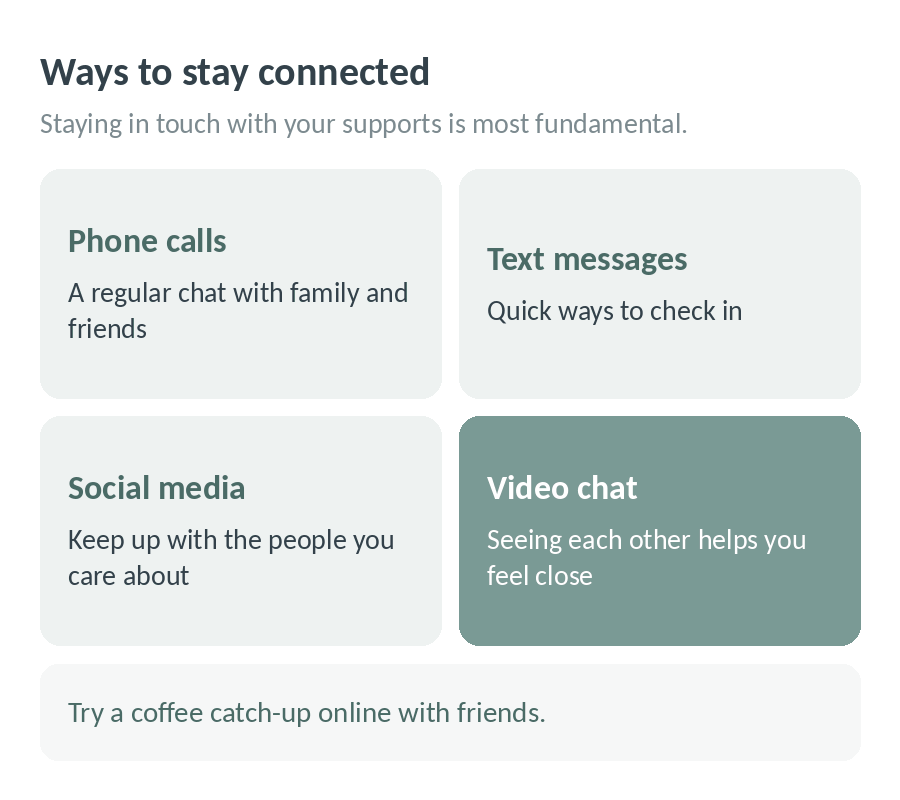
  • Stay socially connected. This is most fundamental! Whilst social distancing inhibits us from seeing friends and family, that doesn’t mean we need to disconnect from our supports. Stay connected to family and friends through regular telephone conversations, text messaging, social media or video chat. My personal preference is video chat, as you can see the person and it helps to form that personal connection. There are lots of group video chat platforms and apps that are free to download, e.g. Zoom, Skype, Houseparty. Why not schedule in a coffee catchup with mates online or play online games together? I was recently introduced to the Houseparty app which I found was a great way to chat to several friends at once and we could play in-built games together through the app which included trivia and the app’s own version of Pictionary. It was great fun!
  • Establish a daily routine. Routines are beneficial as they provide structure, aid us to be more productive and efficient, encourage good habits and reduce stress. Although your regular routine may not be applicable to the current situation, establishing a new routine or maintaining a form of your usual routine is still important. Allowing yourself to fall out of routine can lead to increased distress and feelings of disempowerment. Sticking to a routine such as a regular bedtime and awakening time, scheduling in time for work and study as well as planning enjoyable activities to look forward to each day, regular exercise, and opportunities to relax, can help to increase your sense of control.
  • Exercise. Exercise is a natural way to reduce stress and is great for physical and emotional wellbeing! Try and get outdoors for a walk, jog, run or bike ride (remembering to adhere to social distancing regulations). Ask other members in your household to join you or take the kids for a bike ride or scooter ride. If you have some exercise equipment at home, try to schedule in time each day for a workout. There are lots of apps available, online resources, and YouTube exercise clips you can access. For those with an existing gym membership, your gym may be offering online sessions. Why not make the most of your membership and give it a go?
  • Relaxation. Set aside time each day to engage in a relaxing activity like a nice bath, reading or a jigsaw. You may wish to try mindfulness meditation (the Smiling Mind app is free and has lots of guided meditations to choose from), some gentle stretching, or calm breathing. For more ideas on various relaxation strategies, see my post on incorporating relaxation into everyday life.
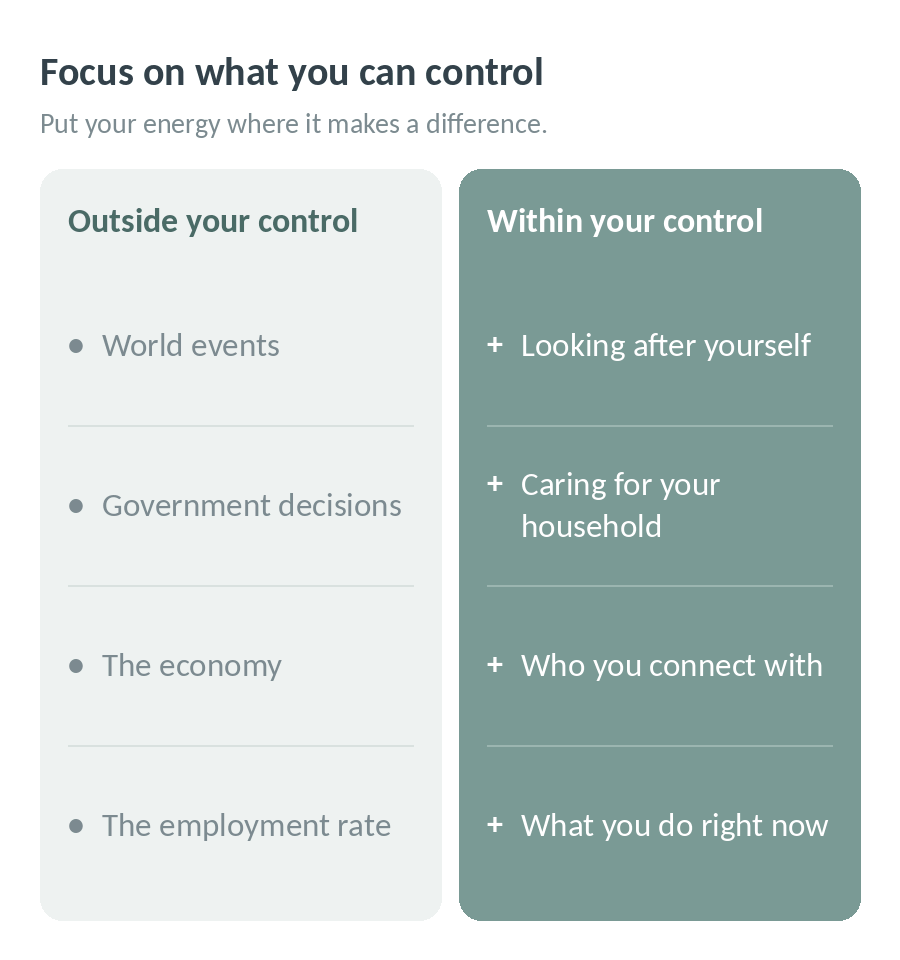
  • Focus on what is within your control. Let’s face it, there is so much that is outside of our control at the moment. No, we cannot control the COVID-19 pandemic, the regulations the government has put in place and is enforcing, the impact the pandemic has had on the economy, employment rate, the way we live our lives — the list goes on. I can’t stress how vital it is to focus on what is within your control, what you can do and the choices you can make. Concentrate on how you can look after yourself and others in your household, who you can connect with and offer support to (this could include family, friends or the community), and things you can do right now, in the moment, that help to enhance your life or that of others.
  • Make it fun. Although there are likely other things you’d prefer to be doing, rather than staying at home all day, take the opportunity to make your time at home fun. Some ideas include:
    • Setting up a tent in the backyard and making a bonfire — you can even roast some marshmallows!
    • Scavenger hunt
    • Games night (board games, cards, video games and so on)
    • Indoor picnic
    • Movie marathon
    • Art and craft activities
  • Manage your exposure to news and media coverage. There is heaps of information out there about COVID-19 and news coverage on every channel. Every time you turn on the TV, radio station, or scroll through social media, you’re likely to come across some form of information about COVID-19 and this can be overwhelming. Stick to reputable sources which can provide you with accurate information.

I hope these tips are helpful in guiding you through this challenging time. Stay safe and healthy. I know it doesn’t seem like it right now, but as the Buddhist proverb says, “this too shall pass”.

If you would like some support, our team of psychologists are here to help. Your Mind Matters Psychology Services offers counselling support through telehealth as well as in person. Call us on (03) 9802 4654, book an appointment online, or read more about telehealth appointments at Your Mind Matters.

Maria Kampantais seated and smiling

Our Blog Author
This post was written by Maria Kampantais, Senior Clinical Psychologist at Your Mind Matters. Maria has a particular interest in working with clients experiencing anxiety disorders and past trauma. Meet our team.

How YMM can support you during the COVID-19 pandemic

SUPPORTING OUR COMMUNITY AND CLIENTS

In the wake of community concerns around COVID-19, we’re committed to providing our clients with ongoing support, so that you can continue working on your health and well-being.


WHAT CAN YOU (AND WE) DO TO REDUCE RISK OF INFECTION?
We are committed to ensuring our team are healthy when they are at work. We are equally committed to reducing your risk of exposure to illness while attending your appointments with us.

We are following Department of Health guidelines around hygiene and encourage you to do the same:

  • Cough into your elbow
  • Throw away used tissues
  • Wash hands for a minimum 20 seconds regularly, or use hand sanitiser often
  • Stay home if you are unwell
  • Follow the guidelines and recommendations set by the Department of Health and self-exclude if you have been to any of the countries with exclusion periods or have been in contact with someone with confirmed or suspected COVID-19. We also ask that you not attend the practice when you are unwell regardless of whether you think this may be COVID-19 or a cold or flu

We are ensuring team members remain at home if they are unwell.

Likewise, we ask that you reschedule your appointments with us at the first sign of ill-health.


WHAT IF MY CLINICIAN IS ISOLATED BUT WELL ENOUGH TO RUN MY SESSION?
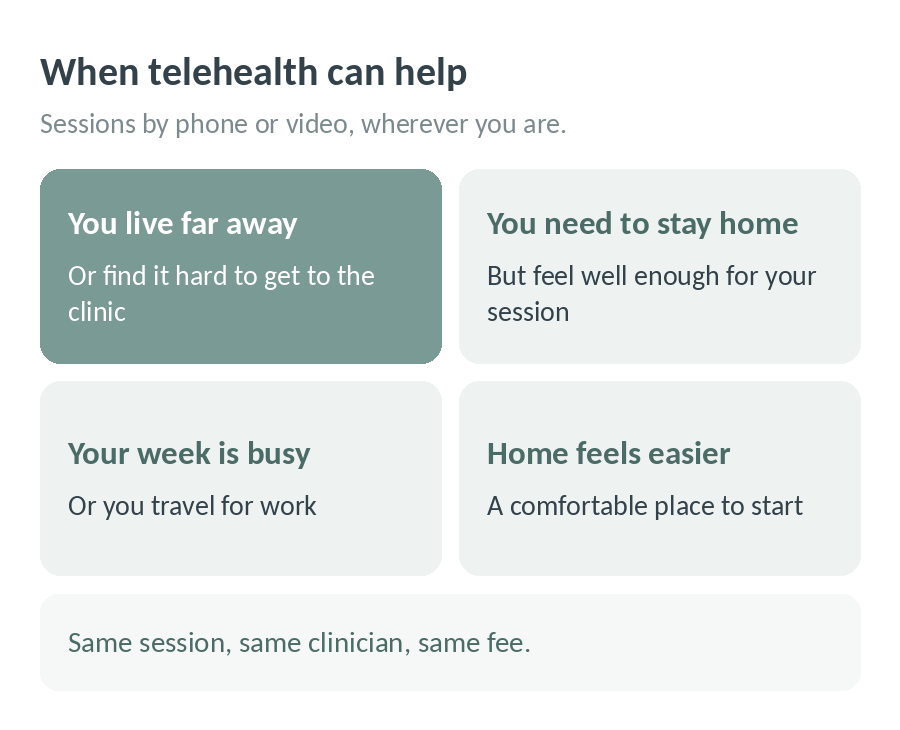
Our clinicians are experienced at offering sessions via telephone or video-chat (telehealth). If your clinician is isolated, but well enough to conduct sessions, you will be offered a telehealth consultation.

WHAT IF I’M ISOLATED BUT WELL ENOUGH TO HAVE MY SESSION?
If you need to cancel your appointment due to isolation, you will be offered teleheath options as an alternative to cancelling.

HOW ARE TELEHEALTH SESSIONS CHARGED?
Sessions fees cover the time spent with your clinician. Therefore, we charge our normal fee for telehealth sessions. NDIS self-managed or Plan Managed clients are able to use their funds for phone and online sessions also. Private clients (those who pay upfront, with or without a Medicare rebate), please check with your private health insurer to see if you can access a rebate under these circumstances.

HOW DO I PAY FOR A TELEHEALTH SESSION?

You can pay for sessions via credit card, which is stored in our secure encrypted system (using Stripe with Power Diary), or we can send you an invoice and ask that you transfer funds as soon as possible (within 48 hours).

If you have any questions please call us on 03 9802 4654.

HOW DO I PREPARE FOR ONLINE SESSIONS?

Prior to your appointment:

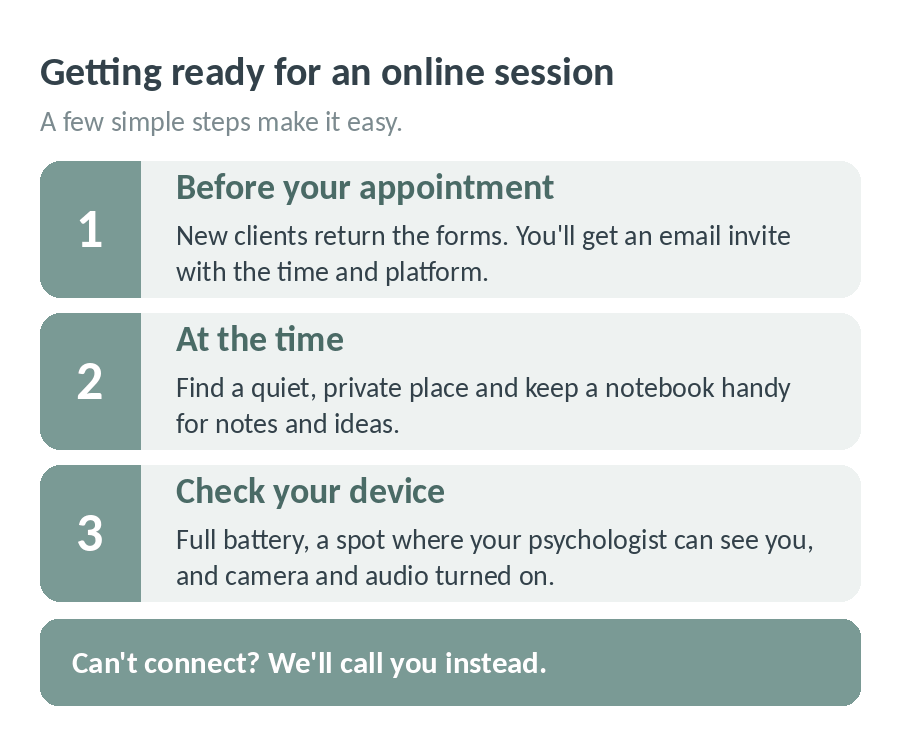
If you are a new client and haven’t signed our new consent form, our admin team will send you some forms to complete. Please print, sign, and email back to us. You will need to return this prior to your first online session. Your Psychologist will email you an invite confirming the time of your appointment, and information regarding what telehealth platform they will use. If they use Zoom, you will receive instructions on how to use it. Here is a little video that outlines how to join a zoom session https://youtu.be/vFhAEoCF7jg.

If they use PowerDiary, all you need to do is click the link at the time of your appointment. So easy!

Make sure at the time of your appointment, you have a quite, private place, and ideally have a notebook with you, so you can take down any notes, ideas, or insights.


Troubleshooting:

  • Make sure that you have a full battery in preparation
  • Practice placing the phone, iPad, laptop or computer in a suitable location so that your psychologist can see you
  • Make sure the camera and audio are turned on (it is a good idea to practice before your scheduled session time)

 If at the time of the session, you aren’t able to connect, we will call you instead!

FAQ ABOUT TELEHEALTH

What if I don’t have the same connection online or on the phone as I do in person?

This is a concern that most of us have had, which is understandable when we are used to face to face interactions. However, most clients report that after a few minutes, and they adjust to the new interface and way of connecting, that video-chat is just as effective! Of course, this may not be everyone’s experience, but it certainly can work under the right circumstances and is better than no support at all.

The first session may be a bit strange and you may be more focused on how the camera is angled or how your voice sounds etc. but once you have settled in, you will likely notice that it feels the same. If it doesn’t, tell your practitioner and work through why and what is happening for you around the connection.

I am not tech savvy, is it complicated?

We use Power Diary (our practice management software) or Zoom (similar to Skype or Facetime, but more secure, check out their privacy policy https://zoom.us/privacy/) and set up the meeting on our end. We then email you a link with any information you need to sign in. 

If we login to the meeting and cannot see you online, we will give you a call. That way, if you are struggling to set up, we can help walk you through the steps. Having said that, if your device doesn’t wish to cooperate, we’ll chat over the phone instead.

Benefits

The beauty of telehealth is that you can be in isolation, and still access support! You don’t need to leave the house, and you can even stay in your PJ’s all day if you like (we don’t mind!) Given the current situation with social distancing as a response to COVID19, online therapy could be a game changer for anyone seeking support!

We truly hope that this pandemic is short lived, but in the meantime, we’re here to help. 

Please call us on 039802 4654 if you have any other questions.

Best wishes, stay safe, and we hope to see you soon!

From all of us at YMM Psychology. 

Accessing Support over our Christmas Closure

Christmas can be a challenging time of year for some of our clients, so we have gathered the support services available while our clinic is closed.

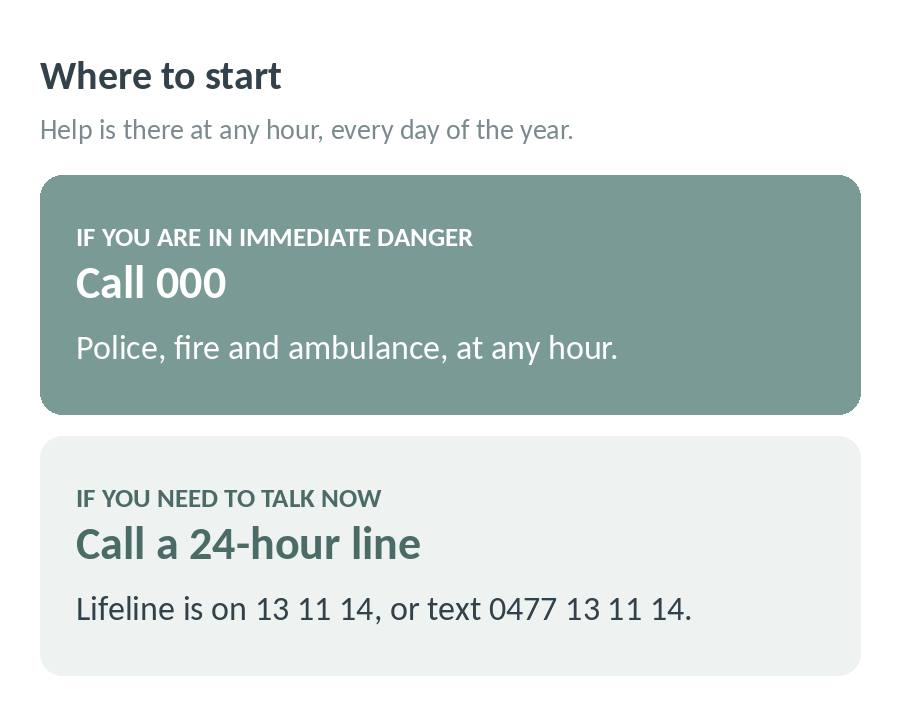
If you are in immediate danger

Call 000 for police, fire and ambulance, at any hour.

24-hour crisis support

  • Lifeline – call 13 11 14 or text 0477 13 11 14. Crisis support and suicide prevention, 24 hours a day, seven days a week.
  • Suicide Call Back Service – call 1300 659 467. Free professional counselling for anyone at risk of suicide, worried about someone, or bereaved by suicide. Available 24/7 for people aged 15 and over.
  • Beyond Blue – call 1300 22 4636. Support for anxiety, depression and related concerns, 24 hours a day.
  • 1800RESPECT – call 1800 737 732. Support for anyone affected by domestic, family or sexual violence, 24 hours a day.

Support for specific groups

  • Kids Helpline – call 1800 55 1800. Free counselling for children and young people aged 5 to 25, 24 hours a day.
  • headspace – call 1800 650 890. Support for young people aged 12 to 25 and their families.
  • MensLine Australia – call 1300 78 99 78. Counselling for men on mental health, family and relationship concerns, 24 hours a day.

Other things that may help

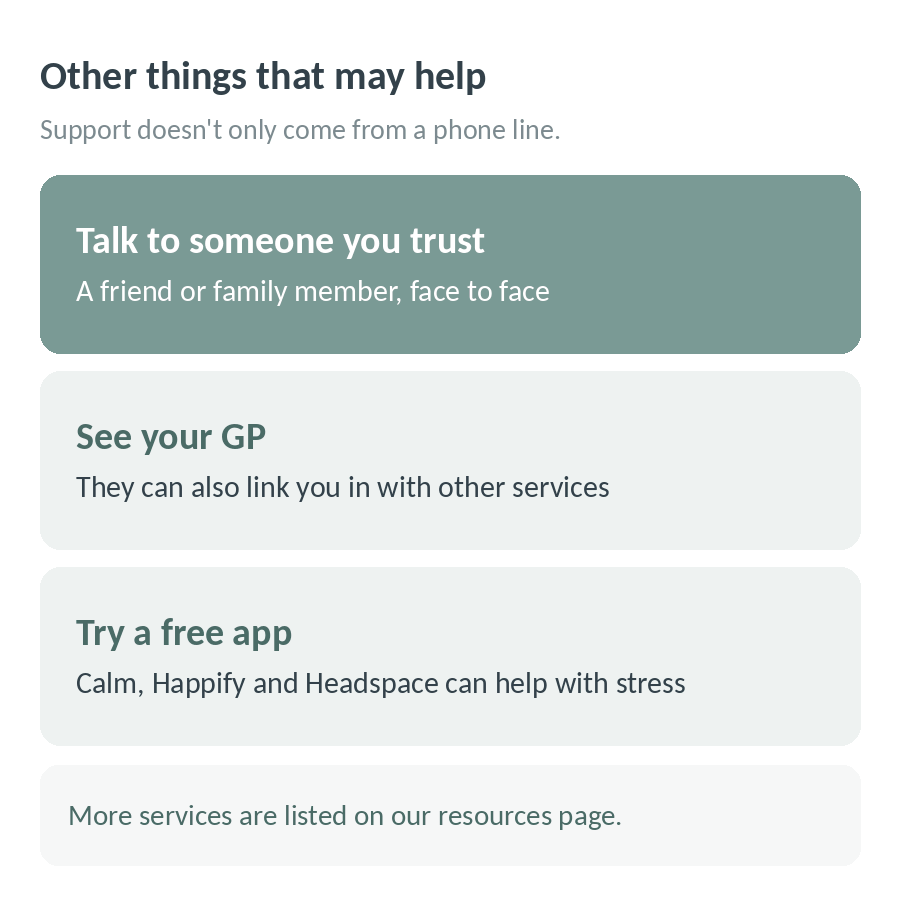
If you would rather talk face to face, speak with a trusted friend or family member, or book an appointment with your GP, who can also link you in with other services.

We also have a number of blog posts on self-care that you may find useful, and there are free apps designed to help with stress management, such as Calm, Happify and Headspace.

A fuller list of services is available on our resources page.

The Relationship Between Diet and Mood

Why is eating healthy also good for your mind and mood?

It’s a no brainer that eating healthy can improve your physical wellbeing. However, did you know that eating healthy can also improve your mental wellbeing? In this blog, we discuss some exciting research that suggest that what we eat can also affect how we think and feel.

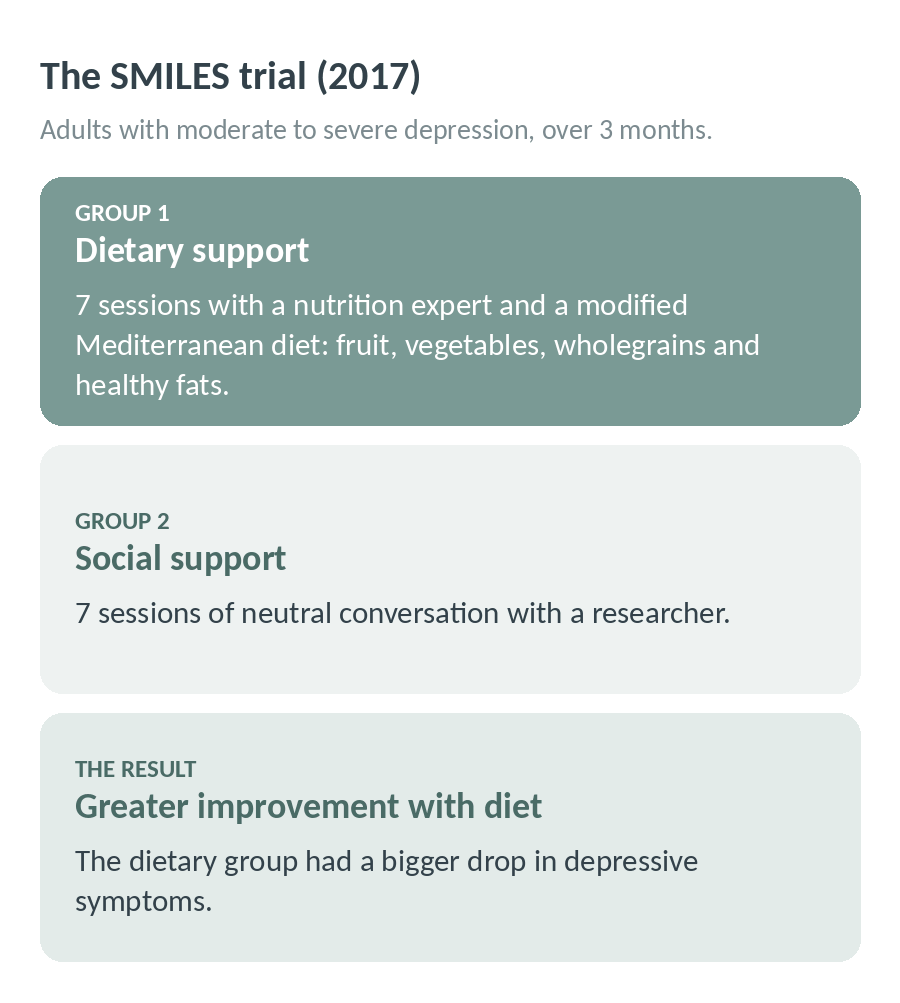
The Food and Mood Centre (Deakin University) recently published a ground-breaking study looking at the relationship between diet and depression. Participants diagnosed with moderate to severe depression were randomly allocated to receive either dietary support or social support group. The dietary group had seven consultation sessions with a nutritional expert and were encouraged to adopt a modified Mediterranean diet – lots of fruit, vegetables, wholegrains and healthy fats. The social support group had seven sessions with a researcher in which they engaged in neutral conversations. At the end of the 3-month trial, the results showed that the dietary group had a greater reduction in depressive symptoms compared to the social support group. Overall, this research provides strong evidence that dietary changes should be considered in the treatment of depression. 

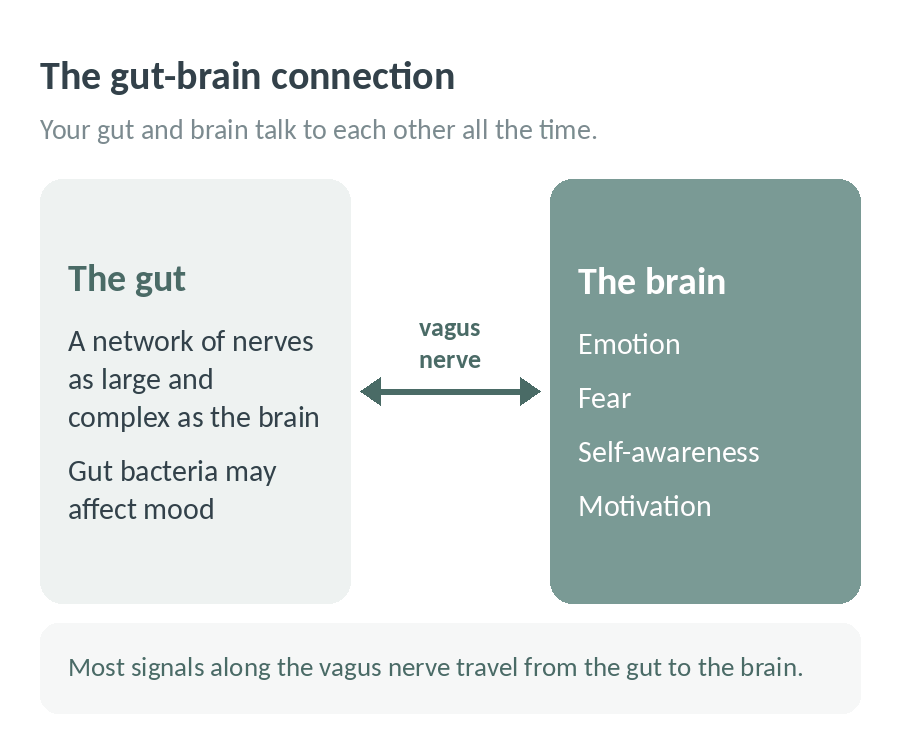
Now let’s look at two main reasons why changing diet can affect your mood. First, there is a lot of research which shows that beyond just digesting food, the gut can influence what goes on in our brain (Enders, 2015; Mayer, 2016). Scientists have found that the lining of the human gut wall contains a network of nerves that is as large and complex as the brain. This ‘gut-brain’ can talk to the brain through a vagus nerve and affect different areas in the brain that control emotion, fear, self-awareness and motivation. Also, most of the signals that travel along the vagus nerve come from the gut not the brain. Interestingly, scientists have found that stimulating the vagus nerve alone can make a person feel more anxious or relaxed. Therefore, in 2010, the European Union approved the use of vagus nerve stimulation for severely depressed patients that did not respond to conventional treatment. 

Second, recent research suggests that the type of bacteria in your gut can affect your motivation and mood. New antidepressants are often first tested on ‘depressed’ mice who are forced to swim around a container of water too deep for them to stand; mice who take the antidepressants should swim longer than mice who do not. Some scientists took this further and fed some mice with a strain of ‘good’ gut bacteria (Lactobacillus rhamnosus JB-1). The result was that mice with the ‘good’ gut flora swam longer. Essentially, this means that eating food that encourage ‘good’ gut bacteria – such as yoghurt, sauerkraut and kimchi – is not only good for your immune system but also good for your mood!

We’ve only just skimmed the surface of the fascinating world of gut-brain psychology. There is also so much that we still don’t know about the gut-brain connection, gut bacteria and how it is related to how we think and feel. However, we can definitely say that what we put into our gut has a strong effect on how we think and feel. Maybe there is scientific truth to the idea that we are what we eat ☺

If you would like some support with managing your mood through diet, why not give us a call? Our team of highly-skilled psychologists are here to help. 

References:

Cryan, J C. & Dinan, T. (2012). Mind-altering microorganisms: the impact of the gut microbiota on brain and behaviour. Nature Reviews, 12, pp 701-712.

Enders, G. (2015). Gut: The inside story of our body’s most underrated organ. Melbourne-London: Scribe.

Jacka, F.N. et al. (2017). A randomised controlled trial of dietary improvement for adults with major depression (the ‘SMILES’ trial). BMC Medicine. 15 (1), 23.

Mayer, E. A. (2016). The mind-gut connection: how the hidden conversation within our bodies impacts our mood, our choices, and our overall health. New York: Harper Collins.

How to cope when you can’t fall pregnant

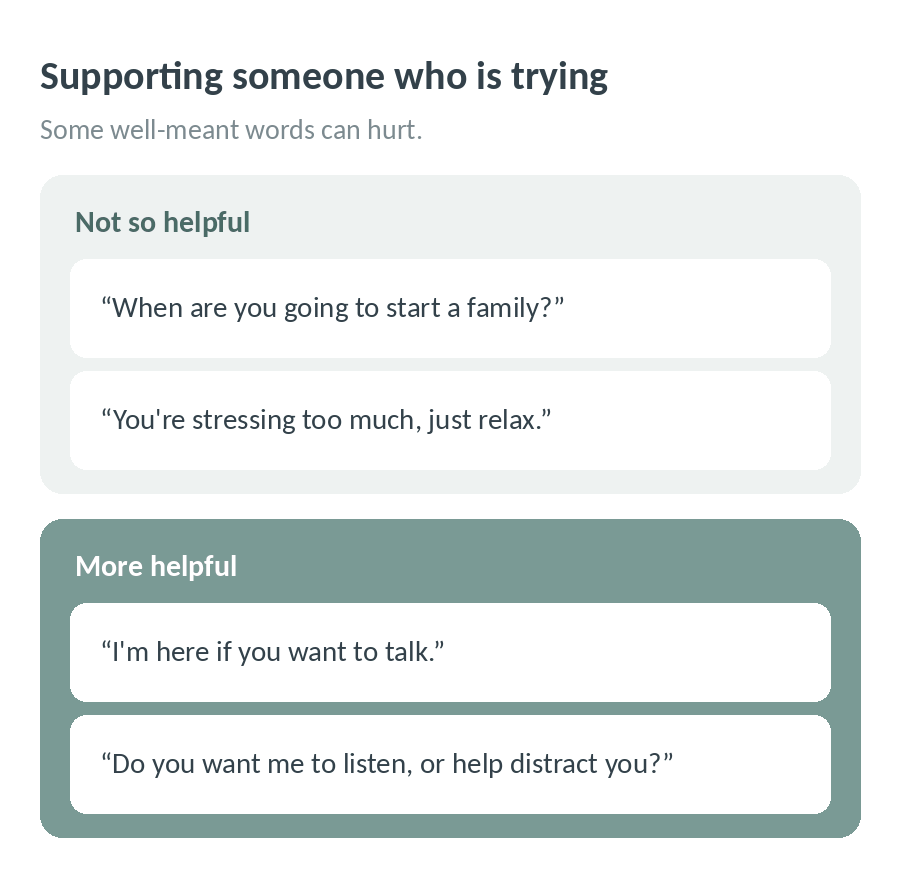
We all have those friends or family members who seem to fall pregnant the instant they decide to have a child. This is fantastic for them, however, for those who have been trying for months to conceive, or maybe years, the news can be bitter-sweet. What hurts even more is when people ask “when are you going to start a family!?”, not realising you have been trying and agonising over it, or when you see, yet again, ANOTHER negative pregnancy test result.

Every month, if you have a 28-day cycle, is a waiting game. There’s hoping, but also not wanting to get your hopes up. Lots of Googling about what could possibly help with falling pregnant. Oh, and don’t forget all the money you’ve spent on ovulation tests, pregnancy tests, and (for those further along the journey) specialist appointments. There’s the feeling of grief when you get your period, there’s tears, feelings of inadequacy, anger, and sometimes sheer despair.

A lot of people don’t realise that you don’t have to lose a child or a pregnancy to experience loss, stress, grief, and a sense of hopelessness. They also don’t realise that when you reach out for help and to talk it out, that “you’re stressing too much, try to relax” is not helpful.

This is why accessing professional support can be so helpful. Falling pregnant can be extremely difficult, and more distressing than most people realise (unless they have been through it themselves). And whilst I would love for you to call us and book in if you are facing this very issue, I know that your journey is yours, and you need to do what’s right for you at this point in time. So, what can you do to help yourself?

  • Get educated – You need to learn how your cycle works – start tracking it in an app. Many women have cycles which are not 28 days in length, which could mean you aren’t trying to conceive when you are actually ovulating (you can purchase ovulation kits to help you work this out).
  • Speak to your GP – they may be able to conduct some tests, provide you with some more information, or refer you to a specialist if they have reasons to believe you need extra intervention.
  • Take better care of yourself – this means eating well, taking time to unwind, to exercise, and have fun. Start cutting out things that aren’t good for your body, such as smoking, binge drinking, or taking illicit drugs. Think about what makes you happy, and DO IT. Do the things you may not be able to do as easily if you start a family.
  • Connect with others on the same journey – there are lots of supportive Facebook groups you can join where people share their stories, resources, and a laugh.
  • Remember, you have options! IVF has come a long way and is now more accessible and affordable than ever with private (e.g. Monash and Melbourne IVF) and public IVF clinics available in Melbourne (e.g. Adora Fertility, formerly Primary IVF).
  • Talk it out with someone you trust – sometimes just talking it out can make the world of difference. Bear in mind, your trusted person will try to alleviate your worries by offering advice or solutions, but if you just need them to sit and listen, let them know. If you want them to distract you, say so. Ask for what you need.
  • Let go of your expectations, “shoulds” and the comparing – Don’t compare yourself to the person who fell pregnant within their first month of trying. Mind you, this is quite unusual – 8 months is the average time it takes for a woman to conceive! Also, let go of all the “shoulds” you have (e.g. “I should be pregnant by now”). These thoughts are not helpful. If you find yourself doing this, kindly remind yourself that you’re doing your best and do something nice for yourself.
  • If you’ve been trying to fall pregnant for over a year, ask your GP to refer you to a specialist – Specialists can check if you are actually ovulating, if there are any medical issues which need addressing (e.g. PCOS, partner’s low sperm count), and guide you on the best way to move forward.

Remember, this is a journey, and your journey is unique. How you navigate your way through is totally up to you. If at any time on your journey you’d like some extra support, give our office a call. We’re always here to help.

Laura Forlani smiling, in a portrait photograph

Our Blog Author
This post was written by Laura Forlani, Director and Senior Clinical Psychologist at Your Mind Matters. Laura works with adults on mood and anxiety disorders and difficulties arising from changes in personal circumstances, and has a special interest in supporting clients on their journey to becoming parents. Meet our team.

Goal Setting

Goal setting is the process of creating an action plan with the aim of motivating a person towards a goal. It is an important part of personal development. Every individual will endeavour to set goals for themselves at some point. The most popular goals are those which we call ‘New Year’s Resolutions’. This tradition focuses on setting goals towards changing an undesirable trait or behaviour, and therefore improving one’s life. This tradition of goal setting is likely so popular because people want to start the year anew. However, it doesn’t need to be the start of a new year for you to set some goals around important areas of your life.

Ever tried to set a goal for yourself and found you couldn’t follow through? Most of us will answer yes. A lack of success in goal setting doesn’t mean that we aren’t as capable as those who seem to achieve all the goals they set. It might just mean that the integral aspect of goal setting known as the action plan has been missed, meaning that you haven’t thoroughly planned out your goal or thought about how you will go about achieving the goals you set. Often people will not achieve their goals because they are too broad and/or are not realistic given the circumstances.

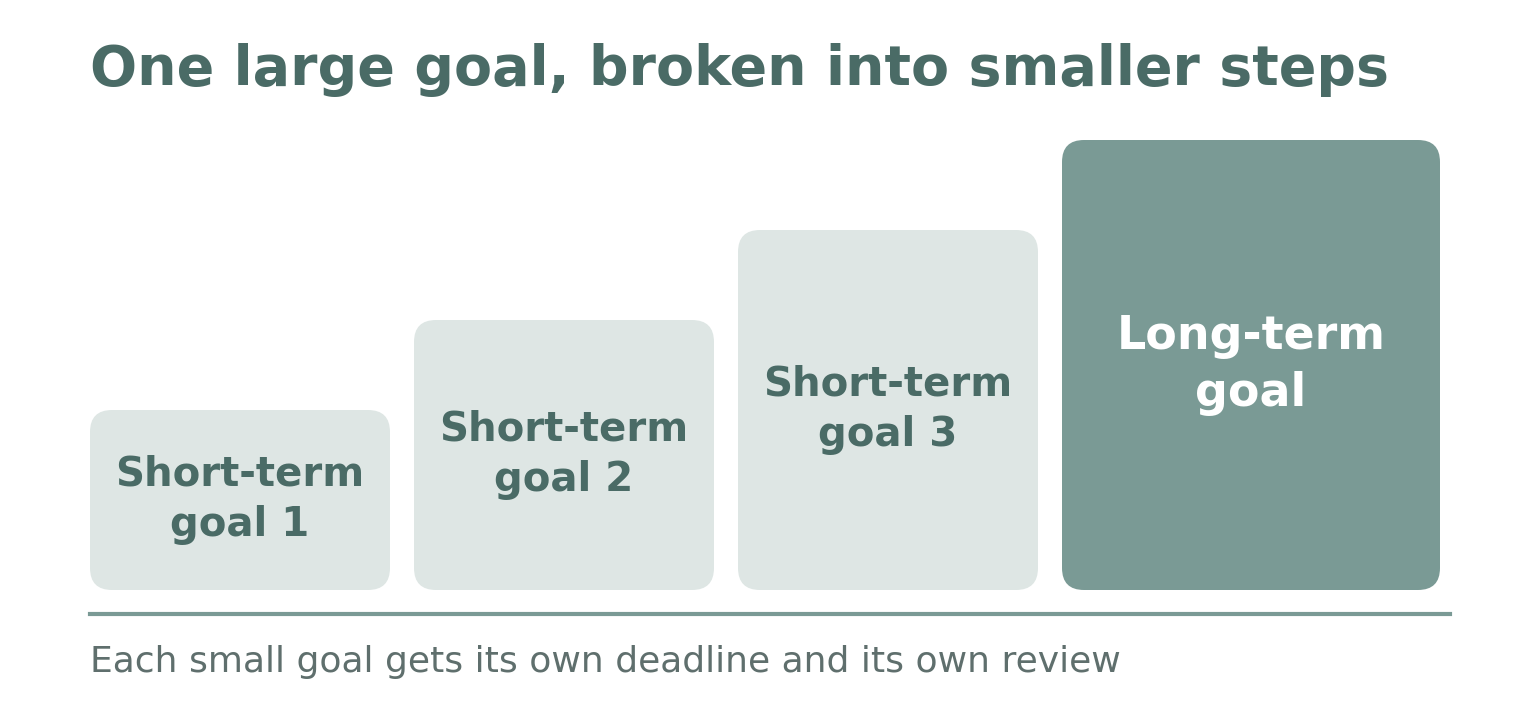
For example, one might set the goal ‘To lose weight’. This goal is very broad and doesn’t tell us any information about what needs to be done to achieve this goal and how we will know when the goal is achieved. So, let’s say the goal was to lose 20 kilograms. In and of itself, this is quite a lot of weight to lose, and the goal has been set quite high. Larger goals should be broken down into smaller, more achievable goals. While the goal to lose 20 kilograms is still there, the focus is on the short-term goal. These small goals lead to achieving the long-term goal. Here’s how it is done.

Three short-term goals of increasing size leading to a larger long-term goal, each with its own deadline and review

The SMART goal-setting framework

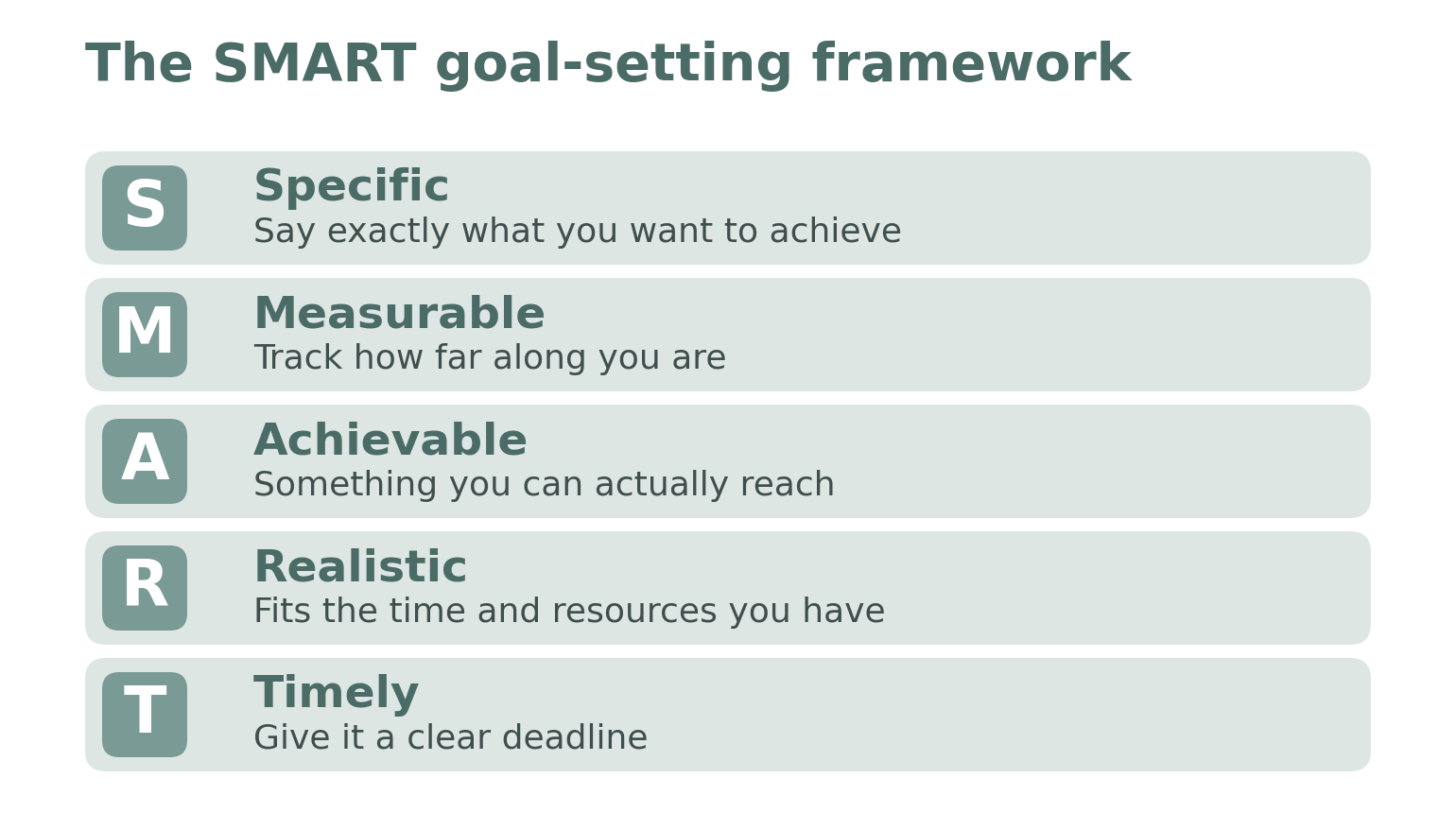
We can follow the SMART goal-setting framework to help create an action plan for goal setting:

The five parts of a SMART goal: specific, measurable, achievable, realistic and timely, each with a short explanation
  • S = Specific: Goals should be well defined. Be specific about what you want to achieve.
  • M = Measurable: Ensure that you can measure the goal over time so you know how far away from completion it is.
  • A = Achievable: The goal needs to be attainable and one that can be reached successfully.
  • R = Realistic: The goal should be realistic given the current circumstances and availability of time, knowledge or resources.
  • T = Timely: Set enough time to complete the goal. Not setting enough time can impact on the overall success of the goal.

Putting it into practice

Using the SMART goals framework and the weight loss example mentioned above, here is our new SMART goal:

To lose 3 kilograms per month, for the next 7 months, by engaging in regular exercise (1-hour gym workout, 4 times per week) and sticking to an eating regime lower in carbohydrates.

Let’s look at how this goal fits within the SMART goal framework:

  • Specific and Achievable: We have specifically outlined what we want to achieve, i.e. to lose 3 kilograms each month, and have outlined how this will be achieved, i.e. by engaging in exercise and sticking to an eating regime.
  • Measurable: We can measure progress towards this goal each month.
  • Realistic: It is realistic given that the action plan involves healthy eating and exercise which we know aid in weight loss.
  • Timely: We have set a time limit of monthly review and want to have achieved the goal in 7 months.

When you follow the SMART goal-setting framework, your chances of achieving your goals are a lot higher. Wishing you all the best of luck on your goal-setting journey.

If you are finding it challenging to set personal goals and would like some support, our team of psychologists is here to help. Call us on (03) 9802 4654 or book an appointment online.

Maria Kampantais seated and smiling

Our Blog Author
This post was written by Maria Kampantais, Senior Clinical Psychologist at Your Mind Matters. Maria has a particular interest in working with clients experiencing anxiety disorders and past trauma. Meet our team.
Book an appointment

Incorporating relaxation into everyday life

Many of us struggle to unwind and relax. We can often get so caught up in the busy nature of life that we forget to take time for ourselves and allow our body and mind to recover. Relaxation is a vital part of maintaining a good level of emotional wellbeing, a reduction in blood pressure and increased energy levels, and it can reduce absenteeism from work and study, and susceptibility to the common cold.

When you think about ‘relaxation’ you may envision sitting or meditating for long periods of time. This can be a deterrent for some and lead to dread and avoidance. Spending as little as 10 minutes a day can be beneficial and is likely to be achievable for most individuals.

There are many forms of relaxation. Below are a few you may wish to try.

Breathing techniques

  • Diaphragmatic or deep breathing: sitting up straight, place one hand on your chest and the other hand on your abdomen. Take a slow deep breath, inhaling through the nose for approximately 4 seconds, hold that breath momentarily, then exhale slowly through your mouth for 6 seconds. Repeat for a count of 3. As you feel more comfortable with this technique, try to stay engaged in this breathing relaxation for longer periods of time.
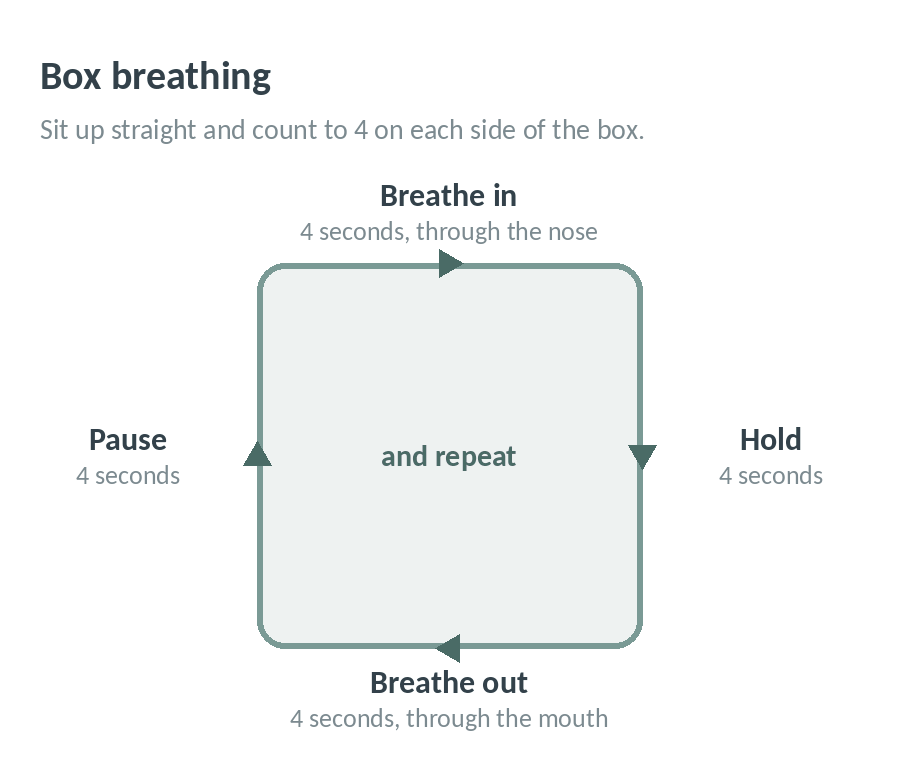
  • Square or box breathing: sitting up straight, inhale slowly and deeply through your nose for 4 seconds, feeling the air completely fill your lungs and moving into the abdomen, hold that breath for 4 seconds, exhale slowly through your mouth for 4 seconds, pause for 4 seconds, and repeat.

Progressive muscle relaxation

This technique involves tensing and relaxing various muscles in the body. Starting with your feet, tense your toes for 5 seconds and then allow the muscles to relax for 10 seconds. Next tense your calves (being careful not to tense too much as this part of the body is susceptible to cramping!) for 5 seconds and then relax the muscles for 10 seconds. Continue to follow this process whilst you work through your body, from your thighs, hips, chest and stomach, shoulders, upper back, neck, arms and face. The Centre for Clinical Interventions publishes a guided progressive muscle relaxation information sheet (PDF).

Mindfulness

Mindfulness is noticing and being aware of the present moment. It’s about paying attention to our thoughts, feelings, and sensations in our body.

Sensory exercise

  • Take 30 seconds to focus on your breathing. You may wish to utilise one of the breathing techniques listed above.
  • Sight: look around and name 5 objects
  • Touch: look at and touch 4 different objects. Notice their texture, weight and temperature
  • Sound: notice 3 sounds
  • Smell: identify 2 smells, paying attention to the aroma
  • Taste: notice 1 thing you can taste

Body scan

  1. Close your eyes and gently bring your awareness to your breathing. Spend 30 seconds focusing on your breathing, not changing it in any way, just noticing your natural breath and how your chest rises and falls with each breath you take.
  2. If you notice your mind begins to wander and you start thinking of other things, remember that this is completely natural and okay. Just gently notice your thoughts, without getting caught up in them, and bring your awareness back to your breathing.
  3. Begin the body scan by noticing your feet. Notice how your feet feel in your shoes and against the floor. Pay attention to all sensations such as temperature, pressure, tingling or weight.
  4. Continue the body scan by noticing each part of your body: legs, hips, chest and stomach, shoulders, upper back, neck, arms and face.
  5. Return your awareness to your breathing, noticing your chest rising and falling as you breathe in and out. Open your eyes.

You may wish to do a variation of this exercise. Follow steps 1 and 2 as above, and when you reach step 3, as you begin to notice sensations in your body, imagine a warm glow of light. Starting at your toes, work your way up your body, imagining that this warm light radiates warmth and comfort.

Guided mindfulness meditation

Mindfulness apps are a great tool to utilise as they provide guided meditations you can engage in throughout the day. I recommend Smiling Mind. Why? Well, it’s a free app, no ads, no junk email sent to your inbox, and it offers ample meditation clips, starting from 1 minute! So, for those of you who are time poor, there is sure to be a guided meditation here for you. There are plenty of great apps out there which require you to purchase the app or to subscribe, and it is totally up to you if you choose to look into these.

Mindful colouring

Mindful colouring is a great way to relax and unwind. Mindful colouring is not just about colouring in a picture or pattern, rather it is about paying attention and noticing the process of the colouring. Notice the feel of the marker or pencil in your hand. Pay attention to each stroke, the pressure you apply, the movement of your hand as you colour in the image, and the sound made as your marker or pencil touches the paper. Adult colouring books are available from local bookstores and department stores, and your local supermarket may stock some. When searching for a mindful colouring book, go with the one whose patterns or images are most appealing to you.

Relaxation doesn’t always have to entail a process. It can also be seen as engaging in enjoyable activities such as having a bath, reading a book, or going for a walk. Try to do these activities mindfully, with openness and curiosity, paying attention to the present moment.

Remember, practice and consistency are key to establishing relaxation in your daily schedule.

If you would like some support with relaxation or managing stress, our team of psychologists are here to help. Call us on (03) 9802 4654 or book an appointment online.

Maria Kampantais seated and smiling

Our Blog Author
This post was written by Maria Kampantais, Senior Clinical Psychologist at Your Mind Matters. Maria has a particular interest in working with clients experiencing anxiety disorders and past trauma. Meet our team.

Handy tips towards improved mental health in adolescents

Adolescence is the peak age of onset for many mental health conditions, with half of all mental disorders usually starting by mid-teens. Despite the increased awareness of mental health issues through a number of initiatives, almost a quarter of Australian teenagers exhibit symptoms of mental illness.

How adolescents can deal with stress and improve mental well-being

If you’re an adolescent, or the parent of an adolescent who is struggling with mental health issues, here are some tips to work towards improved mental well-being.

Sleep

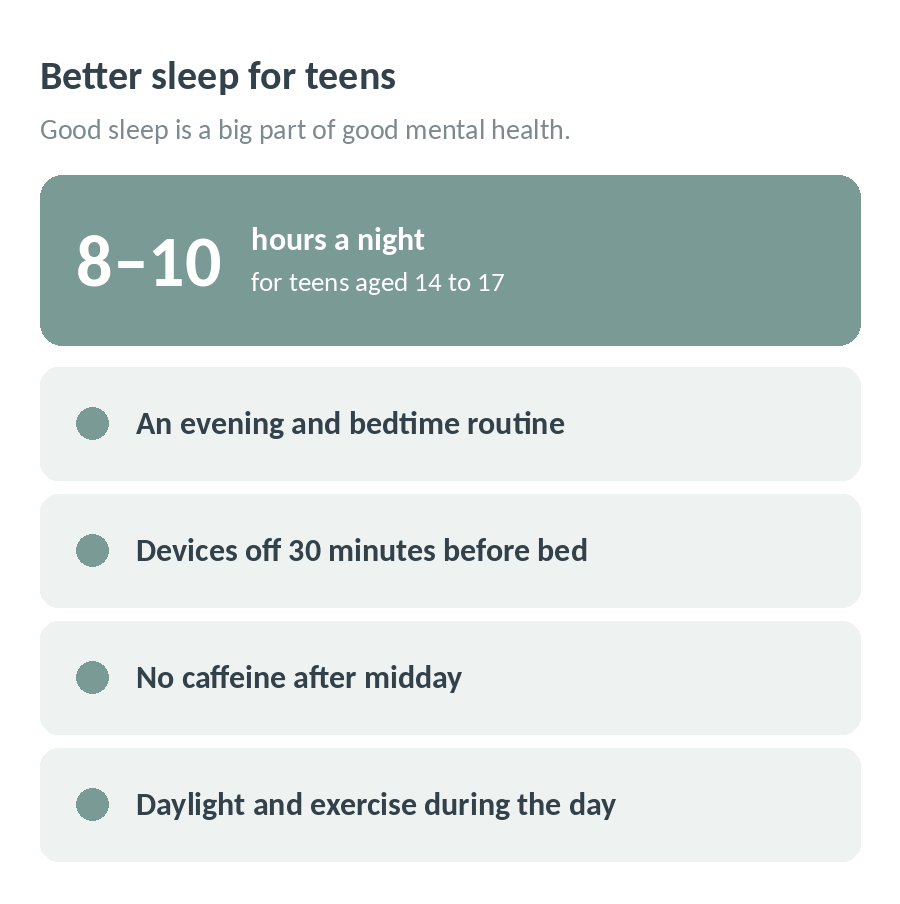
Getting sufficient amounts of good quality sleep is integral for mental health. Inadequate sleep has been linked to depression and substance abuse problems. Teens aged 14–17 require 8 to 10 hours of sleep a night, but it is common for this to not be attained due to school pressures, social life commitments and use of electronic devices.

To achieve better sleep habits, try developing an evening and bedtime routine, turning off all electronic devices at least half an hour before going to sleep, limiting caffeine after midday and trying to get some exercise and sunlight during the day.

Interpersonal relationships

Spending time with friends and family is a vital part of mental well-being. Regardless of how busy your study, work and social schedule is, make sure you make the time to be with people who elevate your mood.

Relationship breakdowns can trigger negative feelings and depressive symptoms, but these feelings should improve over time. It’s important to seek out the support of others during this time and avoid using drugs or alcohol to cope with the pain.

Diet

The food you eat has an impact on your mental as well as physical health. High sugar and fat diets have been linked with emotional and behavioural problems in young people and may negatively affect mood, concentration and general mental health. Adolescence is also a peak time for developing eating disorders, with most young people knowing someone who might have an eating disorder.

A healthy relationship with food is vital to reducing the risk of developing eating disorders, but also to prevent conditions such as obesity, which may result in low self-esteem and also physical implications.

Slowing down and relaxing

Slowing down your pace and mentally removing yourself from everyday worries can help you to deal with stress more easily and prevent you from becoming overwhelmed.

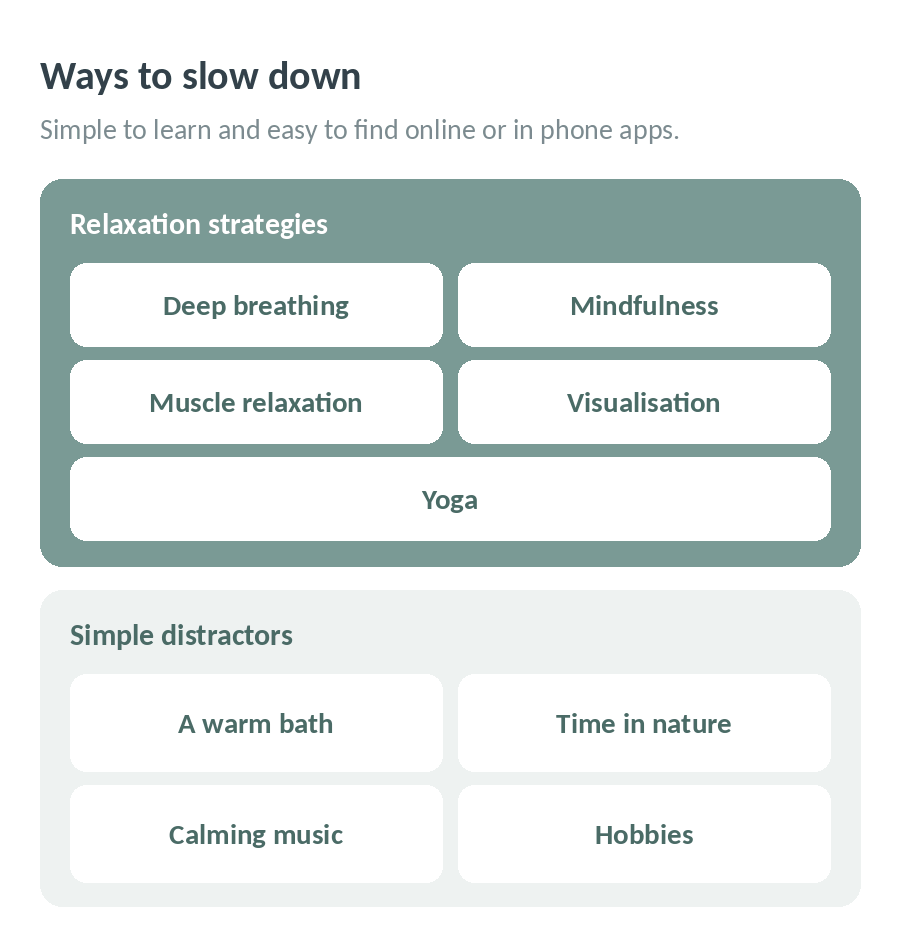
Deep breathing, mindfulness meditation, progressive muscle relaxation, creative visualisation and yoga are all effective relaxation strategies which are simple to learn and readily accessible on the internet and through phone apps. A simple warm bath, time outdoors in nature, calming music or pursuing hobbies are all excellent distractors.

Substance avoidance

Alcohol and other drugs can briefly make you feel an improvement in your mood, but they can have detrimental impacts in the long run, particularly if there are pre-existing mental health issues.

Using drugs and alcohol as an attempt to self-medicate for depression, anxiety and other issues can increase risk of self-harm and also lead to more chronic substance use problems in the future.

When to seek further support

Family and friends are a great source of support, but sometimes things can seem so overwhelming even for them. In those cases, seeking professional advice and support from a trained psychologist can assist young people and their families to work through their challenging situations.

If you or someone you know is going through difficulties and needs support, our team of psychologists are here to help. Call us on (03) 9802 4654 or book an appointment online.

If you need support right now

If this is an emergency, call 000. For 24-hour support, call Lifeline on 13 11 14 or text 0477 13 11 14. Kids Helpline is free and confidential for anyone aged 5 to 25, on 1800 55 1800. For support with eating and body image, the Butterfly National Helpline is on 1800 33 4673. More options are on our resources page.

References

Lana Lubomirska wearing glasses, in a portrait photograph

Our Blog Author
This post was written by Lana Lubomirska, Senior Psychologist at Your Mind Matters. Lana works with children, adolescents and adults from a range of cultural and socioeconomic backgrounds, and is committed to providing a client-centred, safe environment for every individual. Meet our team.
📅 Book an Appointment