An Introduction to Mindfulness

MINDFULNESS – WHAT IS IT, AND HOW CAN I DO IT?

You’ve probably heard the words “mindful” or “mindfulness”, but perhaps you aren’t quite sure what this means, or how to engage in mindful behaviours.

What Is Mindfulness? 

Mindfulness is simply the awareness that arises when we deliberately pay attention, non-judgmentally, to what is happening in the present moment, both externally and in our mind and body.

Crucially, this includes our thoughts. So rather than becoming all consumed by the incessant torrent of distracting and potentially stressful thoughts that flood our minds on a daily basis, we are able to step back from them and let them go.

There is a robust, and ever growing, body of research that shows mindfulness-based practices, such as Mindfulness Based Stress Reduction and Mindfulness Based Cognitive Therapy can help with everything from depression, anxiety, stress and self-esteem to chronic pain, relationship difficulties, creativity and productivity. Mindfulness can also help you to fall asleep at night and assist in moderating your food intake i.e. mindful eating, which is great for those to tend to over-indulge.

Can I Learn Mindfulness?

Absolutely! You have little mindful moments everyday already, we just want to expand on that. You can teach yourself to ‘stop and smell the roses’ more often.

The Basics of Mindfulness 

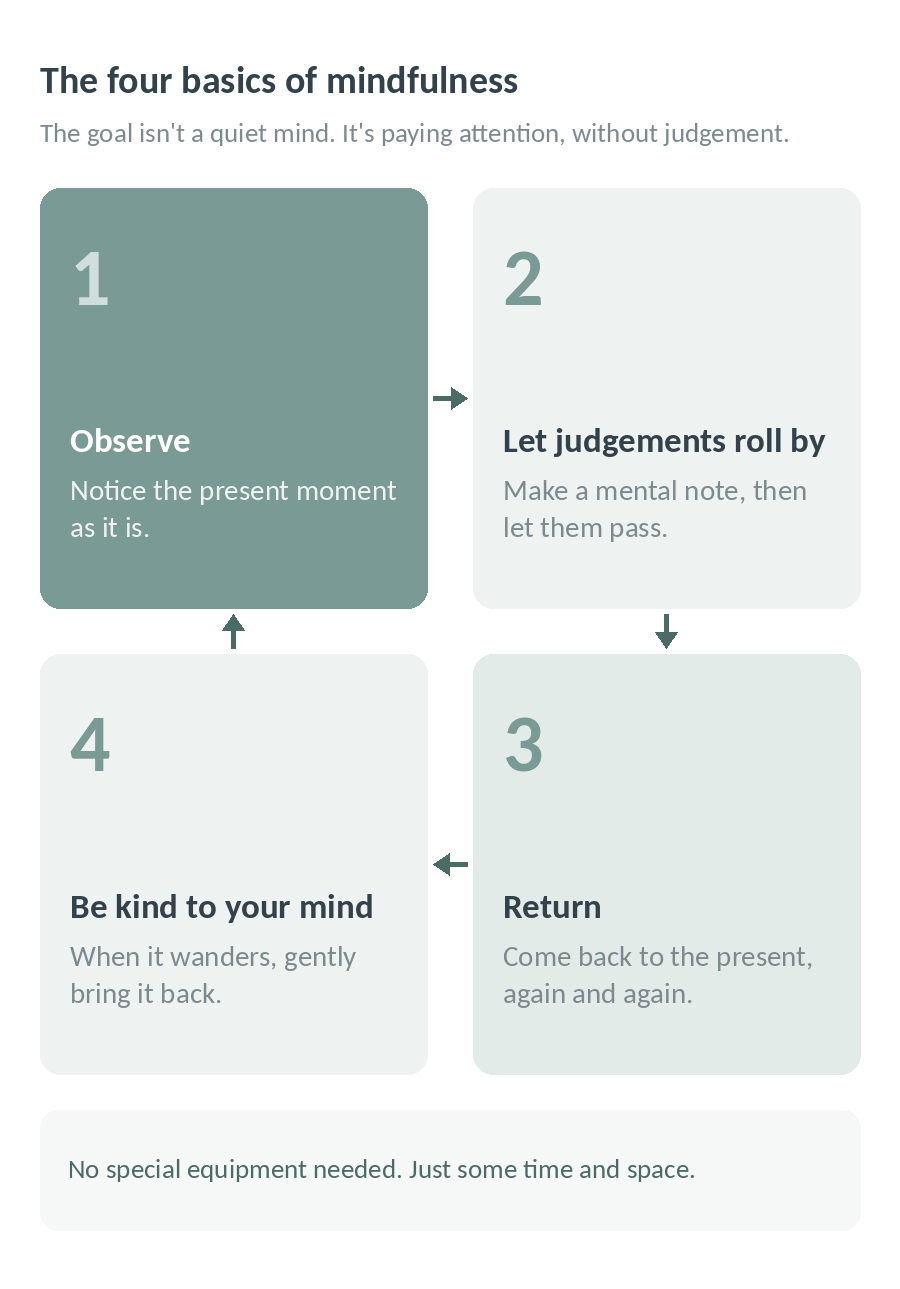
You don’t need a meditation cushion or bench, or any sort of special equipment to access your mindfulness skills—but you do need to set aside some time and space.

Observe the present moment as it is. The aim of mindfulness is not quieting the mind, or attempting to achieve a state of eternal calm. The goal is simple: we’re aiming to pay attention to the present moment, without judgement. Easier said than done, we know.

Let your judgments roll by. When we notice judgements arise during our practice, we can make a mental note of them, and let them pass.

Return to observing the present moment as it is. Our minds often get carried away in thought. That’s why mindfulness is the practice of returning, again and again, to the present moment.

Be kind to your wandering mind. Don’t judge yourself for whatever thoughts crop up, just practice recognizing when your mind has wandered off, and gently bring it back.


Mindful Sleep Exercise – Body scan relaxation exercise

The body scan technique relies on getting your mind to focus on different parts of your body. There are different methods, and one that I’ve found effective is to imagine taking your mind on a trip around your body.

Use the script below, or perhaps listen to The Relaxation Podcast by Professor Colin Espie from the University of Oxford. With a calming voice, he talks you through a simple muscle relaxation exercise step by step.

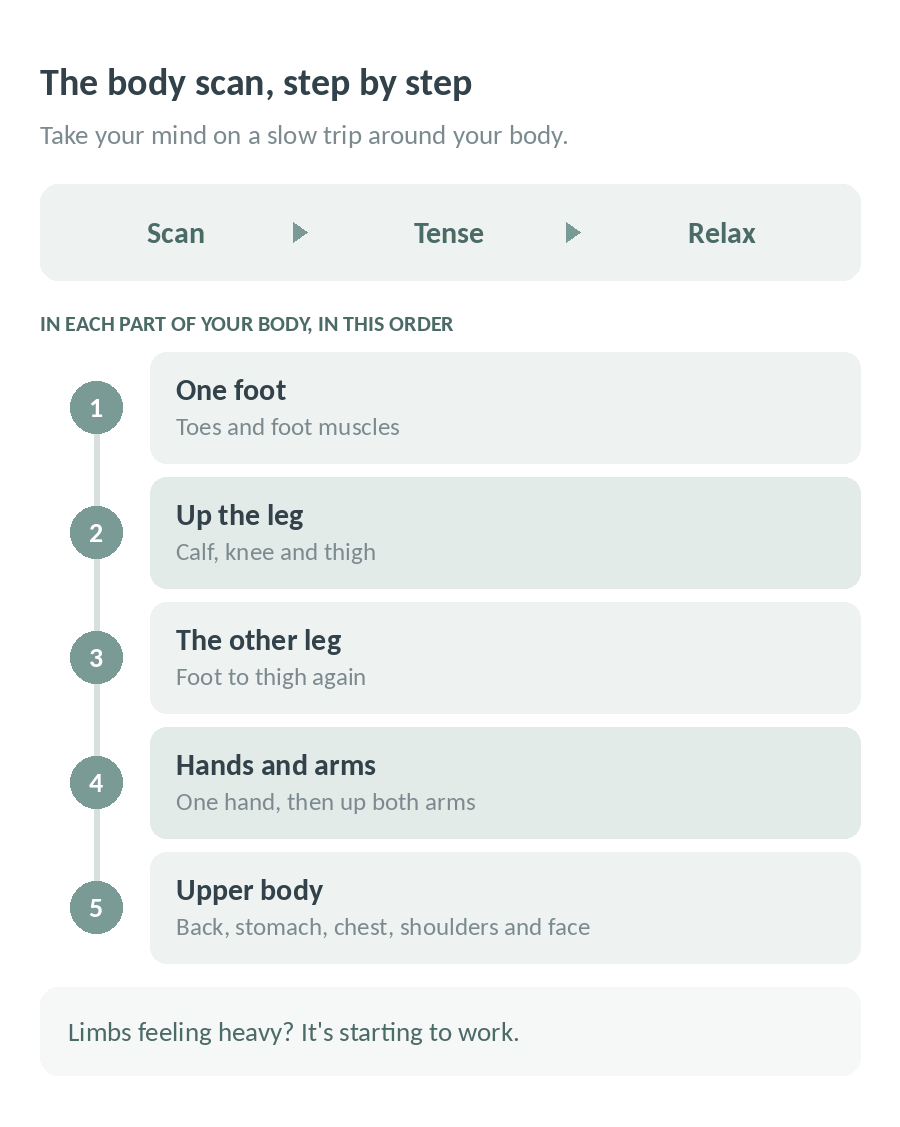
Lie down and get yourself comfortable. Imagine your mind leaving your head, and travelling through your body to one of your feet. How does your foot feel? Is it relaxed, tense or sore? Is it hot or cold? Don’t make any judgments on how it feels – simply scan and observe how you feel.

Imagine your toe and foot muscles tightening, and relaxing again.

Then take your mind up to your calf, knee and thigh.

Stop in each body part to repeat the scanning, muscle tensing and relaxing.

Repeat the exercise with your other leg.

Move to a hand and work your way up both arms.

Scan, tense and relax your back, stomach, chest, shoulders and face.

You can either imagine your muscles tensing and relaxing, or physically tense and relax them – do what feels best.

You’ll know it’s starting to work when your limbs begin to feel heavy and you’re happy to sink comfortably into your mattress.

You might find your mind wanders at times. Acknowledge any thoughts that arise in a positive way, but bring your mind gently back to the exercise.


Mindful Eating Exercise: The Raisin Exercise (this is a classic introduction to mindful eating!)

You can follow the written script below, or, even better, get a raisin or some other bite-sized food you enjoy, and head here for an audio recording: http://www.mbsrtraining.com/mindfully-eating-a-raisin-exercise/

Place a few raisins in your hand. If you don’t have raisins, any food will do. Imagine that you have just come to Earth from a distant planet without such food.

Now, with this food in hand, you can begin to explore it with all of your senses.

Focus on one of the objects as if you’ve never seen anything like it before. Focus on seeing this object. Scan it, exploring every part of it, as if you’ve never seen such a thing before. Turn it around with your fingers and notice what colour it is.

Notice the folds and where the surface reflects light or becomes darker.

Next, explore the texture, feeling any softness, hardness, coarseness, or smoothness.

While you’re doing this, if thoughts arise such as “Why am I doing this weird exercise?” “How will this ever help me?” or “I hate these objects,” then just see if you can acknowledge these thoughts, let them be, and then bring your awareness back to the object.

Take the object beneath your nose and carefully notice the smell of it.

Bring the object to one ear, squeeze it, roll it around, and hear if there is any sound coming from it.

Begin to slowly take the object to your mouth, noticing how the arm knows exactly where to go and perhaps becoming aware of your mouth watering consistency as you chew.

When you feel ready to swallow, consciously notice the intention to swallow, then see if you can notice the sensations of swallowing the raisin, sensing it moving down to your throat and into your oesophagus on its way to your stomach.

Take a moment to congratulate yourself for taking this time to experience mindful eating.


Keen to learn more? Here are some articles you may be interested in:

Why sleep and Mindfulness go hand in hand: https://www.huffingtonpost.co.uk/entry/why-sleep-mindfulness-and-wellness-go-hand-in-hand_uk_57e8f98be4b004d4d86343bd

Mindfulness For Sleep: https://www.thehealthy.com/sleep/mindfulness-for-sleep/ 

The Raisin Exercise for Mindful Eating: http://www.mbsrtraining.com/mindfully-eating-a-raisin-exercise/

6 Ways to Practice Mindful Eating: https://www.mindful.org/6-ways-practice-mindful-eating/

laura About the author:

This blog was written by Laura Forlani, Director and Clinical Psychologist at Your Mind Matters.

Laura has completed undergraduate and post graduate studies in psychology, most recently completing a Masters in Clinical Psychology at Swinburne University.She has experience helping children and adults overcome a wide variety of difficulties such as mood and anxiety disorders, and problems arising due to changes in personal circumstances (e.g. family breakdown or a change in career). Her approach to therapy involves education, collaboration, and evidence-based interventions such as cognitive-behaviour therapy, skills training, and relaxation strategies.

What is self-esteem and how do I improve it?

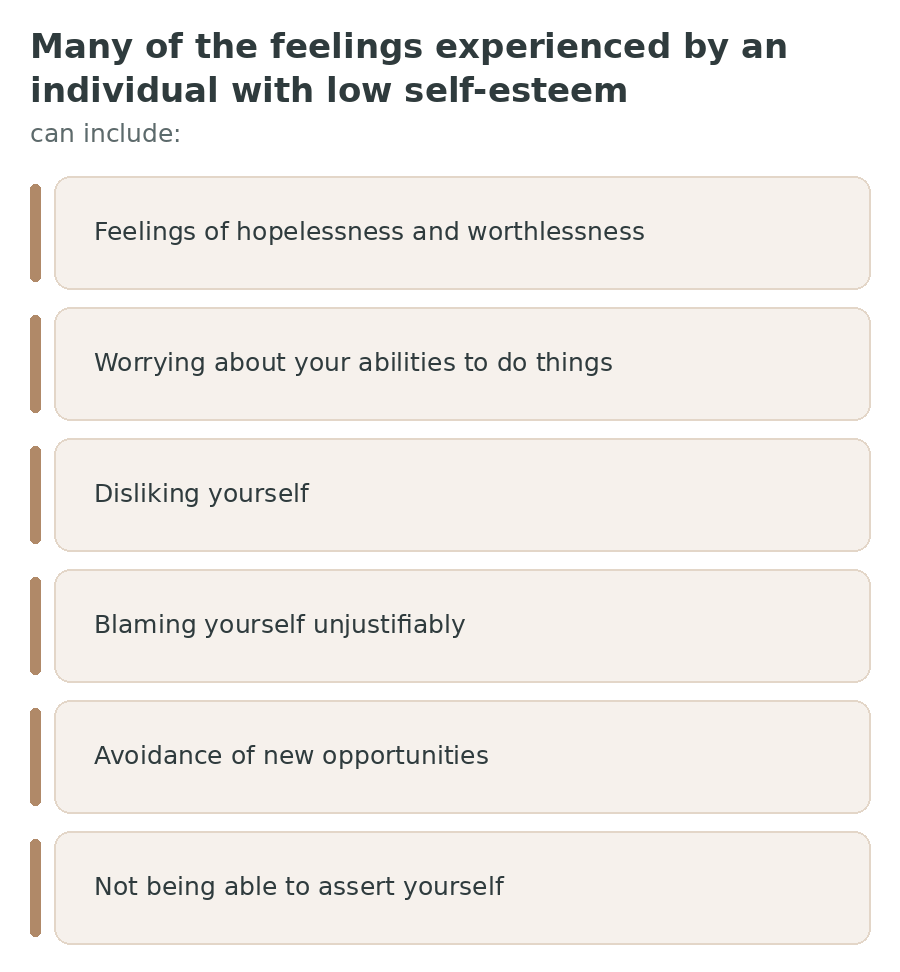
Self-esteem plays a key role towards our emotional well-being. Although low self-esteem is not in itself a mental health issue, the two are closely related. Many of the feelings experienced by an individual with low self-esteem can be similar to those of depression and anxiety and can include:

  • Feelings of hopelessness and worthlessness
  • Worrying about your abilities to do things
  • Disliking yourself
  • Blaming yourself unjustifiably
  • Avoidance of new opportunities
  • Not being able to assert yourself

For many of us, self-esteem is something which we want more of, however we often lack the knowledge of how to improve self-esteem. Below are some common questions about self-esteem and how to start to build it.


The difference between self-esteem and confidence…

Self-esteem refers to your overall sense of value and personal worth. Simply put, it is about how much you may like, respect and be satisfied with yourself. Self-esteem is often confused with confidence and the two terms are used interchangeably. Confidence refers to the belief you have in your abilities and is likely to vary based on the situation. For instance, an individual may have a healthy level of self-esteem, however lack confidence in their cooking abilities.  


Where does self-esteem come from?

Self-esteem is developed throughout your life and your experiences shape how you view yourselves. When you try new things and the results are beneficial to you, this leads to an increase in your self-esteem. For example, being offered a promotion at work to supervise a team for the first time, and having successful results is likely to increase self-esteem. However, if the role as a supervisor does not go as planned, this may impact on your self-esteem. It is important to note, that what affects self-esteem varies from person-to-person. Some common experiences that may impact on self-esteem include:

  • Being involved in a challenging romantic relationship, separation, or divorce
  • Experience of domestic violence
  • Workplace bullying
  • Loss of employment (being terminated or made redundant) and/or difficulty in securing work
  • Medical condition (physical or mental health issues)


Early childhood experiences play a particularly crucial role in development of your self-esteem. How you were treated from those around you including your caregivers, family, teachers and peers helps to mould your view of yourself, your worth, and contributes to your overall self-esteem.

            Childhood experiences that may contribute to healthy self-esteem:

  • Being listened to and acknowledged
  • Recognition for your successes and acknowledgement of mistakes
  • Being treated with respect and spoken to appropriately
  • Sound level of love, nurture and affection

Childhood experiences that may contribute to low self-esteem:

  • Verbal, physical, sexual or emotional abuse
  • Being told that you are not good enough
  • Lack of acknowledgment for your achievements, being told you could have performed better, or failures (e.g. not passing a subject at school) being reflected as a failure of your whole life
  • Being ignored
  • Bullying or teasing


Ways to build self-esteem:

Positive self-talk

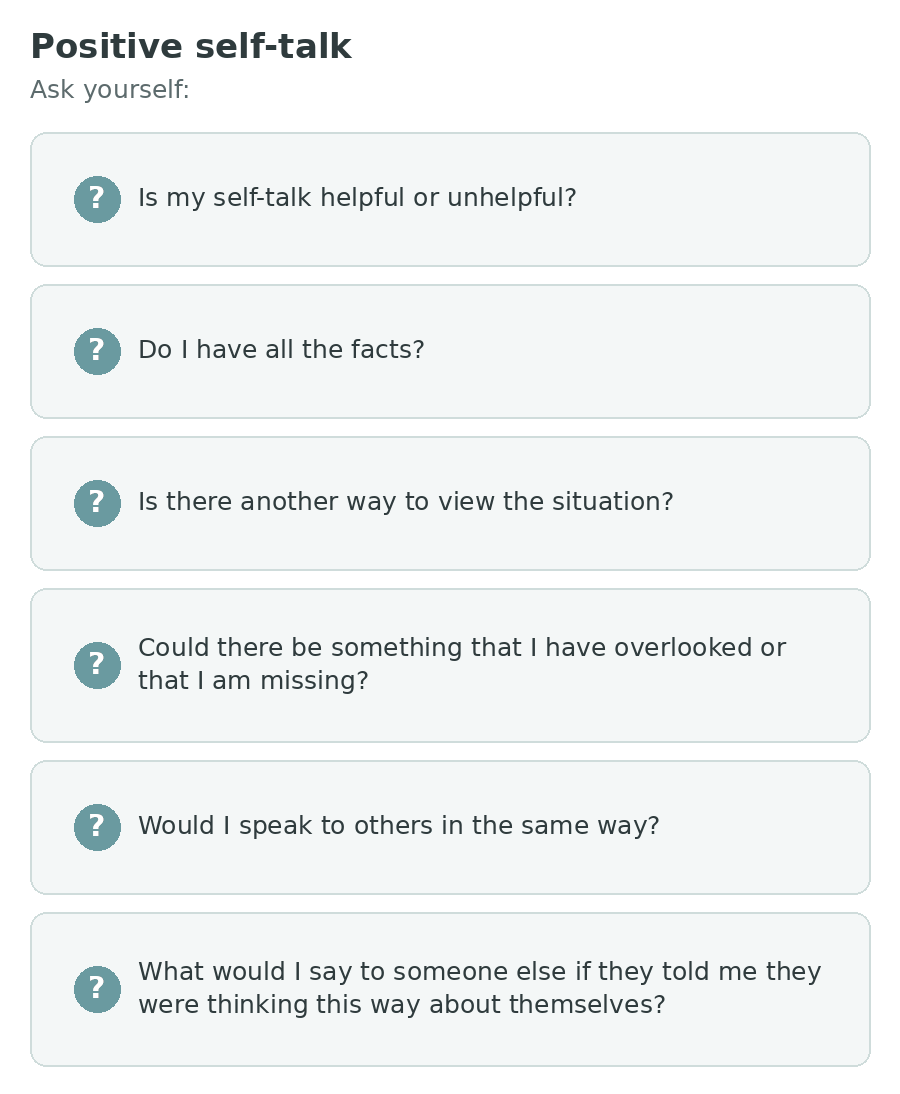
Self-talk is what we say to ourselves, either aloud or in our mind. Often, we may not be aware of our self-talk, but it has an influence on how we perceive ourselves, how we behave and how we feel. Negative self-talk can be extremely harmful to our self-esteem, it includes thoughts like “I can’t do anything right”. To help shift your self-talk to be more positive, try looking at the thought from a different perspective. Ask yourself:

  • Is my self-talk helpful or unhelpful?
  • Do I have all the facts?
  • Is there another way to view the situation?
  • Could there be something that I have overlooked or that I am missing?
  • Would I speak to others in the same way?
  • What would I say to someone else if they told me they were thinking this way about themselves?


Positive affirmations

Affirmations are positive statements that can help to challenge and overcome your negative self-talk. These phrases described how you would like to be. Repeating positive affirmations helps you to start seeing things from a more positive perspective. Think about how doing repetitive physical exercises can improve your fitness and physical health over time. In this similar way, positive affirmations can help to provide you with a more optimistic outlook. Examples of affirmations include: “I am a likeable person”, “I have a lot to be proud of”, and “I am in control of my life”. For a list of positive affirmations visit https://www.getselfhelp.co.uk/docs/PositiveAffirmations.pdf


Strengths and positive qualities

Focus on your strengths and positive qualities. If you struggle, think about what others would say about you. Here is a link with a list of positive qualities: https://www.therapistaid.com/worksheets/positive-traits.pdf

As an exercise, circle your strongest positive qualities and then ask a family member or friend to circle the traits that they identify as your strengths (make sure to give them a new copy of the positive traits list and they don’t see your responses). The results may surprise you and help you see how others may view you in a more positive light.


Gratitude journal

It is all too easy to get caught up in the negative aspects of our day and focus on what didn’t go well. We often don’t think about what we are grateful for or what positive experiences may have occurred. A gratitude journal is a great tool to help you focus on the positive experiences of each day. Think about three things you are grateful for each day. No matter how big or small. If you get stuck, you can use prompts, however these are optional. The following prompts may be useful:

  • The best part about today…
  • Something I am grateful for today…
  • Today I learned…
  • Something beautiful I saw today…

For more information and a different version of a gratitude journal, which doesn’t require daily entries visit https://www.therapistaid.com/worksheets/gratitude-journal.pdf


A final note…

I hope this has been helpful in answering your questions about low self-esteem, as well as provided you with some ideas of how to start to improve self-esteem. If you are experiencing low self-esteem and would like some support, why not give us a call? Our team of highly skilled and well-experienced Psychologists are here to help. Call us now and take that first step towards obtaining the life you deserve.


The following articles were referenced in creation of this blog:

https://www.mind.org.uk/information-support/types-of-mental-health-problems/self-esteem/

https://cmhc.utexas.edu/selfesteem.html


maria

This blog was written by Maria Kampantais, Psychologist at Your Mind Matters.

Maria works with us 4 days per week and has both evening and day session times.  To learn more  about Maria, click here

Building Resilience

Resilience is often described as an individual’s ability to transform adversity into wisdom, insight and compassion. Resilience is ordinary not extraordinary that means everybody has resilience, it’s a question of how well is it used when needed. High resilience does not mean that an individual does not feel pain but simply means that they have found a good way to deal with negative events in life possibly quicker than others.  Like any other human skill, everyone has the capacity to build resilience and to do so the most needed ingredient to the recipe is willingness to do so.

Here’s a list of strategies to build resilience:

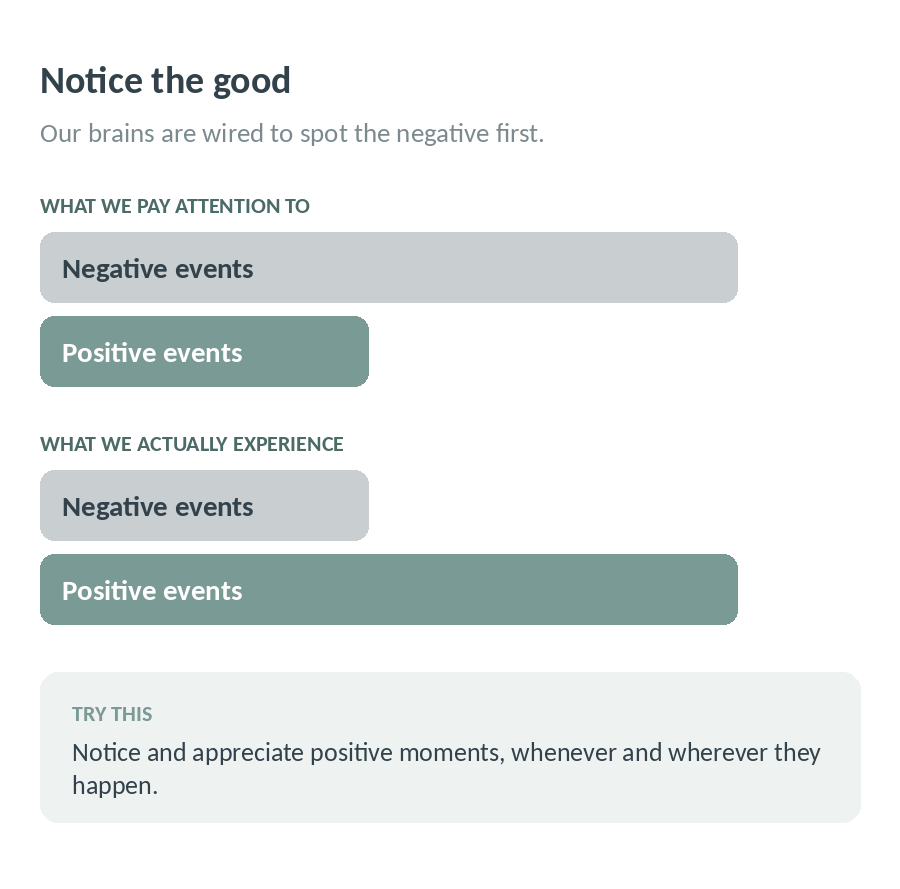
Positive Thinking:  Thinking patterns are known to trigger emotional patterns. Because we have built-in survival mechanisms, our brains are naturally wired to pay more attention to negative events than the positive ones. But in essence, we experience positive events with much greater frequency. One key to building resilience is noticing and appreciating those positive experiences whenever and wherever they occur.


Nurture a positive view of yourself: When you discover a positive attribute in yourself, it is important to nurture it by self-talk, sharing it with important loved ones or by maintaining a journal.  Developing confidence in your ability to solve problems and trusting your instincts helps build resilience.


Self- care:  Taking care of yourself helps to keep your mind and body well equipped to deal with situations that require resilience. So is important to pay attention to your own needs and feelings. Engage in activities that you enjoy and find relaxing and exercise regularly.


Learning from past experiences: Focusing on past experiences and how you dealt with them gives personal strength and ability to identify strategies for building resilience. Learning from reactions to challenging life events is likely to enhance your self-belief, confidence and helps with building wisdom.


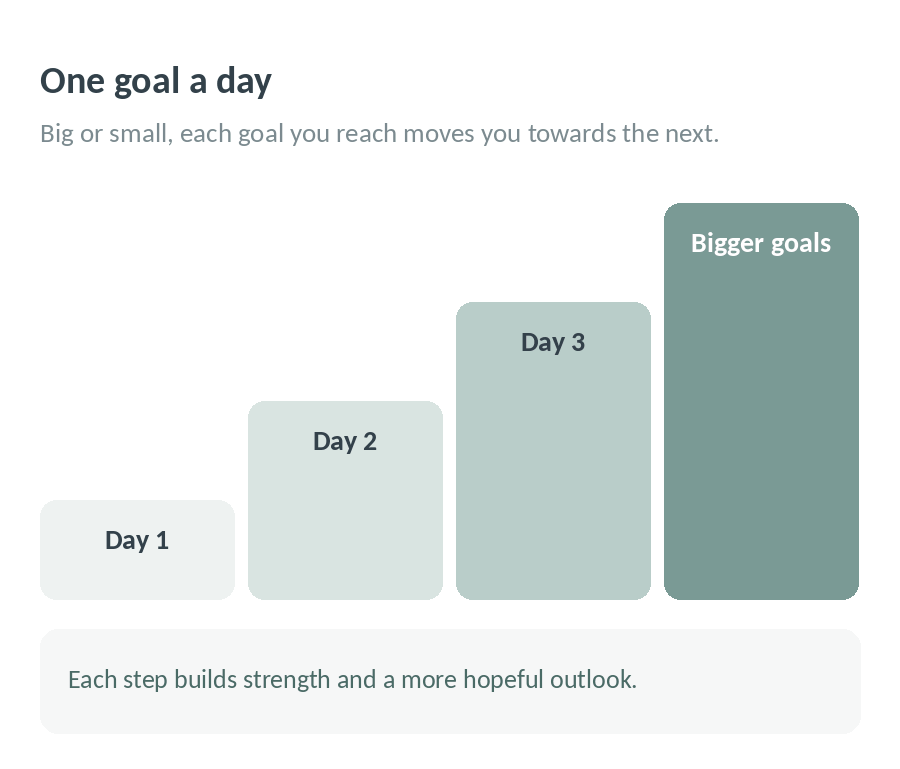
Goal setting:  Developing realistic goals and focusing on achieving one big or small goal each day enables you to move forward and achieve bigger goals. Focusing on this accomplishment is likely to build strength and enhance ability to have a hopeful outlook.


When we tackle obstacles, we find hidden reserves of courage and resilience we did not know we had. And it is only when we are faced with failure do we realise that these resources were always there within us. We only need to find them and move on to using them” (By A P J Abdul Kalam)  


 If you are going through difficulties and need to find your inner strength, why not give us a call today?  Our team of highly skilled and well-experienced Psychologists are here to help.  

photo__1_ aanchal

This blog was written by Aanchal Sood, Psychologist at Your Mind Matters.

Aanchal completed studies in psychopharmacology and psychology in England, and is fluent in both Hindi and Punjabi.

Aanchal has experience assisting adolescents, adults and couples to address a variety of difficulties including anxiety and mood disorders, grief and loss, trauma and stress related disorders, adjustment issues (e.g. cultural adjustment), sleep difficulties, relationship difficulties, schizophrenia spectrum and other psychotic disorders, obsessive compulsive and related disorders. 

Aanchal works with us 1-2 evenings per week. 


Practicing self-care this Christmas


Christmas is fast approaching, and the 2017 year is nearing a close. For many the festive season is a time of giving, spending time with loved ones, and let’s not forget the elaborate feasts! It’s all too often that we get caught up in the hype of the festive season, whether it be buying gifts, writing our seasons greetings or preparing for Santa’s arrival. We can easily forget the importance of caring for ourselves and the focus all too often becomes caring for those around us. Here are some tips for self-care this festive season:

Be mindful

What is mindfulness? Mindfulness is noticing and being aware of the present moment. It’s about paying attention to our thoughts, feelings, and sensations in our body.

Mindfulness can be a great tool to help us identify when the pressure of the holidays is getting too much. We quickly find ourselves in the pattern of carrying on from one task to the next, and feeling as though we are running a marathon! And YES we do get things done, but at times we can be left feeling exhausted and drained. Through the process of getting caught up in the hype of the holidays, we may lose touch of the present and miss out on enjoying the moment.

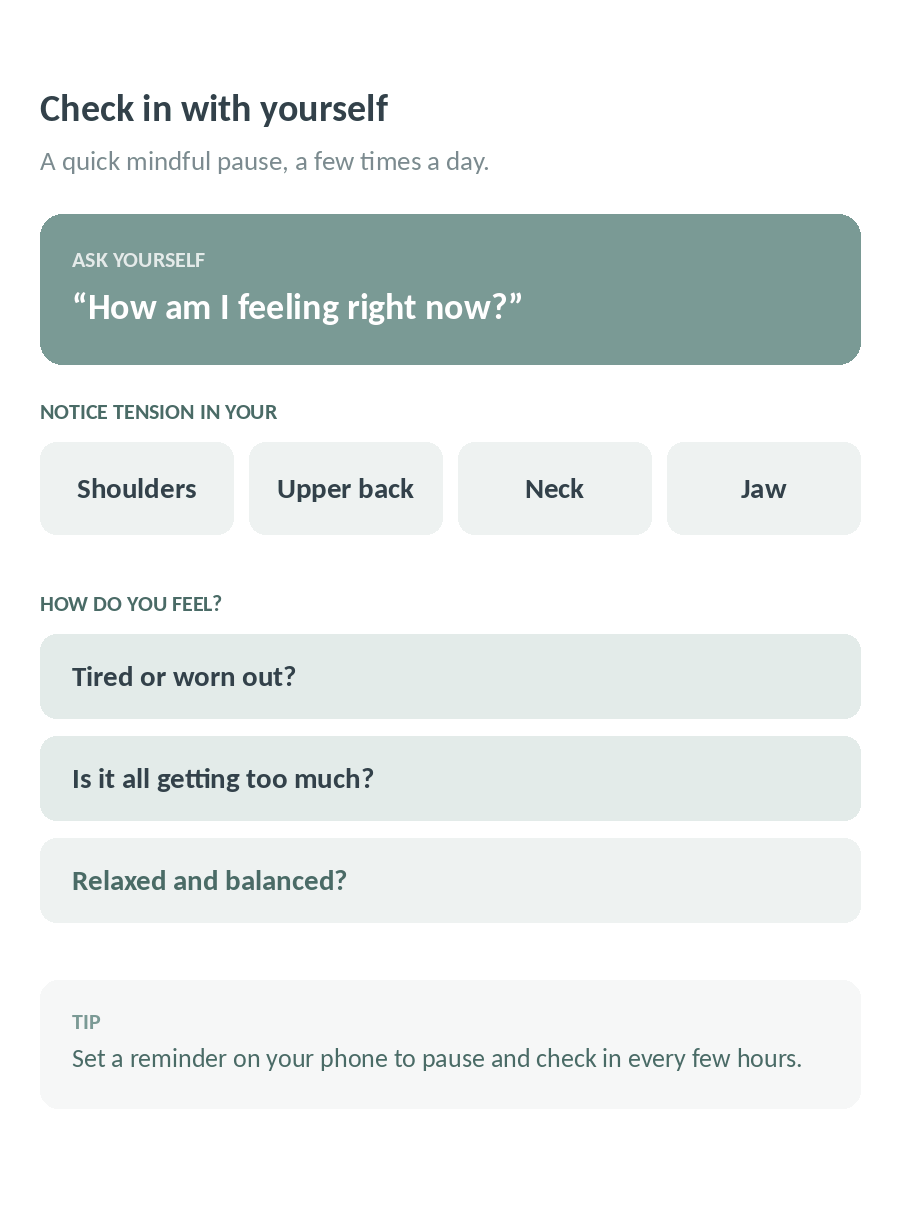
Try and incorporate mindfulness this Christmas. Ask yourself “how am I feeling right now?”. Notice any tension in your body (most of us hold tension in our shoulders, upper back, neck and/or jaw). Are you feeling tired? Worn out? Is everything getting too much and leading to that sense of overwhelming doom? Or are you feeling relaxed and balanced? Unless we are in the habit of checking in with ourselves regularly, we may not notice the signs. Set a reminder on your phone to pause and check in with yourself every few hours, listen to your body. Guided mindfulness meditation can be beneficial. Smiling Mind is a free app that can help you to learn how to engage in mindfulness practices. Pay attention to your senses and notice what you can see, feel, hear, taste or smell. For example, listen to your favourite song and immerse yourself in it by paying attention to the lyrics and the music. 

Remember to breathe

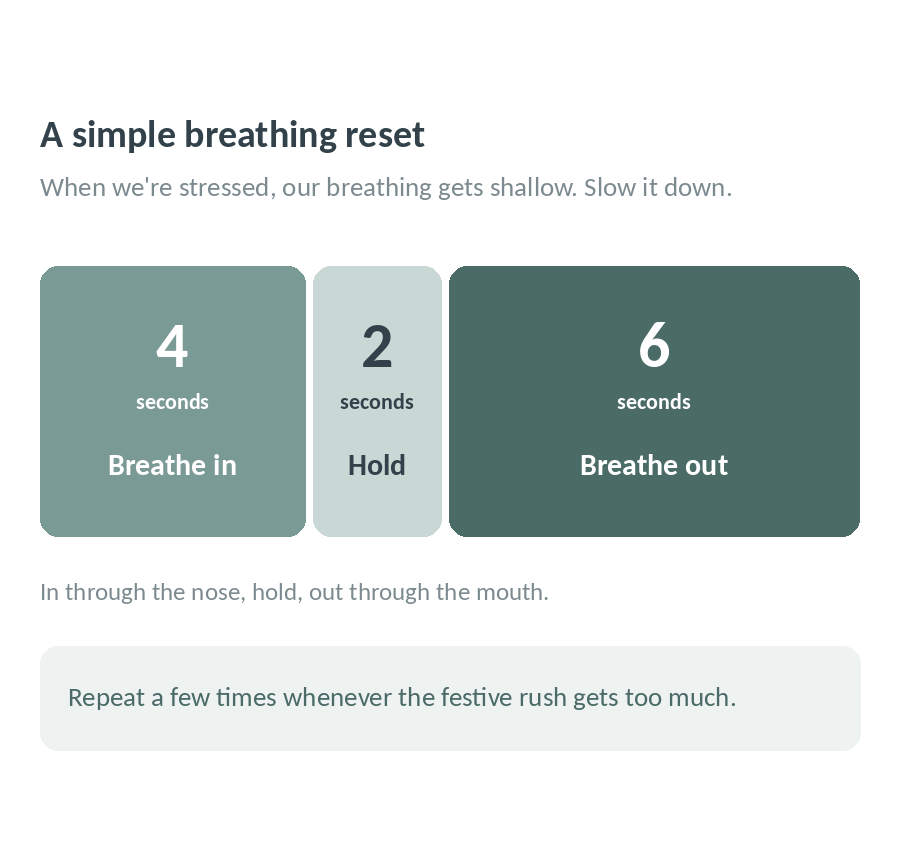
Focus on your breathing. When we are stressed, our breathing tends to become shallow. Practice taking slow and steady breaths by inhaling through your nose for four seconds, holding that breath for two seconds, and exhaling through the mouth for six seconds.

Just five minutes

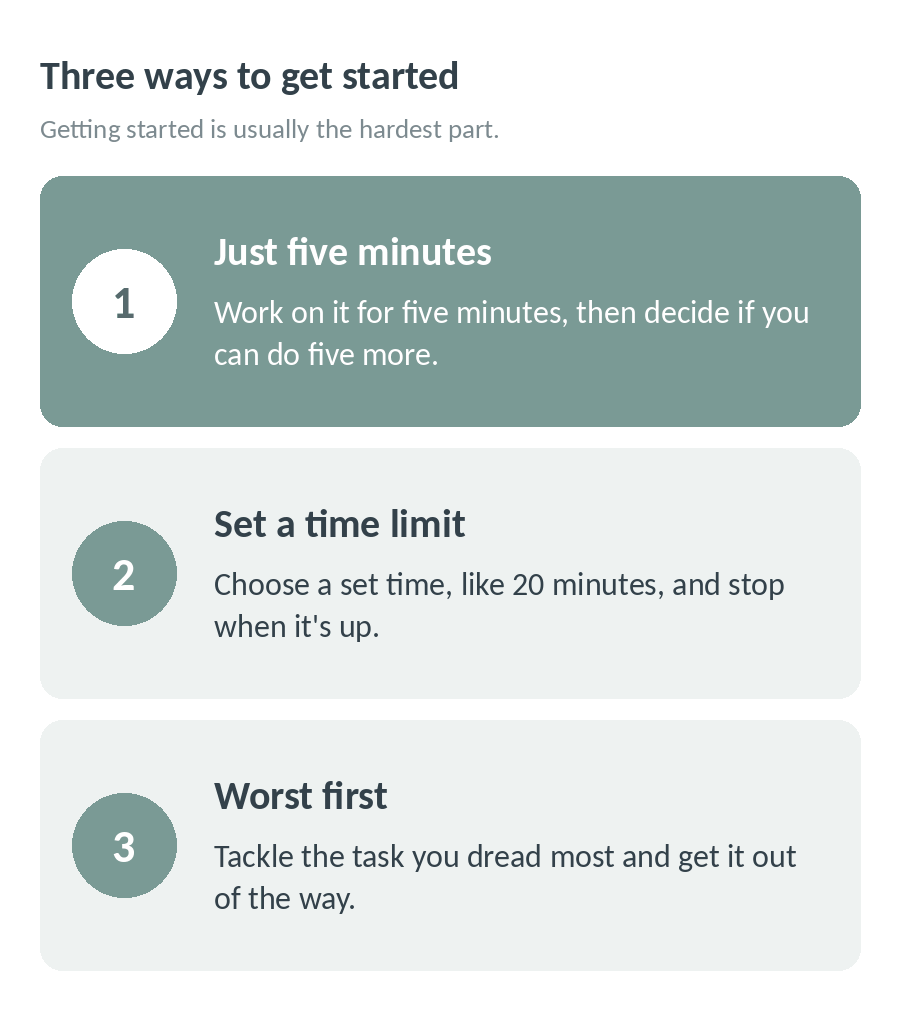
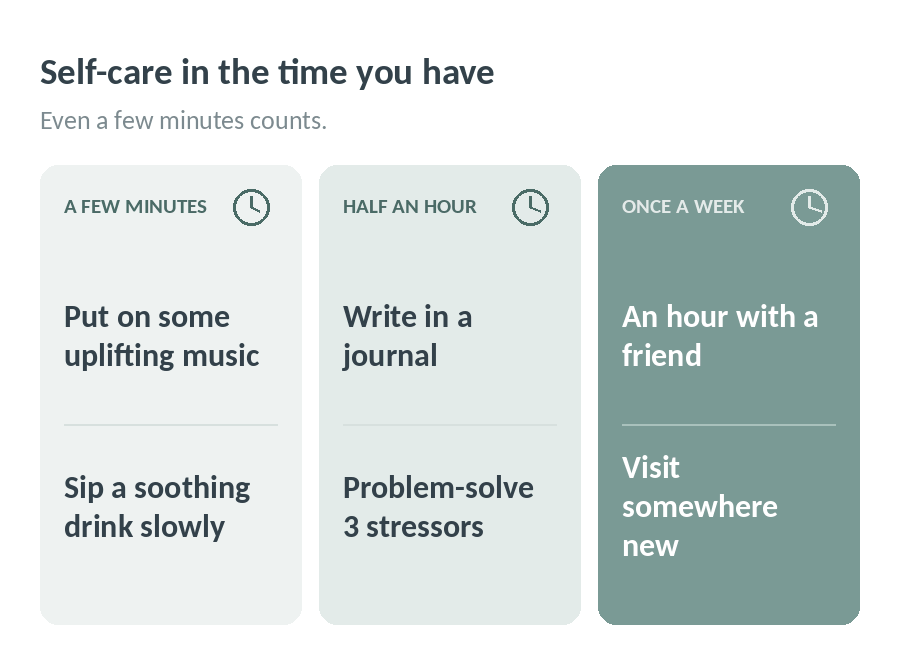
When you notice yourself feeling overwhelmed by a situation, take five minutes away from the task at hand to engage in a relaxing activity. This can include going outside and sitting in your garden, spending time with your pet whether this means playing fetch with your pup or snuggling up on the couch with your feline fur baby, doing some gentle stretching, making a cup of tea/coffee, dancing to your favourite song, calling a friend, or watching a funny clip on YouTube. The options are endless.

Exercise

Exercise is a great way to reduce stress and produce endorphins (mood enhancing chemicals in the brain). Going for a walk or bike ride can be a great way to escape the busyness of the holiday season and can help to clear your mind of those worries. Engaging in yoga or Pilates can help to reduce stress and manage low mood and anxiety. Or why not try something fun this festive season like ice skating or getting out those roller skates. Whatever form of exercise you engage in will be beneficial and why not have some fun with it.  

Do something creative

Being creative can be enjoyable as well as relaxing. Try making your own Christmas cards or ornaments. Instead of buying gifts, you could consider DIY gifts such as mason jar brownie mix or body scrubs. Whip up a bunch of festive cookies, make a gingerbread house or some fruit mince pies.  

Drink plenty of water

Water helps to keep you hydrated, increases energy levels and relieves fatigue. Challenge yourself, friends, family and co-workers to see who can drink the most water. You will have fun as well as reap the benefits.


Remember to take a pause, reflect, and engage in self-care this Christmas.

From all of us, at Your Mind Matters Psychology, we wish you a Merry Christmas and a safe and prosperous New Year!!!!


maria

This blog was written by Maria Kampantais, Psychologist at Your Mind Matters.

Maria works with us 4 days per week and has both evening and day session times.  To learn more  about Maria, click here


Medicare Funded Online Counselling (Telehealth)

DID YOU KNOW….?

As of 1st November 2017, Psychologists will be able to provide video counselling to patients in rural and remote areas of Australia. These sessions will be subsidised by Medicare under a Mental Health Care Plan (Better Access).

What is considered rural and remote? This will be based on the Modified Monash Model (MMM), with people residing in regions MMM 4 to MMM 7 being eligible for telepsychology. A map of Australia with the MMM categories is available on the DoctorConnect website.

How many sessions can be used via telehealth? Up to 7 of the 10 regular Better Access items can be delivered via telehealth to eligible patients. At least 1 of the first 4 consultations must be delivered face-to-face.

How is telehealth being delivered? The telepsychology consultation must have a video and audio link between the provider and the patient. The Government will not mandate the exact type of video conferencing technology that can be used to deliver telepsychology. However, providers will have to use technology that ensures quality, privacy, and security; that is, it must:
-Provide sufficient video quality to facilitate effective service delivery
-Meet the privacy requirements for health information, and
-Adhere to the applicable laws for security and privacy.

Do referring Practitioners need to use different MBS item numbers? Medical Practitioners will continue to use the same Mental Health Care Plan item numbers.

If you have any questions about our services, please call us on (03) 9809 5947.

Getting a better night’s sleep

Sleep is an important part of our well-being. Just ask a shift worker, a new mother, emergency service employees, a student studying for an exam,  people who travel overseas for work… being tired and exhausted doesn’t feel good.

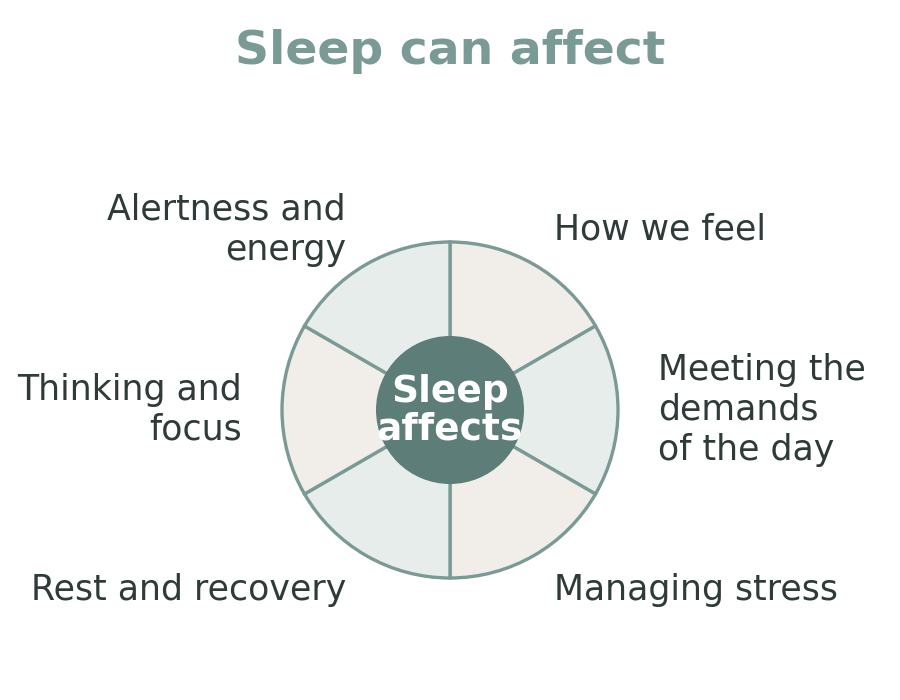
Sleep can affect:

  • How we feel
  • How we meet the demands of the day
  • How well we manage stress
  • Our body’s ability to rest and recover
  • Our ability to think, plan, concentrate, and focus
  • Our alertness and energy levels

What can impact on sleep?

Those experiencing anxiety or/and depression may find sleeping difficult, or perhaps the quality of sleep has changed. Racing thoughts and finding it hard to relax are often reported by people with anxiety.

Some health conditions can impact on sleep quality, such as sleep apnoea and snoring.  People with chronic pain may also find sleep difficult.  Pregnant women often experience difficulty with remaining asleep.

Lifestyle factors can also impact on sleep and sleep quality by effecting the body’s natural wake and sleep cycles, such as using electronic devises (including gaming) before bed, eating shortly before bedtime, consuming alcohol and caffeine, and exercising late in the evening.

Jet lag occurs when we travel to different time zones. The body generally adjusts but can take a few days.

What is your current bedtime routine? What could be impacting on your sleep?


How much sleep do I need?

Everyone needs slightly different amount of sleep. Children and adolescents often need more sleep than adults. Healthy adults need on average 8 hours of sleep, but some people can be alert with 6 hours of sleep while others need 10 hours.

Working out how much sleep you need to feel good, alert and focused is a good place to start.


How to get more sleep

Make sleep a priority.  Just as a healthy diet and being active is important, so too is sleep.  Some tips to help with getting to sleep and staying asleep include:

  • Making bed time a priority- try to set a consistent bed time every night
  • Wake up the same time every morning- this helps your body to get in a good sleep cycle.
  • Get in touch with your body’s sleepy signs- ignoring when you are feeling tired may mean you go to sleep when your body isn’t tired.
  • Don’t use electronic devises within 1-2 hours of bedtime. If you need to use them, look at removing the blue light (some phones and devices have this function, or you may need to install an application)
  • Limit alcohol consumption within 2 hours of bedtime. Alcohol may relax you but your body has to work hard to metabolize it and often causes people to wake up and not fall into deep sleep.
  • Create an inviting sleep environment: not too warm or cold, dark, no or little noise, and a place that you feel comfortable to sleep in.
  • Try not to be highly active within the two-four hours before bed time so your body can relax
  • Dim lights and do more relaxing activities in the evening – limit brain stimulation
  • Drink a relaxing herbal tea or warm milk
  • Napping isn’t usually recommended as it can effect feeling tired in the evening. However, for new mothers, napping is encouraged as some sleep is better than none. Short sleeps are also encouraged if you feel fatigued while driving.

Are there any changes you could make to improve your sleep?


What can I do if I find relaxing and falling asleep difficult?

A range of factors can impact on being able to relax, which is required to be able to fall asleep.  If you have been finding it difficult to fall asleep, it is normal to feel anxious and not look forward to bedtime.  Creating a soothing bedtime routine can be helpful.  Some additional tips can include:

  • Doing some guided mindfulness exercises in beds. There are a number of apps that can be useful, such as Smiling Mind and Headspace. There are also many guided mindfulness tracks and relaxation music on YouTube and Spotify. Have some fun exploring and trying different tracks you like.
  • Create a bedtime routine that is calming and one you look forward to. For example, have a bath with some relaxing essential oils, such as lavender. Visit a good health food store for advice. Many emergency service workers on shift work have very warm showers just before bed to encourage the body to cool down which helps to drift off to sleep.
  • If after 20 mins you can’t fall asleep, get out of bed and do something quiet and calming, in a dark/dim room and then try again when you feel sleepy. Or, listen to the guided mindfulness track or relaxing music again.
  • Keep a notepad or journal near your bed and write worries or things you have to remember to do the next day. Writing them down helps to stop the thoughts from running through your mind, allowing you to relax.


Should I see my doctor?

It is always a good idea to speak to you doctor about the difficulties you are experiencing with falling and staying asleep, and if you are waking not feeling well rested and still very tired. Some medications cause sleep to be disturbed. There may also be a biological reason that can be managed.  Doctors may prescribed medication to assist with sleep, such as Melatonin that can help with helping the body to get back into a good wake/sleep cycle.  Sleeping tablets may be prescribed for short term assistance, but long term use is not usually advised.


How can your psychologist help?

A thorough assessment will be conducted and you may be asked to keep a sleep diary for a week. Using a range of techniques, such as CBT and ACT, your psychologist can assist with developing strategies you can use to help with relaxation and sleepiness, managing anxious thoughts and developing a bed time routine that suits you.

Want to talk to us about getting a better night’s sleep?

Call us on (03) 9809-5947, or send us an email: admin@yourmindmatters.net.au

This post was written by Anita Missiha, Psychologist.

Anita recently completed her post graduated studies in Psychology after working in the training and education industry.

Anita has experience working with students in school settings, and also works with adults.

What can you expect when you visit a Psychologist at Your Mind Matters Psychology Services?

Coming to see a Psychologist can be rather daunting. Who wakes up in the morning and says, “I’d love to chat to a complete stranger about my deepest fears, thoughts, and feelings, and see what they think?”  We understand that the idea of speaking with someone about your worries opens the floodgates to “what if…?” thoughts, such as “what if they think I’m crazy?” or “what if they can’t help me?”  Makes your anxiety go up just thinking about it, right?

But what if I were to tell you that we absolutely DO NOT think this way? After all, we went to university for a minimum of 6 years to help you, and it is honestly an absolute privilege. We are not here to judge you, we are here to share your hardships and difficulties, and help you navigate your way through them.

So, how does someone become a client of ours? Often it all starts by a) Googling us, or b) speaking to your GP. Clients with a referral from a GP often access a Medicare rebate, which will subsidise counselling, but you can still come in without a referral. Bear in mind, you can always book in with us, then go to your GP and request a referral to us specifically. The order of events doesn’t really matter.

When you call us, you can expect to speak with an Administration Assistant. They will speak with you about our team members and work with you to determine who may be the best Psychologist to support you as we all have different areas of interest and skills. Admin will ask for some details, such as your name, email (so we can email you our location map and information about the Psychologist you’ll be working with), and mobile number, so we can text (sms) you an appointment reminder or call if we need to.

On the day of your initial appointment, please come in 10 minutes to complete some paperwork if you haven’t already done this using our online forms. If you have a referral, Admin will also collect this so we can rebate any Medicare benefits immediately following your appointment. This saves you from having to go to Medicare.

When it’s time to start, your Psychologist will come to reception, introduce themselves, and walk you to their consulting room. Our rooms have large armchairs and couches, and we encourage you to get comfortable. You can put your feet up, lie down, sit up, or snuggle up in a blanket. Whatever works for you. If your appointment is via Telehealth, your Psychologist will email you a link which you need to click at the start of your appointment – super easy!

During the initial consultation, your Psychologist will discuss with you some of the fundamentals around privacy and confidentiality, house rules (e.g. sessions are 50 minutes in duration, where the toilets are located), and general policies (e.g. our cancellation policy, which you will also see when you fill out your initial paperwork). This spiel takes about 2 minutes.

Then it’s over to you! We typically ask something along the lines of “What has brought you here today?” The first session with a Psychologist is usually information gathering. We want to know about your circumstances, what is and isn’t working for you, and what you want to achieve throughout counselling. This allows us to start formulating and create a treatment plan aimed at helping you achieve your goals.

If your appointment is in the office, at the end of the session, your Psychologist will walk you back to reception to complete a handover with our Admin team. If your appointment is via Telehealth, your Psychologist will email Admin our handover immediately, so that when you call to give payment a few minutes later, they already know if/when to rebook (if you haven’t already done so) and if they need to process a Medicare rebate for you.

Most of the time, our clients finish their session feeling much better than they did the previous hour (it’s called “therapy” for a reason!), and feel right at home in our clinic. They tend to waltz into the clinic for subsequent sessions because those initial feelings of anxiety about seeing a Psychologist are no longer present, which we love to see!

I hope this has been helpful, we really are here to support you and we want you to feel at home here.

We hope to see you soon!

Laura Forlani 

Director and Clinical Psychologist at YMM. 


Quality Counselling and Assessment Services

~Support to help you thrive~

World Suicide Prevention Day

World Suicide Prevention Day

10th September 2016

The World Health Organization estimates that over 800,000 people in the world die by suicide each year – that’s one person every 40 seconds. 

Facts about suicide in Australia

  • Suicide is the leading cause of death for men and women between the ages of 15-44
  • The population death rates are around 10/100,000 people every year
  • Annual number of deaths by suicide in Australia is around 2,500 each year
  • 65,000 plan or attempt to take their life each year
  • 400,000 people think about taking their life each year
  • The Global Burden of Disease Report cited 36 million years of healthy life were lost as a result of suicide in 2010

The tragic ripple effect means that there are many, many more people who have been bereaved by suicide or have been close to someone who have tried to take his or her own life, as well as those struggling to manage suicidal ideation.

World Suicide Prevention Day events occurred in local communities across Australia. Check out the Events page to see what’s happened near you. To find out about events planned across the globe, go to the International Association for Suicide Prevention (IASP) page: http://wspd.org.au/events/


IF YOU NEED HELP

Getting through difficulties on your own can be difficult. Talk to friends, family, your doctor, other health professionals or a telephone helpline about your substance use. The following will provide help and assistants and point you in the right direction if you need further help.

  • Suicide Call BACK 1300 659 467, support if you, or someone you know, is feeling suicidal.
  • Kids Help Line (age 2-5) 1800 551 800, to talk to someone about anything that’s going on in life.
  • Life Line 13 11 14, support and advise in as personal crisis.


Coping with Bereavement

Bereavement affects people in different ways. There’s no right or wrong way to feel.

Experts generally accept that people usually move through four stages of bereavement: 

  • accepting that your loss is real
  • experiencing the pain of grief
  • adjusting to life without the person who has died 
  • putting less emotional energy into grieving and putting it into something new (in other words, moving on)

You may go through stages, but you won’t necessarily move smoothly from one to the next. You may even get stuck at a stage. Your grief might feel chaotic and out of control, but these feelings will eventually become less intense….with time How long you ask? Good question, and there is no answer; grief is experienced differently among individuals, and unique to each loss.  

You might feel:

  • Shock and numbness (this is usually the first reaction to the death, and people often speak of being in a daze)
  • Overwhelming sadness, with lots of crying
  • Tiredness or exhaustion
  • Anger, for example towards the person who died, their illness or God
  • Guilt, for example guilt about feeling angry, about something you said or didn’t say, or about not being able to stop your loved one dying
  • Some people become forgetful and less able to concentrate.

Coping with grief

We all cope with grief differently, and what is helpful varies from person to person. You may try: 

  • Talking and sharing your feelings with someone is often the most helpful thing you can do. You may speak with friends, family, colleagues, or a healthcare professional (e.g. psychologist, psychiatrist, GP). 
  • For some people, relying on family and friends is the best way to cope, But if you don’t feel you can talk to them much (perhaps you aren’t close, or they’re grieving too), you may benefit from engaging in self-care activities. These may include: exercise, pampering, going for a long walk, visiting a much-loved place, reading a book, walking the dog. Self-care is all about you, and doing what you enjoy or find relaxing. 
  • If distraction works well for you, get busy and productive!

If you’re out of ideas for self-care, head here: http://elishagoldstein.com/assets/183-pleasurable-activities-to-choose-from.pdf

Most importantly, be patient and compassionate, with yourself and others.  

If you are having trouble with a loss, give our team a call and arrange a consultation with one of our psychologists. 


Overcome Mental Exhaustion

5 Ways to Overcome Mental Exhaustion

Feel like you’re at the end of your tether? 
Here are 5 simple tips to recharge mentally that don’t require much of a commitment of energy you don’t have.

Tip 1- Spot small opportunities to rest your mind. I know we are all encouraged to multitask, and often do so while waiting (e.g. replying to work emails while waiting in a queue at the supermarket), however, this creates brain overload. Instead of multitasking while waiting, why not use this time to engage in some mindful breathing?

Tip 2. Reduce excess sensory input, or go mono-sensory. We live in a world that is full of sensory input, which takes a lot to process. To give your mind a break, try to eliminate excess sensory input. This may involve closing your eyes, or turning off the tv when you’re not actively watching in. Alternatively, tune in to one sensation e.g. close your eyes and focus on all the sounds around you. Listen for sounds close to you, then expand your awareness to sounds further and further away from you.

Tip 3. Give yourself permission to relax. I know you always have something you could or should be doing (and I use that term loosely as “should is a bit of a dirty word in my books), however, if you find yourself relaxing, ENJOY IT. No need to feel guilty, your self-care is equally important as the million other things that you could be doing.

Tip 4. Stop being unrealistic about how much you can get done.  Have you noticed how hard it is to get to the bottom of our “do to” list? That’s because the goals is a moving target!  Instead, be honest with yourself – what is realistic? What would you expect someone else to be able to achieve?

Tip 5. Prioritize the types of work that are an investment. Some efforts pay dividends well beyond the initial effort you put in. For example, as a Psychologist, we write many, many reports. So spending a few hour or even days creating a user friendly template significantly reduces the time spent later on down the track. Another example is spending time on the weekend to plan your meals for the week or even prepare them in advance. If you prioritise these tasks, you’ll set yourself up to have more spare mental and physical energy over time.

For more information, read the original article at: https://www.psychologytoday.com/blog/in-practice/201604/5-ways-overcome-mental-exhaustion?platform=hootsuite