📅 Book an Appointment

5 Signs You Might Benefit from a Telehealth Psychologist

In today’s busy world, accessing support has become easier with online services. A Telehealth psychologist offers the same professional, evidence-based care you would receive in person, but with the convenience of connecting from home, work, or anywhere with internet access.

Not sure if Telehealth psychology is right for you? Here are five signs you might benefit from working with a psychologist online.

1. You Live in a Regional or Remote Area

For many Australians, local psychology services may be limited. A Telehealth psychologist in Australia makes it possible to access professional support without travelling long distances. This ensures you can receive consistent care, no matter where you live.

2. You Have a Busy Schedule

Balancing work, study, or family life can make it difficult to attend in-person sessions. Telehealth appointments save time by cutting out travel, making it easier to fit therapy into your week.

3. You Feel More Comfortable at Home

Some people find it easier to open up in a familiar environment. Meeting with a psychologist via Telehealth can provide a greater sense of comfort and reduce the anxiety that may come with attending a clinic.

4. You Need Flexible Options

Telehealth can be combined with face-to-face sessions, giving you choice and flexibility. This means you can still see a psychologist in person if you prefer, but switch to online sessions when needed — such as during busy times, illness, or travel.

5. You Want Access to Evidence-Based Care & Services

Whether you are seeking an ADHD assessment online or counselling for trauma, anxiety, or relationships, Telehealth gives you access to psychologists who may not be based in your local area. This expands your options and helps you find the right professional fit.


A Telehealth psychologist provides the same standard of professional care as in-person sessions, with the added convenience of flexibility and accessibility. If you are considering support for your mental health, Telehealth might be a helpful option.

At Your Mind Matters Psychology Services, our Melbourne-based team also offers Telehealth psychology across Australia, including assessments and therapy.

📞 Get in touch today to book a Telehealth psychologist appointment.

Accessing Psychology Services via Telehealth at Your Mind Matters

Why Telehealth Matters in Mental Health Care

In today’s busy world, flexibility in accessing mental health support is more important than ever. Telehealth psychology sessions allow you to connect with a qualified psychologist from the comfort of your home, school, or workplace. At Your Mind Matters (YMM), our clinicians offer secure, evidence-based telehealth services to ensure support is available wherever you are in Victoria and across Australia.

What is Telehealth in Psychology?

Telehealth refers to psychological consultations delivered via a secure online platform. You’ll speak with your psychologist in real time, just as you would in a clinic, but without the need to travel. Research shows that telehealth can be just as effective as face-to-face sessions for many mental health concerns, including:

  • Anxiety and depression
  • ADHD and executive functioning challenges
  • Autism assessments and therapy supports
  • Trauma-informed care
  • NDIS-related psychological assessments and reports

Benefits of Choosing Telehealth at YMM

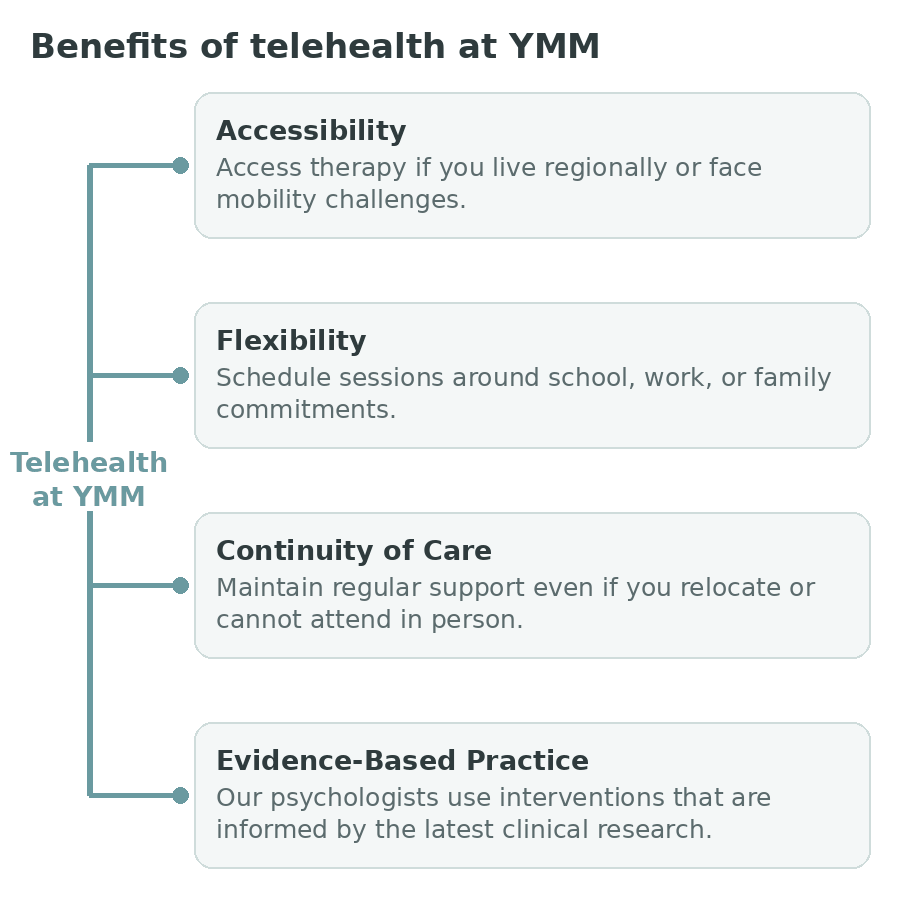
  • Accessibility: Access therapy if you live regionally or face mobility challenges.
  • Flexibility: Schedule sessions around school, work, or family commitments.
  • Continuity of Care: Maintain regular support even if you relocate or cannot attend in person.
  • Evidence-Based Practice: Our psychologists use interventions that are informed by the latest clinical research.

Is Telehealth Right for You?

Telehealth may be suitable if you prefer the comfort of your own space, live outside Melbourne, or find it difficult to attend in person. For children and young people, telehealth can work best when a parent, carer, or support worker is nearby to assist with technology and engagement.

If you’re unsure, our team can help you decide whether telehealth or in-clinic appointments are the best fit for your needs.

How YMM Delivers Safe and Effective Telehealth

At Your Mind Matters, our psychologists follow strict professional and ethical standards to ensure that online sessions are safe, private, and effective. This includes:

  • Using secure, encrypted video platforms
  • Maintaining confidentiality and privacy at all times
  • Providing clear information so you can make informed decisions about your care
  • Following AHPRA and Psychology Board of Australia guidelines for safe practice

Booking a Telehealth Appointment

Accessing telehealth psychology at YMM is simple:

  1. Get in touch with our team to discuss your needs, or view our clinician profiles.
  2. Book an appointment at a time that suits you through our online portal.
  3. Connect online with your psychologist using a secure link sent before your session.

Whether you are seeking an ADHD or autism assessment, or ongoing therapy, our telehealth psychologists are here to support you.

Book a telehealth appointment with a psychologist today. Take a look at our clinicians and, once you know who you’d like to work with, call us or book online.

Distress Tolerance: An Introduction to a Dialectical Behaviour Therapy (DBT) Principle

A person sitting on the bedroom floor with their back against the bed, one hand at their head, seen from behind and out of focus, with headphones and clothes on the floorboards

Why emotions can feel overwhelming

There’s no question that feelings can be highly, highly unpleasant. For many people, emotions can become so overpowering that they can compel us to do things we mightn’t be proud of – we can yell, throw things, or binge drink.

Many clients we see at Your Mind Matters struggle with big emotions – some clients report feeling emotionally dysregulated when they’re upset, and struggle to bring themselves back to a baseline, neutral state. It’s a common problem, and can lead to all kinds of difficulties.

What Distress Tolerance is

This blog is about Distress Tolerance, which is a host of psychological tools that can help us when we’re struggling with truly overwhelming feelings. The goal of Distress Tolerance is not to eliminate an emotion, or even significantly reduce its intensity – instead, it’s about teaching us to tolerate the emotion, and withstand the urges that can come with it. It belongs to a kind of therapy called Dialectical Behaviour Therapy (DBT).

Where Distress Tolerance fits within DBT

DBT is an evidence-based therapy for multiple forms of mental health challenges, and contains plenty of ideas that can be great for anyone’s emotional wellbeing. DBT breaks itself up into lots of different bits and pieces – one of these is a Skills component, that has Distress Tolerance as a sub-school inside it. You can think of DBT as a big book – Skills is a chapter, and Distress Tolerance takes up a few pages in that chapter.

Diagram of the Distress Tolerance Toolkit: self-soothing, distraction, connecting with others and mindfulness
Four reflection questions: why don’t I like unpleasant feelings, how do I deal with them, do I do things that make my life worse, and am I being too hard on myself

Distress Tolerance is about asking yourself what behaviours your emotions urge you toward, with a particular focus on the kind of behaviours that lead to greater distress later on – i.e., make the situation worse. For instance, if you were a tennis player whose emotions led to an urge to smash your racquet against the court, your Distress Tolerance goal could be to reduce your racquet-smashing – because this will make you feel embarrassed or guilty later on, and avoid the competitive consequences that come with it. Note the player’s goal wouldn’t be to feel less angry, although this would be nice… instead, Distress Tolerance asks you to ride that emotion more effectively, and not make the feeling worse.

Other behavioural goals can be:

  • Not binge-drinking alcohol.
  • Not texting people with threats, sarcasm, or aggressive themes.
  • Not using drugs.
  • Not self-harming.

Building your Distress Tolerance Toolkit

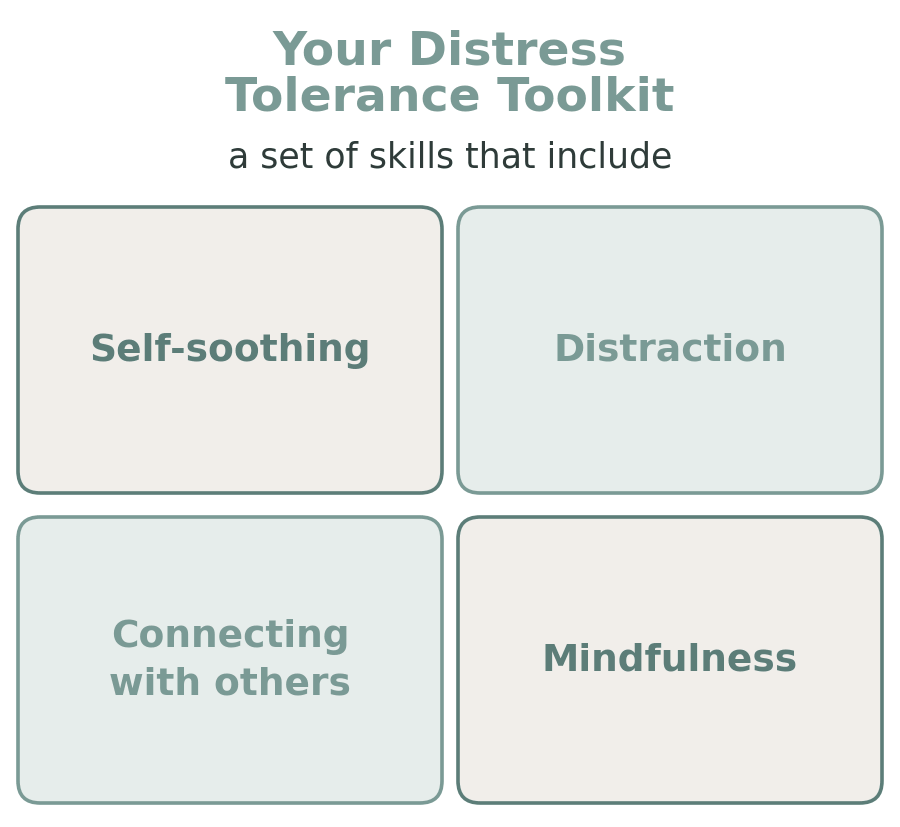
Distress Tolerance asks clients to build a Distress Tolerance Toolkit – i.e., a set of skills that include self-soothing, distraction, connecting with others, and mindfulness. Again, we’d hope these tools reduce the intensity of your feelings; but more importantly, we’d hope they lead to you tolerating your distress without engaging in life-worsening behaviour.

There are lots of methods and strategies DBT uses in their Distress Tolerance framework – many of them are available for free from the Dialectical Behavior Therapy distress tolerance page.

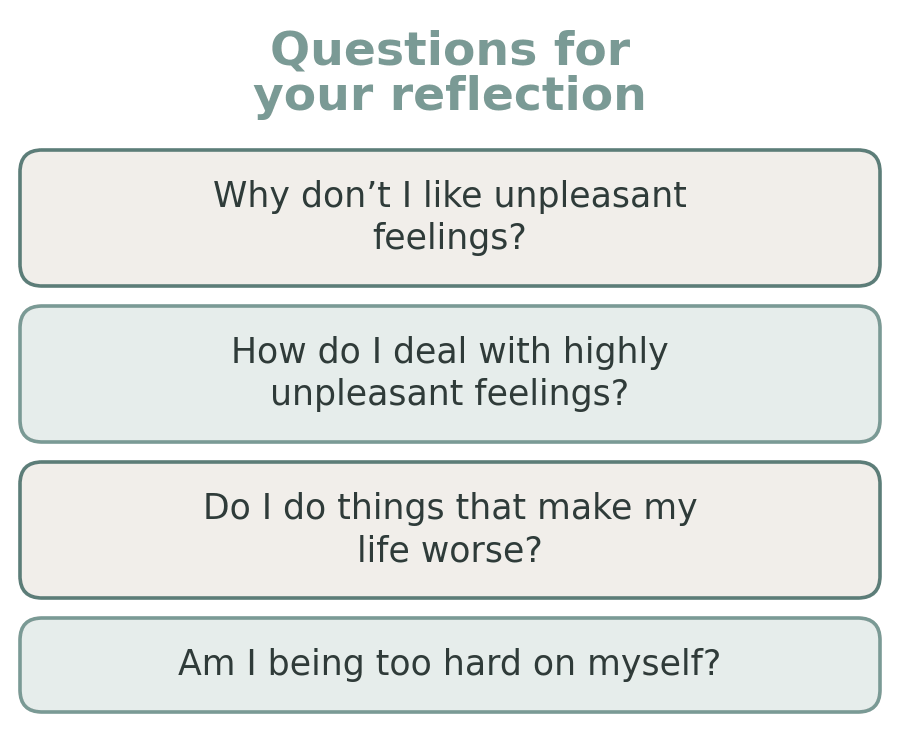
Questions for your reflection

  • Why don’t I like unpleasant feelings? Aside from being viscerally uncomfortable, is there something I’m worried the feelings will do to me? I.e., that I’ll lose control, or not be able to recover?
  • How do I deal with highly unpleasant feelings? If I watched myself living with difficult feelings on CCTV, what would I see myself doing?
  • Do I do things that make my life worse, or increase a sense of shame or guilt? What sort of things are they? Do I want to change these typical responses, and why?
  • Lastly – am I being too hard on myself? Often, clients say they ‘respond badly’ to certain feelings… but there’s nothing necessarily wrong with eating more chocolate than usual, or scrolling on your phone for a few minutes. If you want to change those things, that’s great – but it’s certainly not compulsory for good mental health.

If you need support right now

If this is an emergency, call 000. For 24-hour support, call Lifeline on 13 11 14 or text 0477 13 11 14. DirectLine, the Victorian alcohol and drug counselling service, is available on 1800 888 236. More options are on our resources page.

Patrick Carey smiling outdoors, in a portrait photograph

Our Blog Author
This post was written by Patrick Carey, Clinical Psychologist at Your Mind Matters. Paddy works with adults presenting with anxiety and mood disorders, trauma, obsessive-compulsive disorders, substance and gambling issues, psychosis spectrum disorders, and grief and loss, and is trained in CBT, ACT, Cognitive Processing Therapy, Metacognitive Training and mindfulness approaches. Meet our team.

Book an appointment
📅 Book an Appointment