📅 Book an Appointment

Mind Full or Mindful?


A couple on a park bench under gum trees: one hunched over a phone with papers spilling from a bag, the other sitting back with their head tilted up to the canopy

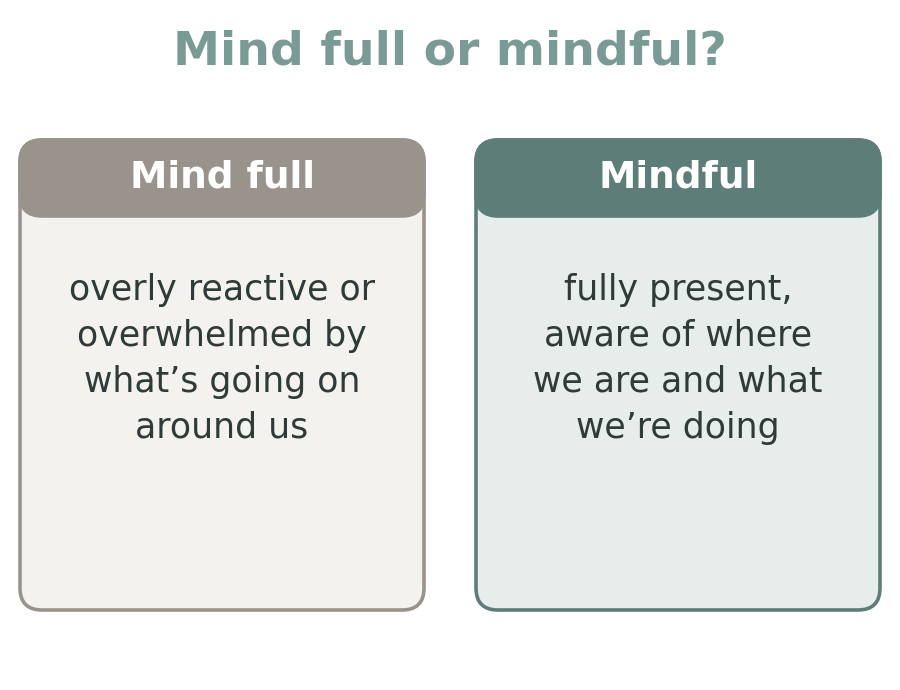
No doubt you, as a therapist or client will at some point in the process be introduced to the principles of Mindfulness. Mindfulness is the basic human ability to be fully present, aware of where we are and what we’re doing, and not overly reactive or overwhelmed by what’s going on around us. It is an integral part of some forms of therapy such as Mindfulness based Cognitive Behavioural therapy and Dialectical Behaviour therapy. Mindfulness can provide strategies to manage challenging thoughts and emotions through a focus on the here and now.

Mindfulness can act as a grounding approach to settle ourselves when we’re feeling overwhelmed. If you find yourself stuck with a strong emotion, this approach can help you to feel anchored in the present and restore balance in your body and mind. Grounding skills are helpful to build sensory and cognitive awareness which can also help in therapy as you begin to recognise patterns and trends that either help or hinder you in your goals.
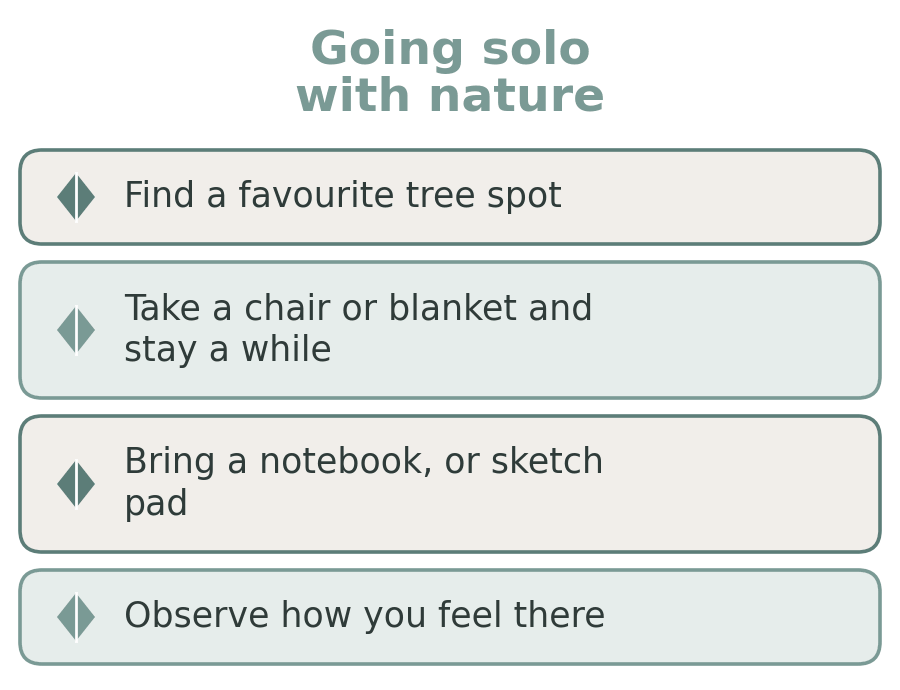
Four suggestions for going solo with nature: find a favourite tree spot, take a chair or blanket, bring a notebook, and observe how you feel there
Two panels comparing a mind full, overly reactive or overwhelmed by what is going on around us, with mindful, fully present and aware of where we are and what we are doing

Connecting to nature can be a key part of developing mindful and grounding activities. Nature has the power to reconnect us to ourselves, our present, and our memories, through our senses. Indeed, as Lao Tzu, the Chinese Philosopher from 500 BCE said, ‘Nature does not hurry, yet everything is accomplished’. There is stillness and motion, acceptance and change, all happening under our feet and above our heads.

There are many ways of connecting to nature, but here are a few ideas to get you started.

Forest Bathing

We know from our own experiences that when we are surrounded by trees and their canopies, we can feel calmed, and the scents of the earth and leaves and bark can stimulate our senses in a way that encourages relaxation and reconnection with ourselves and nature.

The Japanese practice of Shinrin-Yoku, translated as ‘forest bathing’, recognises the healing power of forests which provide sensory stimulus to decompresses our nervous system, allowing us to reset and recharge. Originating in the 1980s in Japan it has become a key preventative element of Japanese medicine, with 44 accredited Shinrin-Yoku forests across the country. Internationally this practice is also called ‘Forest Therapy’.

You don’t need to live close to a forest to benefit from forest bathing. A local park with trees will also provide opportunities for wellbeing. As forest bathing is gaining in popularity in Australia there are many choices of accessing in-person or online forest bathing sessions. The Royal Botanic Gardens in Melbourne offers two- or three-hour sessions involving time spent in key gardens and with certain trees, concluding with a shared tea ceremony. for more details: the Royal Botanic Gardens forest therapy page

Other ways to connect with Forest Therapy is through individual trained practitioners such as Forest Walks and Three Little Birds Nature Therapy where in person and online events occur. You can learn more about this developing health sector here: the International Nature and Forest Therapy Alliance

If you prefer to go solo with nature, here are some suggestions:

  • Find a favourite tree spot from your favourite nature place
  • Take a chair or blanket and stay a while.
  • Bring a notebook, or sketch pad.
  • Observe how you feel there. Be with yourself and the natural world.

Water

Similarly, the atmosphere of forests, bodies of water can evoke a sense of calm and tranquillity in us. Watching water or being close to this ‘blue space’ can be meditative. It allows us to connect to the vastness of the ocean landscape, or the intimacy of a flowing river with all of its living lifeforms, bringing us greater calm and connection. Marine Biologist, Wallace J. Nichols, writes about in his book, Blue Mind. Connection to water comes in many different forms from the beach and ocean, or the local creek or river, to a swimming pool or floatation tank. If we are water observers, we can benefit for the connection to it with a walk alongside our chosen blue space. If we prefer to be emersed and receive benefit that way, regular swims at our local pool or beach, spas at a bathhouse (Sense of Self) or natural springs (Peninsula Hot Springs) can support our wellbeing. A more immersive water experience can be found in a floatation tank. Floatation tanks are pods filled with warm salt water and hour-long sessions emersed in them alone can include music and different lightening effects, or quiet darkness. There are many centres around the city, and across the country offering this service and you can learn more here: Float Therapy Australia

Whichever nature path you choose to take, connecting to the earth can support our mental health in many ways.

Ian Clark smiling on a beach, with the sea behind him

Our Blog Authors

This post was written by Ian Clark, Senior Clinical Psychologist at Your Mind Matters, together with Rachel Clark. Ian works with adolescents and adults presenting with mood disorders, anxiety, and stress related to school or work, and has years of experience supporting victims of domestic violence. Meet our team.

Rachel Clark is an educator and community organiser with 25 years of experience in teaching, cultural diversity, disability, and social justice.

Book an appointment

Are you really practicing gratitude?

Two friends sharing a laugh over coffee at a table by the window of a neighbourhood café

But I should be grateful… right?

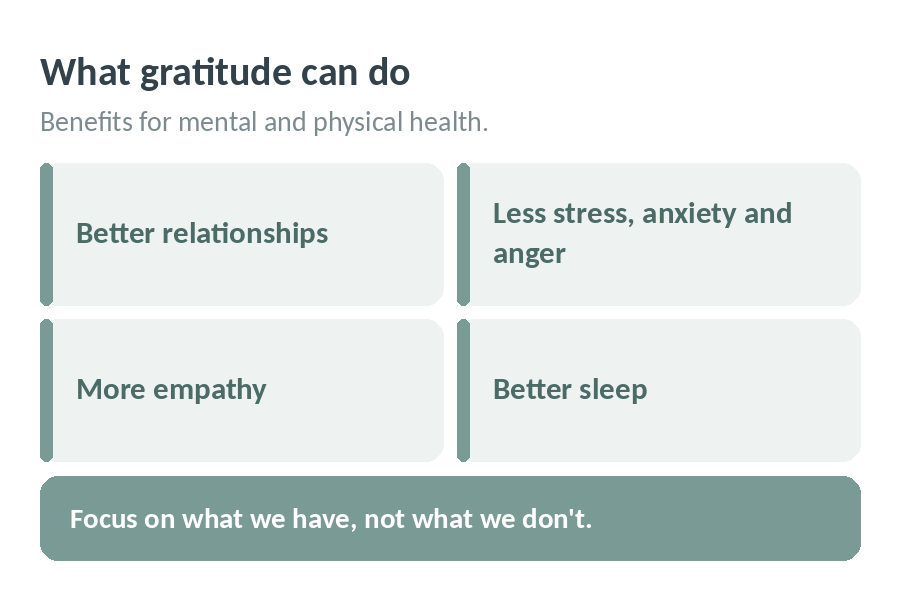
Recent times have called for the re-evaluation and adjustment of self-care practices and an emphasis on perspective and acceptance-based skills. One perspective skill that has garnered increasing interest is gratitude. Gratitude is known for its positive impacts on mental and physical health, such as improved relationship satisfaction, reductions in stress, anxiety, and anger, enhancing empathy, and aiding sleep. How? One reason is that feeling grateful floods us with oxytocin, which in turn creates more oxytocin receptors: an upward spiral that makes us happier.

A search of the web resulted in many differing definitions of gratitude; however, there was a consensus across definitions, being that of the ability to conjure feelings of thankfulness and appreciation for others, the world, and ourselves. It is suggested that this can be aided by focusing on what we have, rather than focusing on what we don’t.

“I am thankful for all that I have and all that I am”

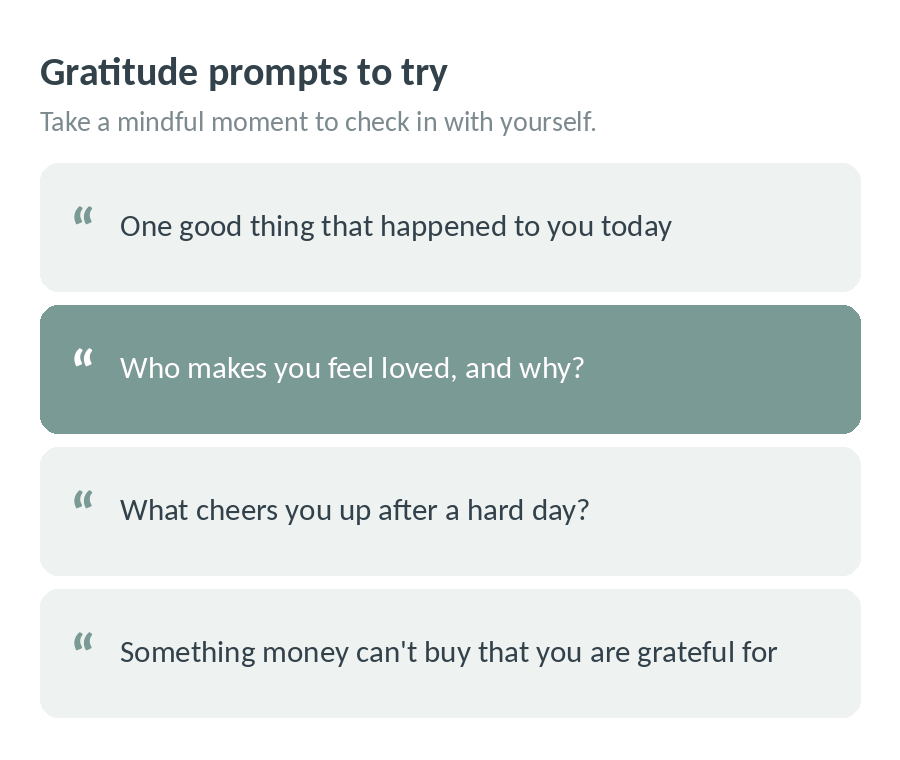
Gratitude prompts to try: one good thing that happened to you today; who makes you feel loved, and why; what cheers you up after a hard day; something money can't buy that you are grateful for
What gratitude can do for mental and physical health: better relationships, less stress, anxiety and anger, more empathy and better sleep. Focus on what we have, not what we don't

Gratitude prompts

If you are a fan of journaling, you are probably not a stranger to a gratitude prompt, for example:

  • Write down one good thing that has happened to you today.
  • Who makes you feel loved and why?
  • What cheers you up when you’ve had a hard day?
  • What is something that money can’t buy that you are grateful for?

Prompts such as these allow us to check in with ourselves and take a mindful moment to consider what small, or big things, we have to embrace in life.

When gratitude gets misunderstood

The world has gone through its fair share at the moment, as has all its beings. Statements that I am hearing more and more frequently recently include: “but I should be grateful for…” and “other people have it worse”. These statements promote self-invalidation, as to suggest that their understandable mental health struggles are unjustified. Therein lies the misunderstanding of gratitude, that it involves being appreciative of the things that haven’t gone wrong, all the while dismissing the painful thoughts and feelings we are experiencing. It is understood that these statements present as an ability to manage difficult feelings; however, often attempts to minimise thoughts and feelings only serve to amplify them. As psychologist and emotional agility researcher Dr Susan David suggests, give yourself permission to feel all of your emotions, not only the “positive” ones.

We all deserve to tread lightly with ourselves, particularly when times are hard. This might call for the incorporation of self-compassion in our gratitude practices.

If you are interested in setting up a gratitude practice, Grateful Living has tips for keeping a gratitude journal.

So, are you practising gratitude or invalidation?

If you would like some support, our team of psychologists are here to help. Call us on (03) 9802 4654 or book an appointment online.

References

Blair Raatjes smiling, in front of a wall with a hanging plant

Our Blog Author
This post was written by Blair Raatjes, Psychologist at Your Mind Matters. Blair is committed to providing a warm, accepting and compassionate environment, and works with clients using Cognitive Behaviour Therapy, Motivational Interviewing and mindfulness-based approaches such as Acceptance and Commitment Therapy. Meet our team.

Book an appointment

Importance of Self-Compassion

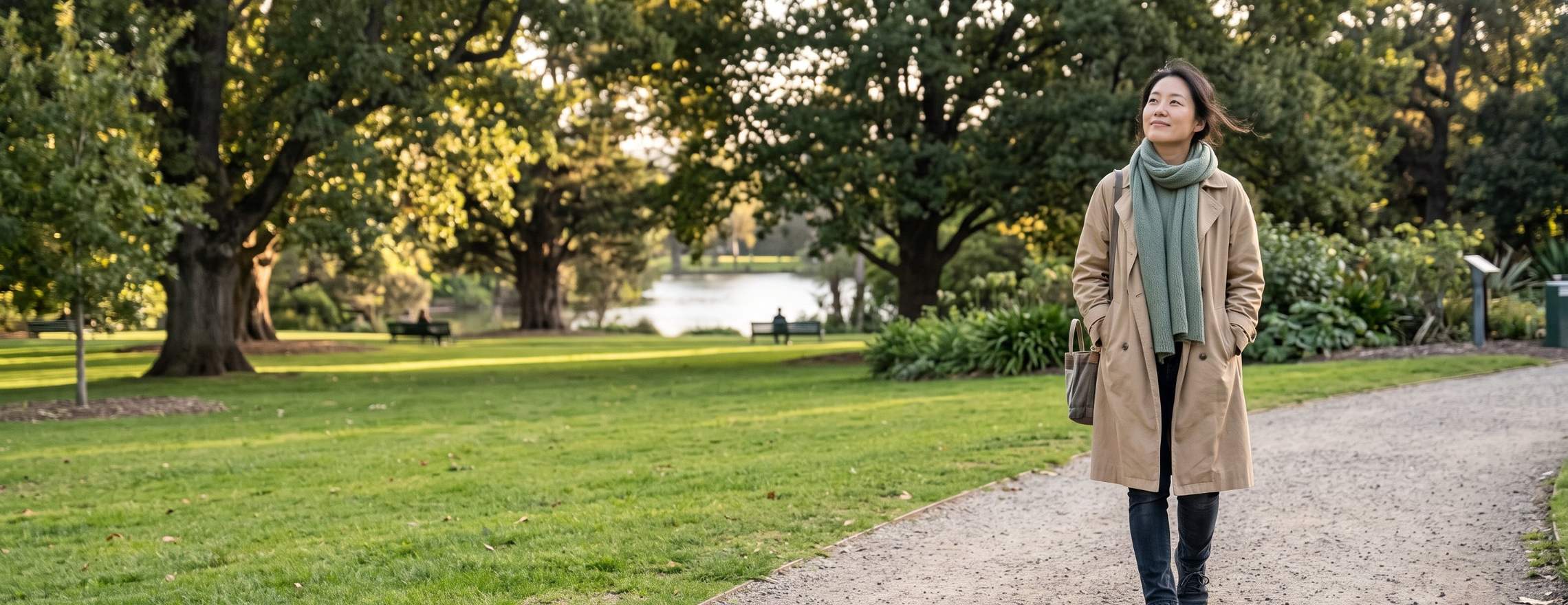
Woman enjoying a quiet late-afternoon walk through the Royal Botanic Gardens, smiling calmly in the golden light

At some point in our lives, we all have heard the phrase that ‘charity begins at home’! Most of us accept it and even preach it to others when the opportunity for sharing wisdom arises (yeah, we are good at that!). The essence of the above phrase is seated in the value of compassion or kindness towards others. Compassion is empathy, kindness and understanding for others during suffering or challenging times.

So, I have a question for you – have you ever heard that ‘compassion starts with self’? Probably not, aside from the fact that I made the phrase up. Chances are that self-compassion is an alien concept and only comes into our lives through social media memes. So let me give you a brief snapshot and advocate the case for ‘self-compassion’ as an essential in our lives.

A simple Google search will define ‘self-compassion’ along the lines of empathy, understanding and kindness towards one’s own self, when big or small life challenges happen. Kristin Neff, the world’s leading researcher on self-compassion, has identified three main components to it:

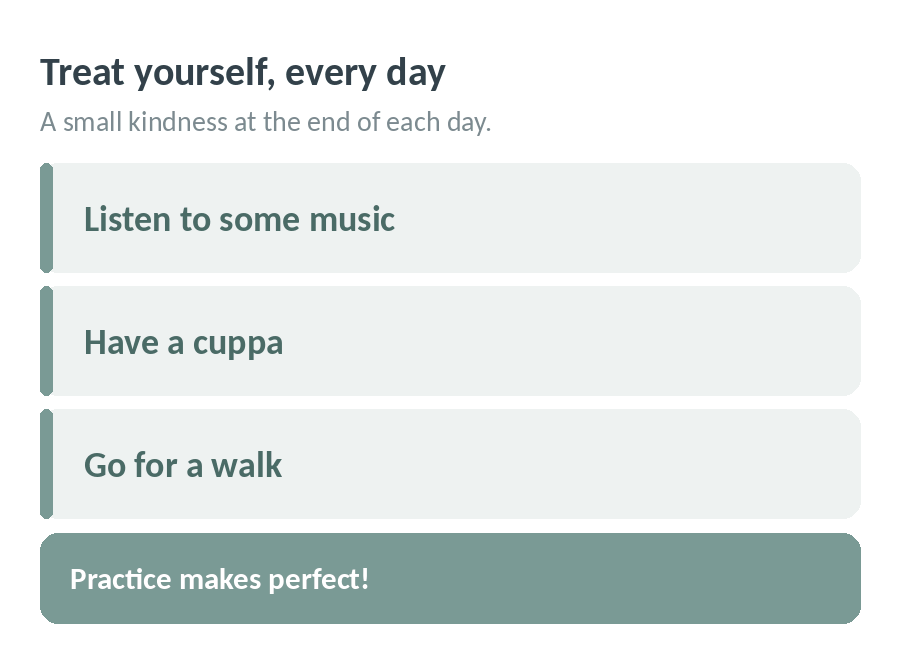
Treat yourself every day with a small kindness at the end of each day: listen to some music, have a cuppa or go for a walk. Practice makes perfect
Compassion starts with self: compassion is empathy, kindness and understanding for others in challenging times; self-compassion is the same empathy, kindness and understanding towards yourself when big or small challenges happen
  1. Self-kindness vs self-judgement: treating ourselves with kindness and understanding when we fail, suffer or feel inadequate, as opposed to ignoring our needs or belittling ourselves.
  2. Common humanity vs isolation: remembering that everyone fails and suffers at times and that we are not the only ones.
  3. Mindfulness vs over-identification: taking a balanced approach to our challenges and emotions, without over-identifying with heavy emotions or situations.

Kristin’s research has contributed significantly to understanding the importance of practising self-compassion in daily life and more so when experiencing mental health challenges. Self-compassion also forms a crucial part of my own therapy model and aims at supporting and empowering clients, by helping them connect and understand their own emotions and situations. A simple activity that I encourage clients to do is to treat themselves at the end of the day, each day. This can be as simple as listening to some music, having a cuppa or going for a walk. Practice makes one perfect!

So, I invite you to explore self-compassion for yourself and incorporate it in small ways within your daily life. Self-compassion will be the strongest script that you can have for yourself. If you would like to work on further developing your skills, our psychologists at Your Mind Matters will be happy to assist you.

Source: self-compassion.org

Your Mind Matters Psychology Services

Our Blog Author
This post was written by Prabha Mishra, formerly a Psychologist at Your Mind Matters. Prabha worked with clients using psychoeducation and research-based interventions including Cognitive Behavioural Therapy, Acceptance and Commitment Therapy and play-based therapy. Support with self-compassion continues to be part of our services. Meet our team.

Book an appointment

Self-care This Holiday Season

Woman relaxing with a book on her back verandah on a summer afternoon, with a Christmas wreath on the door behind her

It’s that time of year again….December! The new year is fast approaching and for many of us, December can be an extremely busy month, catching up with friends and family, and winding up with work for the year. For many, this time of year is associated with getaways and family holidays. After a year of ups and downs and challenges, as the invitations start rolling in, we might find ourselves feeling quite overwhelmed and quickly burnt out.

It is important to take a moment to pause and reflect on self-care and how you’re coping. Whilst some may feel obligated to spend every moment socialising, it is important to remember that balance is the key. Here are some tips which I hope you find helpful:

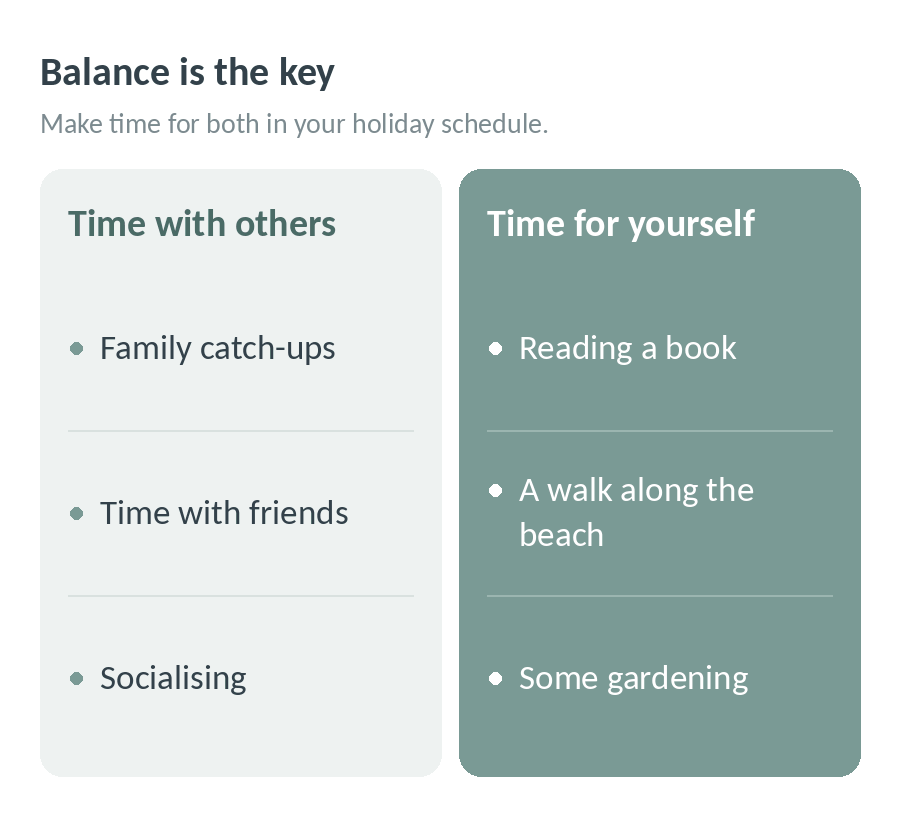
  • Have a balance. I can understand how busy the holiday season can become. Take a moment to draw up a schedule and make time for socialising with family and friends as well as time for yourself.
  • Be kind to yourself and focus on your needs. We are all unique. Whilst others may recharge by spending lots of time with family and friends, this isn’t the case for everyone. Really tune into what your body and mind need. This might be some quiet time reading a book, going to the gym, walking along the beach or doing some gardening.
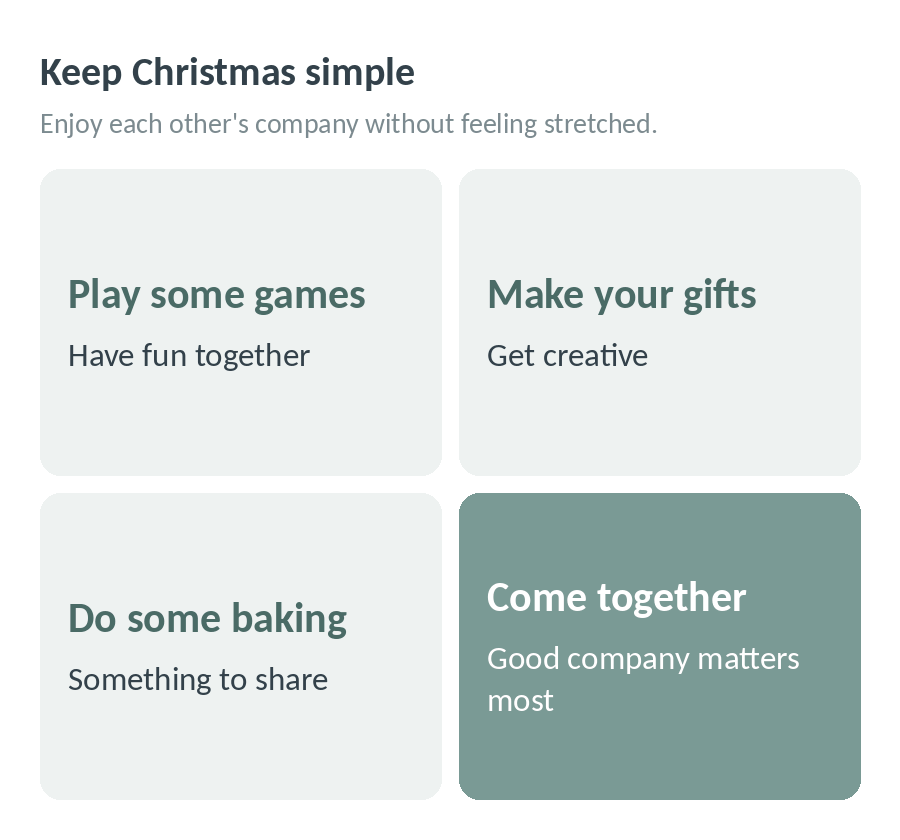
Keep Christmas simple: play some games, make your gifts, do some baking and come together, because good company matters most
Balance is the key: make time for others, like family catch-ups, friends and socialising, and time for yourself, like reading a book, a walk along the beach or some gardening
  • Plan ahead. If a big family trip isn’t on the cards this year, why not organise some day trips in Victoria? We live in such a beautiful city. I am sure there are plenty of little towns that are waiting for you to go and explore.
  • Don’t feel obligated. For a lot of people, money can be tight. Christmas is one of the most expensive times of the year and often people find themselves feeling obligated to spend big on gifts. This year, try and keep it simple. What matters most is good friendship and support. Why not make this a time to come together and enjoy each other’s company? Play some games, have fun. Try and be creative. Make your Christmas gifts or even do some baking. But most importantly focus on what you can do and what isn’t going to lead you to feel financially stretched.
  • Say “no” : Sometimes, you just need to say no for your own well-being. If you find yourself saying “yes” out of obligation because “no” feels really difficult, here are some links which may be helpful: Tiny Buddha: how to stop saying yes when you want to say no; Mindful: compassionate boundaries; Video: how to say no without feeling guilty
  • Set goals. Take some time to draw up some goals for the new year. Don’t think of them as resolutions, but more as an opportunity to reflect on what you want to work on. Remember to be true to yourself.

If you are finding this time of year difficult and you would like some support, why not give us a call? Our team of psychologists are here to help.

Your Mind Matters Psychology Services closes over the holiday season. If you require support during this time, please contact your GP. There are phone counselling services you can contact including Beyond Blue on 1300 22 4636 and Lifeline on 13 11 14, or text Lifeline on 0477 13 11 14. If you require immediate support please call 000 or attend the Emergency Department at your local hospital.

From all of us here at Your Mind Matters, we wish you a Merry Christmas and a safe and prosperous New Year.

Maria Kampantais smiling, in a portrait photograph

Our Blog Author
This post was written by Maria Kampantais, Senior Clinical Psychologist at Your Mind Matters. Maria works with adolescents and adults on anxiety, depression, interpersonal difficulties, grief and loss, and past trauma. Meet our team.

Book an appointment

make-this-your-best-year

New Year fireworks over the Melbourne skyline and the Yarra River, seen from a balcony with two glasses of champagne on the railing

As we near the end of another year, we often start to think about our New Year’s resolutions. We reflect on the year that was and what we hope to achieve in 2027. We usually create goals related to work, family, health, holidays, money… which is all well and good however, we often drop the ball within weeks, if not days!

WHY?

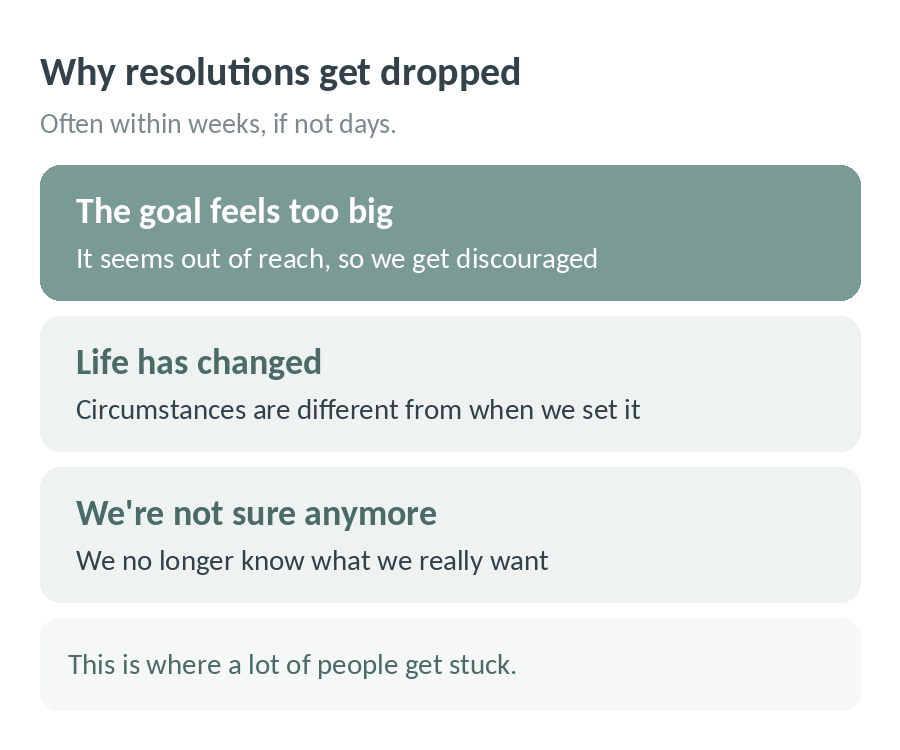
Well, lots of reasons. Perhaps the goal you set seems too big to ever possibly achieve and you have become discouraged. Maybe your circumstances were different when you made your goals (to learn more, see Psychology Today: why New Year’s resolutions fail), or maybe you aren’t sure of your goals anymore….and this is where a lot of people get stuck.

The question “What do you want? What will make you happy?” can be tricky to answer. Sure, most of us would love to win the lottery and live a life of leisure, or at least a life whereby there is financial freedom to do as we please, but let’s be honest, a lottery win is unlikely and also, we know that money doesn’t always equal happiness.

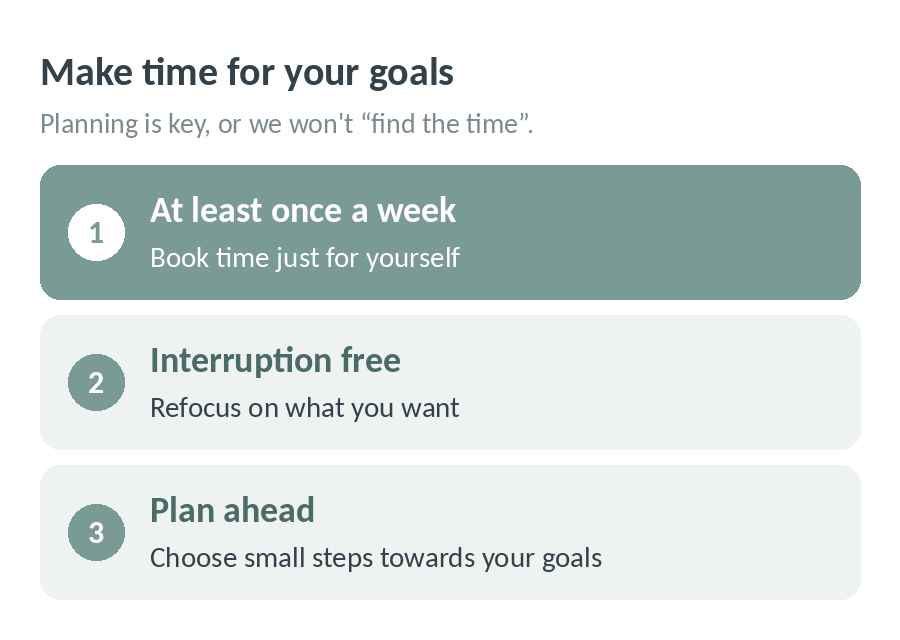
Make time for your goals: at least once a week book time just for yourself, keep it interruption free to refocus on what you want, and plan ahead with small steps towards your goals
Why resolutions get dropped, often within weeks: the goal feels too big and we get discouraged, life has changed since we set it, or we are no longer sure what we really want

That in mind, let me ask you some questions (you may want to get a pen and some paper):

  1. What would you do if you KNEW you could not fail?
  2. What would you do if you had all the knowledge, courage, and resources you needed?
  3. If you had all the time and money you needed, what would you spend your days doing?
  4. In the last month, when were you the happiest? What were you doing? Who were you with? Where were you?

Okay, next step, let’s start thinking about what you can start doing TODAY to move you closer towards the things which bring you fulfilment. Think about each question and start brainstorming. Start off small if you like, and work your way up to bigger things. Our goals are usually achieved through a series of smaller achievements, but when you string them all together, the outcome can be incredible!

You may also need to think about the things which you are doing which are not bringing you happiness, and think about the ways to do less of those things.

Another huge barrier to actively working on your happiness is the age-old excuse “I have no time” (I am also guilty of this!) The harsh reality is, we probably do have time, but we typically end up looking at our screens, doing low-energy tasks like flopping on the couch and doing something to zone out because we are exhausted and want to reward ourselves with some kind of “rest”. But here’s the thing, resting won’t energise you anywhere near as much as working on your happiness, and non-productive rest is unlikely to help you reach your goals.

What I propose is scheduling in time to refocus on your goals. Prioritise this! Find a time at least once a week where you will have time to yourself, interruption free, to refocus and plan some things to do in advance which will move you towards your goals.

Planning is key, otherwise we won’t “find the time”, but really, we just haven’t prioritised it.

So…you know what you need to do.

Go grab a coffee, some pen and paper, answer the questions and start planning your best year yet!

Laura Forlani smiling, in a portrait photograph

Our Blog Author
This post was written by Laura Forlani, Director and Senior Clinical Psychologist at Your Mind Matters. Laura works with adults on mood and anxiety disorders and difficulties arising from changes in personal circumstances, using cognitive behaviour therapy, skills training and relaxation strategies. Meet our team.

Book an appointment

Self Care Resources

Woman in a public library browsing a book from the shelf, with two more books under her arm and a sage green tote bag

Steps We Could Take to Take Care of Ourselves

One of our psychologists has taken the time to put together a batch of her favourite self care resources! The team at YMM loves it and we thought we should share if with you.

Here are some resources on self care and self compassion :

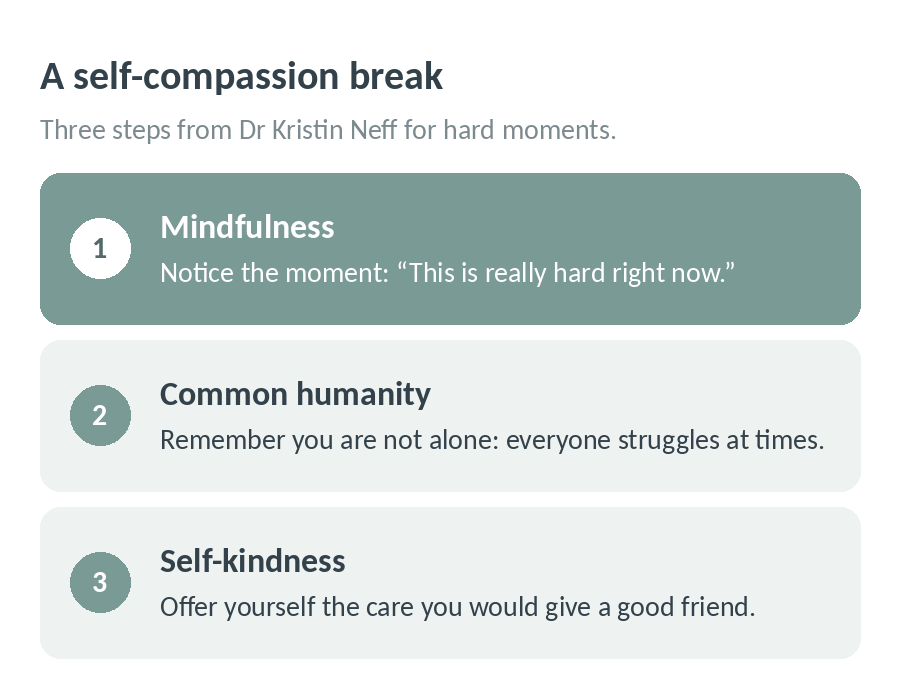
A self-compassion break in three steps from Dr Kristin Neff: mindfulness to notice that the moment is hard, common humanity to remember everyone struggles, and self-kindness to treat yourself like a good friend
Types of self-care: physical, emotional, social, mental, practical and self-compassion

Dr Kristin Neff practices for self-compassion as self-care:

TED playlist on the importance of self-care:

If you are going through difficulties and need support, why not give us a call today? Our team of highly skilled and well-experienced Psychologists are here to help.

Your Mind Matters Psychology Services

Our Blog Author
This post was written by the team at Your Mind Matters. Our psychologists share resources like these to help you look after yourself between sessions. Meet our team.

Book an appointment
📅 Book an Appointment